
The Biggest Terror Bird Ever Found Is Known From One Shin Bone, and Something Bigger Ate It
One Bone, One Giant Bird
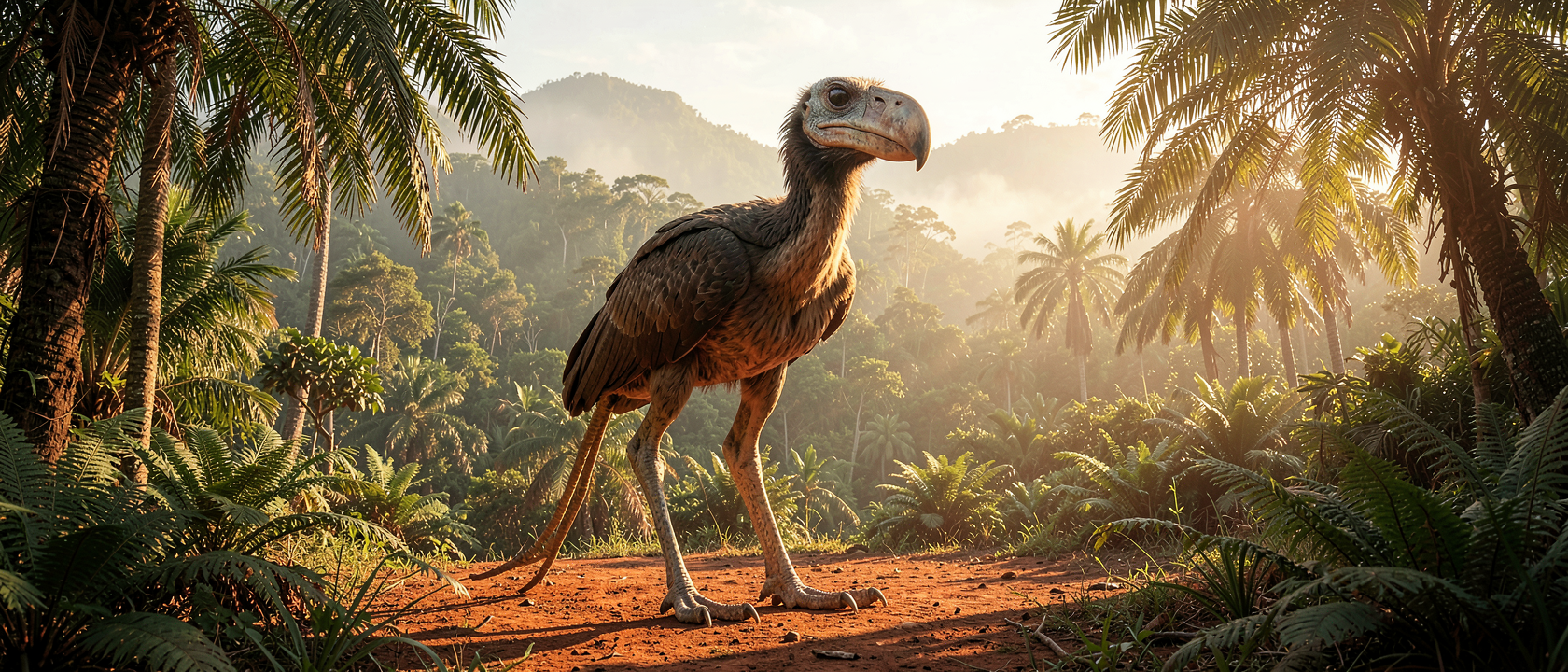
A single fossil fragment, the lower end of a left tibiotarsus (the fused shin-and-ankle bone in a bird’s leg), turned up in Colombia’s Tatacoa Desert and has been identified as a Phorusrhacid, the family of flightless predatory birds known as terror birds. A team led by evolutionary biologist Federico J. Degrange, of Argentina’s Center for Research in Earth Sciences, estimates the living bird stood over 9.8 feet tall (3 m) and weighed around 343 pounds (156 kg), 5 to 20 percent larger than any Phorusrhacid documented before it. Previously known species in the family topped out between 3 and 9 feet (0.9 to 2.7 m). No skull, no vertebra, no other bone turned up alongside it. The entire size record rests on one piece of one leg.
How a Fragment Talks
Degrange’s team, working with Johns Hopkins paleontologist Siobhán Cooke, scanned the fragment in 3D and found deep pits on its surface, muscle-attachment marks diagnostic of Phorusrhacid leg bones specifically, not just of some large flightless bird in general. That confirmed the family. From there, researchers measured the fragment’s proportions against complete leg bones from known, smaller Phorusrhacid species and scaled the numbers up, which is how a 5-to-20-percent size increase comes out of a bone with no body attached. The anatomy confirms the family; the geometry estimates its height.
Something Bigger Was Waiting
The fragment’s surface carries a second finding: tooth marks matching the scale of Purussaurus, an extinct caiman relative that grew up to 30 feet long (9 m), among the largest crocodilians known to have existed. “We suspect that the terror bird would have died as a result of its injuries given the size of crocodilians 12 million years ago,” Cooke said. Terror birds lived on the ground, ran down their prey, and mostly ate other animals, Cooke notes, which turns the usual order upside down: an apex predator built for chasing things down on land, marked by something that hunted from the water. This fossil is also the northernmost Phorusrhacid find recorded in South America. Terror bird fossils cluster farther south on the continent, which supports the idea that the family arose there and only later reached this tropical corner of what is now Colombia.
New Species, or Just a Big Titanis?
Here is where the bone stops talking. With no skull, no beak, and no vertebrae, the team cannot say whether this bird is a genuinely new species or an unusually large individual of an already-named genus like Titanis. Species-level identification in Phorusrhacids leans heavily on skull and beak shape, exactly the material missing here. The height and weight figures are themselves extrapolations from one bone’s geometry, not measurements taken off a complete skeleton. The paper’s authors note that the fragment has features that look unique, but without comparable leg bones from known species to rule out, that call stays open.
Twenty Years on a Shelf
Cesar Augusto Perdomo, an amateur fossil hunter, found the bone lying in the Tatacoa Desert roughly two decades ago. Nobody recognized it as a terror bird at the time. It sat unidentified until 2023, when it was finally flagged for scanning and analysis, the work that led to the 2024 paper in the journal Papers in Palaeontology. A desert find sat on a shelf for two decades before anyone realized what it had actually survived to tell.