
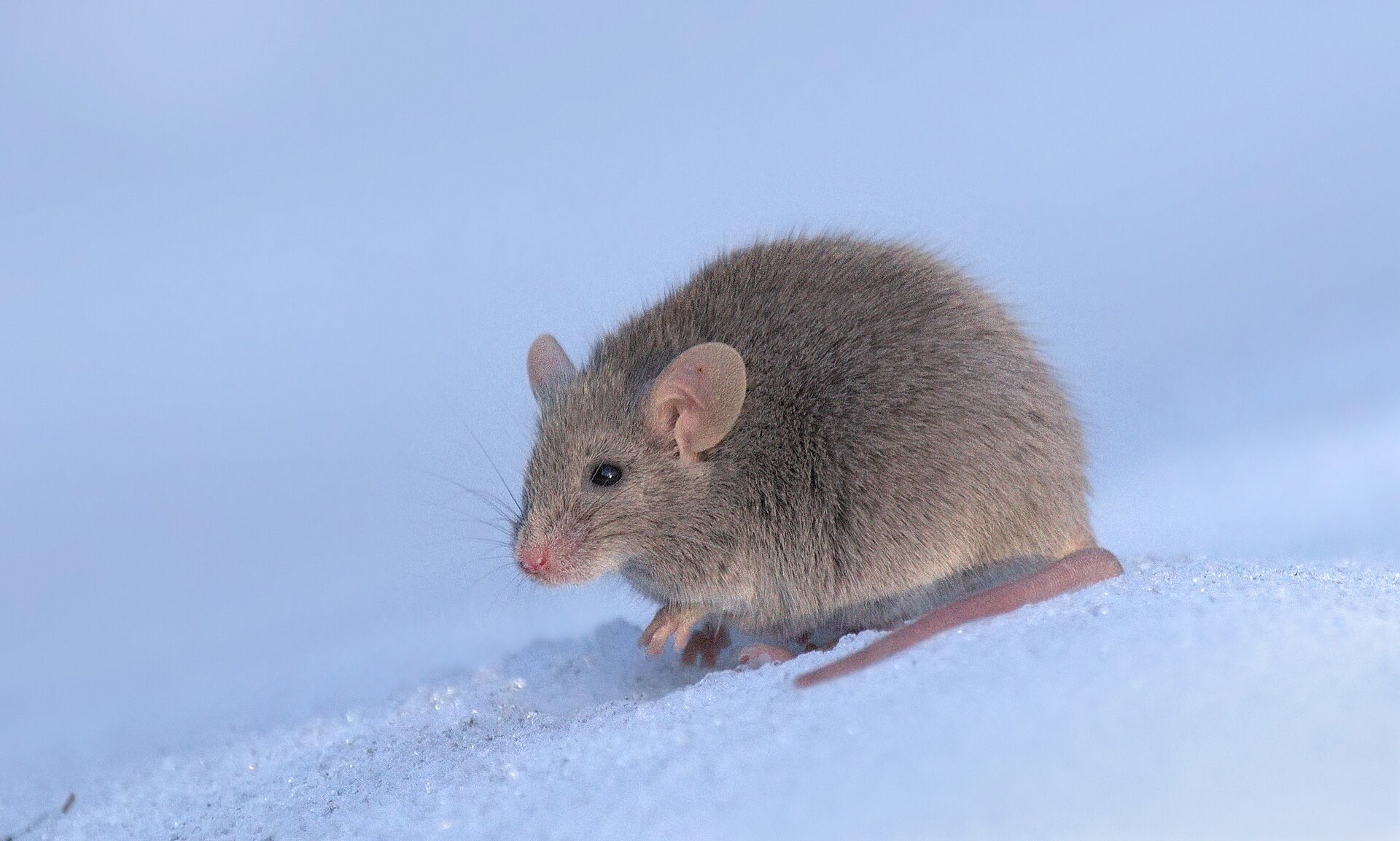
Mus musculus, the house mouse, is a small rodent in the family Muridae thought to have originated in a region corresponding to modern-day Iran, Afghanistan, Pakistan, and northwestern India, with the earliest recognised fossil occurrences dated to approximately 1 million years ago in central Asia and northern India. It has since reached every continent except Antarctica, having been spread by humans to the point that truly wild populations are now considerably less common than synanthropic populations near human activity. Commensal populations can reach densities of up to 10 individuals per square metre.
Key facts
- Scientific name: Mus musculus
- Kingdom: Animalia
- Phylum: Chordata
- Class: Mammalia
- Order: Rodentia
- Family: Muridae
- Genus: Mus
- Taxonomic rank: species
- Habitat: grassland
Physical description
Wild house mice vary in fur colour from grey and light brown to black. Individual hairs display agouti colouration, meaning each strand carries alternating bands of pigment. The coat is short, and both the ears and tail carry little hair. The most immediately recognisable features are a pointed snout, large rounded ears, and a long, almost hairless, scaly tail ringed by circular rows of scales called annulations.
The hind feet are short relative to those of closely related Apodemus mice, measuring only 15 to 19 mm. The normal walking gait produces a stride of about 4.5 cm. Vibrissae on the snout are embedded in densely innervated follicles and serve as tactile sensors for spatial navigation in confined or dark spaces, supplementing what are otherwise poor eyes.
Senses and behaviour
The visual system of Mus musculus is weak and the species is colour-blind. Smell, taste, touch, and hearing compensate substantially. House mice can detect ultrasounds above 20 kHz, a range that is inaudible to humans and that the animals use for communication. Over 10 distinct syllable types have been classified in their ultrasonic calls, which share structural features with the vocalisations of birds and cetaceans.
House mice are generally nocturnal, although individuals living inside human dwellings sometimes shift to daytime activity. They exhibit thigmotaxis, keeping their bodies in contact with walls and using whiskers and guard hairs to orient themselves. In the wild, populations live in complex underground burrow systems with several tunnels, separate nesting and storage chambers, and three or four exits. Near human habitation, nesting sites shift to spaces behind rafters, inside woodpiles, or other concealed spots close to food.
Mus musculus is territorial and colonial in commensal settings. A dominant male establishes a territory shared with several females and their young; all members of the group defend that territory against outsiders. The mating system is polygynous. Gestation lasts 19 to 21 days and may extend by several days if the female is simultaneously lactating. Under suitable conditions a female can produce 5 to 10 litters per year.
Reproduction and lifespan
Litters typically contain 3 to 12 offspring, most commonly 5 or 6. Pups are born naked and blind. Full fur is present by 10 days of age, the eyes open at 14 days, weaning occurs at 3 weeks, and sexual maturity is reached at 5 to 7 weeks. The pace of development is matched by a reproductive biology that allows near-continuous breeding: a female enters postpartum oestrus just 12 to 18 hours after giving birth, so she can carry a new litter while still nursing the previous one, with a potential interval of one litter every 25 days.
Wild house mice live approximately 12 months on average. Captive individuals typically reach about 2 years. Some mutant or calorie-restricted captive individuals have survived as long as 5 years, though these represent outliers rather than the norm for the species.
Diet
Mus musculus is an omnivore. In natural settings its diet includes seeds, fleshy roots, leaves, stems, and insects such as beetle larvae, caterpillars, and cockroaches. In human-associated environments the species will consume almost any digestible material available, which partly explains its success as a commensal organism.
Origin, spread, and relatives
Carl Linnaeus formally described Mus musculus in 1758 in the tenth edition of Systema Naturae, recording the type locality as Uppsala, Sweden. The species is thought to have originated in a region corresponding to modern-day Iran, Afghanistan, Pakistan, and northwestern India, with the earliest recognised fossil occurrences dated to approximately 1 million years ago in central Asia and northern India.
The closest relatives of Mus musculus are the mound-building mouse Mus spicilegus and the Algerian mouse Mus spretus. Mus spretus diverged from Mus musculus approximately 2 million years ago. Humans have transported Mus musculus to every continent except Antarctica; truly wild populations away from human activity are now considerably less common than synanthropic populations. The subspecies Mus musculus domesticus is considered the most effective coloniser of new continents and islands in recent centuries, and its global distribution has been used to partially reconstruct historical European shipping routes.
Public health
House mice are identified carriers of multiple zoonotic pathogens: Leptospira interrogans, Salmonella Enteritidis, Clostridium difficile, and Toxoplasma gondii. Transmission routes include contamination of stored food and water supplies. Commensal population densities, which can reach 10 individuals per square metre in favourable conditions, amplify exposure risk wherever mouse activity overlaps with human food storage.
Genome and biomedical significance
In 2002, the Mouse Genome Sequencing Consortium published the complete reference genome of Mus musculus, sequenced from the inbred strain C57BL/6J. The genome of Mus musculus is estimated to have diverged from the human lineage approximately 75 million years ago, yet the two species retain a high degree of genetic similarity that has made the mouse the central non-human model organism for human biology.
In 2025, researchers published the first telomere-to-telomere genome assemblies for two key inbred strains, C57BL/6J and CAST/EiJ. Those assemblies added 213 megabases of new sequence containing 517 protein-coding genes to the existing reference, filling gaps that had persisted since the original 2002 publication.
One anatomical detail reinforces how much remains to be learned from this heavily studied species: house mice carry a second functional thymus organ, a pinhead-sized structure in the neck beside the trachea, in addition to the standard pea-sized thymus in the chest. Among well-studied mammals this trait has not been found elsewhere.
History of selective breeding
In 1787, a Japanese money exchanger named Chobei Zenya published a booklet titled The Breeding of Curious Varieties of the Mouse, one of the world’s earliest known guides to selective animal breeding.
Did you know
- The house mouse is capable of jumping vertically up to 45 cm, roughly 4 to 6 times its own body length, despite having hind feet measuring only 15 to 19 mm long. (thainationalparks.com)
- In 1787, a Japanese money exchanger named Chobei Zenya published a booklet titled The Breeding of Curious Varieties of the Mouse, one of the world’s earliest known guides to selective animal breeding. (afrma.org)
- House mice communicate using ultrasonic vocalizations above 20 kHz that are inaudible to the human ear; over 10 distinct syllable types have been classified in their calls, which share structural features with the songs of birds and cetaceans. (ncbi.nlm.nih.gov)
- In addition to the regular pea-sized thymus organ in the chest, house mice possess a second functional pinhead-sized thymus organ in the neck next to the trachea, a trait unique among well-studied mammals. (jungledragon.com)
- The house mouse can squeeze through openings as small as 6 mm in diameter, approximately the width of a standard pencil, due to a compressible ribcage and reduced clavicles. (grokipedia.com)
- A female house mouse experiences postpartum estrus just 12 to 18 hours after giving birth, meaning she can carry a new litter while still nursing the previous one, potentially producing a new litter every 25 days. (animaldiversity.org)
- The genome of Mus musculus is estimated to have diverged from the human lineage approximately 75 million years ago, yet mice and humans share a high degree of genetic similarity, making the mouse an essential model for understanding human biology. (genome.gov)
Data sources
- GBIF
- Wikidata
- thainationalparks.com
- animaldiversity.org
- mammaldiversity.org
- biorxiv.org
- ncbi.nlm.nih.gov
- discoverlife.org
- grokipedia.com
- pmc.ncbi.nlm.nih.gov
- inotiv.com
Data updated: 2026-10-29