
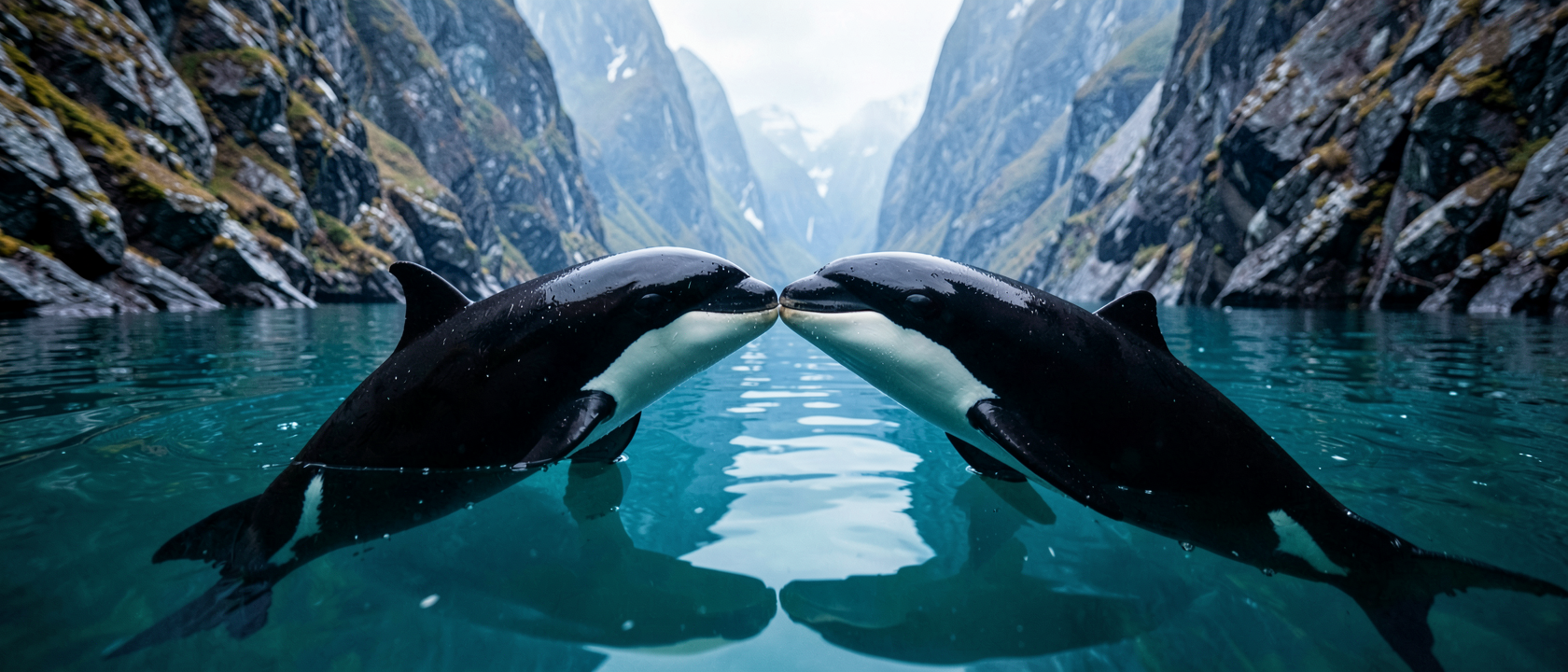
Two Orcas, One Fjord, and a Very Long Kiss
In October 2024, citizen-scientist snorkelers in Norway’s Kvænangen fjords, about 68 miles (109 kilometers) northeast of Tromsø, filmed two wild orcas (Orcinus orca) doing something nobody had caught on camera in the open ocean before. The pair pressed mouth to mouth and gently nibbled each other’s tongues, across three distinct bouts, for just under two minutes, before separating and swimming their own ways. The footage became the centerpiece of a paper published June 11, 2025, in the journal Oceans, led by Javier Almunia of the University of La Laguna and the Loro Parque Fundación, with co-authors Johnny van Vliet and Debbie Bouma. The behavior itself was not new to science. Seeing it in a wild, free-ranging orca was.
Why the Mouth Does the Job the Hands Can’t
An orca has no hands, no arms, nothing built for grasping. Its flippers steer and its tail flukes propel, and neither was shaped by evolution to touch another animal with any precision. Almunia’s team argues that this anatomical gap is exactly why the mouth has taken on a job that primates hand to their fingers: the orca’s lips, tongue, and jaw are the one surface sensitive and controllable enough to deliver a deliberate, gentle touch to another individual. That is their proposed explanation, not a settled fact about cetacean nerve physiology. The same logic, per the researchers, may account for the mouth-to-mouth contact already documented in beluga whales (Delphinapterus leucas) under human care. Take the hands away from a highly social mammal and the mouth appears to become the backup channel, the one tool left for a job that would otherwise go to fingers.
A Handshake, a Lick, a Pod
If the mouth is the tool, bonding is the proposed job. Almunia’s paper frames tongue-nibbling as an affiliative signal, something closer to lip-touching between primates or the submissive licking seen in dogs and wolves than to courtship or feeding. Under that reading, two orcas doing this are not exchanging food or testing dominance. They are maintaining a relationship, the way a pod depends on long-term bonds between specific individuals rather than anonymous group membership. The paper notes the behavior resembles sequences already described in detail at facilities that house orcas, and suggests it may be part of the species’ ordinary social repertoire, possibly leaning toward younger animals. That is the interpretation on offer, attributed to the study’s authors, not a mechanism anyone has confirmed with physiological data.
Not Just a Captivity Thing
Before October 2024, every documented case of orca tongue-nibbling had come from animals under human care. It was first recorded in captive orcas in 1978, then again in 2019 at Loro Parque in Tenerife, Spain, where trainers reported that four individuals there had shown the behavior, though not for several years at a stretch. With no wild sightings on record, it was a reasonable guess that this was something confinement produced: boredom, close quarters, or a social structure shaped by human management rather than by the ocean. The Kvænangen footage breaks that assumption. Two genetically wild, free-ranging orcas were filmed doing the same thing, unprompted, in open water. Almunia, who also directs the Loro Parque Fundación, told Live Science that the behavior is “exceptionally rare” and that caretakers at several facilities know of it, but that it may appear and then go unseen again for several years. Rare, in other words, in both settings. Exclusive to neither.
One Video Is Not a Conclusion
Luke Rendall, a marine mammal researcher at the University of St. Andrews who was not involved in the study, is not ready to call this a kiss, a handshake, or anything else. He points out that a single two-minute clip cannot establish what the behavior is actually for. It could be a form of begging, he suggests, or a form of grooming. It might even be closer to a passing fad than a fixed social ritual: the paper itself raises the comparison to a known orca population that took to balancing dead fish on their heads like hats for a while, then simply stopped. Rendall also questions how much captive-orca behavior can tell researchers about wild pod life in the first place, since a tank’s social arrangement is not a clean stand-in for a free-ranging family group. And he specifically pushes back on any suggestion that this finding offers support for swim-with-cetacean tourism, a conclusion he says the data do not back up. Nobody disputes what the camera caught. What it means is still an open file, built on exactly one sighting.