
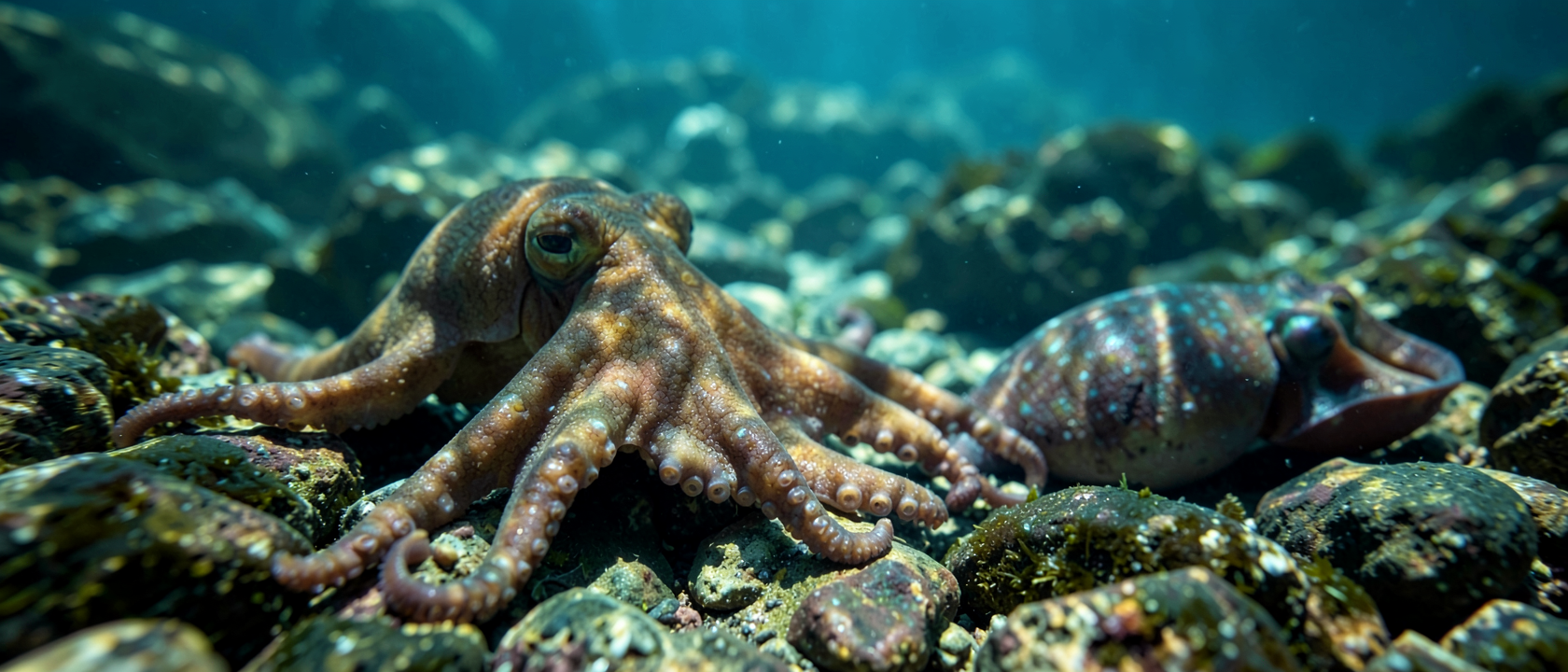
The arm checks first
A male California two-spot octopus (Octopus bimaculoides) has a mating arm that will not do its job until it has tasted something first. The arm is the hectocotylus, a modified third arm that finds the female’s reproductive opening and carries sperm to it. According to a 2026 study in Science by Pablo Villar and colleagues, working in Nicholas Bellono’s lab at Harvard, the tip of that arm will not release sperm until its sucker cups make direct contact with progesterone, the hormone produced by the female’s ovaries. No progesterone, no delivery, regardless of how far the mating has otherwise gotten.
A chemical gatekeeper at the tip of an arm
During mating, the male probes inside the female’s mantle, the soft body wall covering her organs, searching for the oviducts, the ducts that lead from the ovaries. Sperm travels the length of the hectocotylus toward the tip. Villar’s team found that the sucker cups there are dense with chemosensory receptors, cells that sense chemicals on direct contact rather than through sight or smell at a distance, and identified one in particular, named CRT1, as the receptor doing the work. In lab tubes lined with different substances, contact with progesterone triggered sperm release. Everything else triggered what the researchers called “aversive behavior”: the arm recoiled instead. Severed hectocotyluses, tested on their own and still electrically active, fired specifically to progesterone and not to other steroids or bitter compounds (3 to 6 arms per test, p < 0.005). The team also found progesterone itself in the ovary, oviduct, and skin of wild-caught females, so the arm has something real to find. Examining tissue from three individuals, the researchers counted up to three times more of these receptors, and three times more neurons, packed into the hectocotylus than into an ordinary arm.
Why an arm needs taste buds
Villar’s team proposes these progesterone receptors evolved from older neurotransmitter receptors, repurposed for a new job: sensing a hormone instead of relaying a nerve signal. The arm’s two functions, sensing and delivering, did not get bolted together afterward. They evolved tangled up with each other. While mapping where these receptors turned up across the octopus’s body, Villar noticed how concentrated they were in the hectocotylus specifically. By his own account, that was the detail that stopped him: why would an arm built purely for transferring sperm need a receptor like that at all? The tube experiments gave him an answer.
In a Perspective written alongside the study, Anna Di Cosmo argues the implications go further than confirming a receptive partner. A sensory system that checks a mate’s chemistry before releasing sperm could, across many generations, bias which partners ever get recognized as suitable in the first place. Small shifts in how sensitive that receptor is could quietly separate populations reproductively, even without anything else changing. Di Cosmo’s phrase for it: sensory systems acting as molecular gatekeepers at the earliest stages of speciation, not just referees of a single mating.
Not a hose. A sensor.
Textbooks and documentaries have long treated the hectocotylus as plumbing, a specialized arm built to move sperm from one animal to another and nothing more. Nicholas Bellono, the study’s senior author, corrected that directly: the arm’s reproductive role had been documented for a long time, but nobody knew it was also a sensory organ. Villar adds a second detail that undercuts the plumbing picture further. Male octopuses do not use the hectocotylus the way they use their other seven arms. They keep it coiled against the body, out of service, and do not send it out across the sea floor hunting for food the way the rest of their arms do constantly. For most of an octopus’s life, this arm sits idle, waiting for one specific molecule before it does anything at all.
The gaps in the tube test
All of this comes from work on one species, the California two-spot octopus, and from small numbers: three individuals for the receptor count, three to six severed arms for the nerve tests. Whether other octopus species, or cephalopods more broadly, run the same chemical check before mating is not established. Some researchers note that related receptors and signaling chemicals are broadly conserved across cephalopods, which makes the question of how widespread this exact mechanism is more open, not less. A separate critique in the scientific record raises questions about how precisely the hormone itself was identified, since progesterone sits in a family of closely related steroids. And Di Cosmo’s idea, that this chemical vetting could nudge populations toward becoming separate species over time, is a hypothesis she raises in her Perspective. Nobody has shown it happening yet, in octopuses or in anything else.