
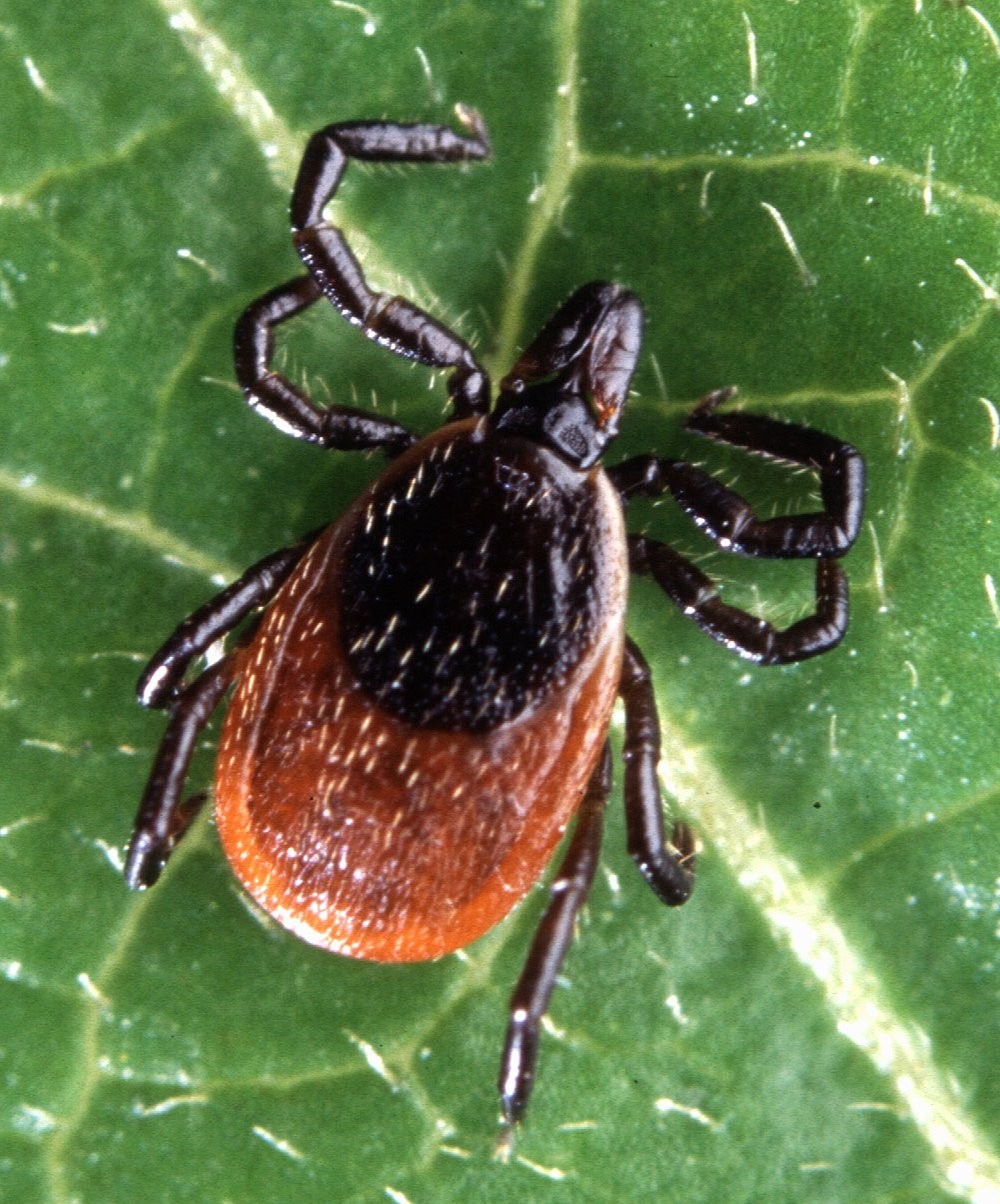
Ixodes scapularis, the eastern black-legged tick, is a three-host, obligate blood-feeding arachnid found across the eastern and north-central United States and into southern Canada, where its range has been expanding northward at an estimated 46 km per year. An estimated half a million people are treated annually in the United States for Lyme disease transmitted by this species.
Key facts
- Scientific name: Ixodes scapularis
- Kingdom: Animalia
- Phylum: Arthropoda
- Class: Arachnida
- Order: Ixodida
- Family: Ixodidae
- Genus: Ixodes
- Taxonomic rank: species
Identification and physical appearance
Unfed adult Ixodes scapularis range from 2 mm to 4 mm in length. Females are generally larger than males, and an engorged female may reach 12 mm and turn dark gray as feeding progresses. The female’s dark, inornate scutum covers only the anterior portion of the body, leaving the exposed idiosoma orange to red. The male’s scutum is rigid and covers the entire body, a structural difference that physically prevents males from engorging.
The species lacks eyes entirely, and its anal groove forms a distinctive horseshoe shape anterior to the anal pore on the ventral surface. Three comparisons help place it among common North American ticks: it is smaller than Dermacentor variabilis (the American dog tick), lacks the marginal festoons of that species, and carries a dark rather than an ornate scutum. Unlike Amblyomma americanum (the lone star tick), it has no white spot on its dorsum.
Habitat and geographic range
The species favors wooded and forested areas with dense leaf litter, high tree stem count, midstory cover, and canopy cover. It also occurs at ecotones between forest and meadow and along stream-bank vegetation. Between feedings, ticks shelter in leaf litter or soil. In the North Central United States, tick presence is positively associated with deciduous, dry to mesic forests and alfisol-type soils of sandy or loam-sand textures overlying sedimentary rock. Grasslands, conifer forests, and wet or acidic soils are consistently absent from the tick’s recorded distribution.
The range of Ixodes scapularis has been expanding steadily since the mid-20th century. Reforestation accompanied by a resurgence of white-tailed deer populations in the United States is the primary driver, while climate warming has facilitated northward expansion into Canada at an estimated 46 km per year. Migratory birds accelerate this spread: individual birds can carry ticks as far as 425 km in a single flight, seeding reproducing populations well beyond any distance the tick could walk.
Life cycle and feeding biology
Ixodes scapularis is classified as a three-host tick: each of its three active life stages (larva, nymph, and adult) feeds once on a separate individual host before molting or, in the case of the adult female, laying eggs. The complete cycle spans two years under typical conditions and can extend to three or four years in colder regions. Eggs are laid in spring of year one; larvae feed in late summer of that year; nymphs feed in spring and summer of year two; and adults feed in fall and early spring of year two.
Larvae hatch as six-legged individuals before molting into eight-legged nymphs. Larvae and nymphs feed primarily on small and medium-sized mammals, including white-footed mice (Peromyscus leucopus), chipmunks, voles, and shrews. Adult females feed predominantly on white-tailed deer (Odocoileus virginianus). Each feeding stage requires 3 to 7 days to reach full engorgement. An engorged female then lays a single clutch of approximately 1,500 to 3,000 eggs in the environment and dies.
Adult males present a striking biological exception: they carry a scutum that covers the entire dorsal surface and physically cannot engorge. Males live solely to locate and mate with females on the host, and die shortly after copulation without ever taking a blood meal. Because pathogen transmission through feeding is impossible for a male, only females and immature stages (larvae and nymphs) are capable of transmitting pathogens to humans.
Questing behavior
Ixodes scapularis locates hosts by questing: it climbs low-lying vegetation, generally between ground level and approximately 3 feet high, and extends its forelegs to detect and grasp passing hosts. The tick does not jump and does not drop from trees. A widely repeated image of ticks falling from overhead branches is a myth; contact occurs from low vegetation or leaf litter.
Northern and southern populations of the species differ in questing height. Northern nymphs quest above the leaf-litter surface and contact humans more readily. Southern nymphs remain beneath the leaf litter. This behavioral difference has been proposed to explain why Lyme disease prevalence is substantially higher in northern parts of the tick’s range despite the presence of the tick in the South.
Pathogens vectored
Ixodes scapularis has been identified as a vector of at least seven human pathogens. An estimated half a million people are treated for Lyme disease in the United States each year.
A study published in CDC’s Emerging Infectious Diseases journal in 2026 detected Powassan virus in adult Ixodes scapularis ticks collected during 2025 from two sites in northern Illinois, confirming the pathogen as lineage II (deer tick virus) and representing a southward geographic extension of previous detections.
Taxonomy and evolutionary relationships
Ixodes scapularis belongs to Kingdom Animalia, Phylum Arthropoda, Class Arachnida, Order Ixodida, Family Ixodidae, and Genus Ixodes. Its closest relatives are Ixodes pacificus (western United States), Ixodes ricinus (Europe), and Ixodes persulcatus (Eurasia). These four species form the Ixodes ricinus species complex. Within that complex, I. scapularis and I. pacificus are sister species, as are I. ricinus and I. persulcatus.
Genome and molecular biology
The nuclear genome of Ixodes scapularis measures 2.1 gigabases, placing it among the largest arthropod genomes known. Hill of Purdue University and supported primarily by the National Institute of Allergy and Infectious Diseases. Annotation of scaffolds representing approximately 57% of the genome revealed 20,486 protein-coding genes and expansions in gene families associated with tick-host interactions.
Among the findings from genomic analysis: the tick’s genome harbors horizontally acquired bacterial dae2 genes encoding amidase effectors. These effectors limit Borrelia burgdorferi proliferation within the tick itself, indicating that the tick’s own DNA has a role in moderating the density of the pathogen it carries and transmits.
Current research
In March 2025, researchers at Yale School of Medicine published a study in Science Translational Medicine describing IscREAM (Ixodes scapularis rapid extracellular antigen monitoring). The technique detects antibody responses to more than 3,000 tick antigens and was presented as a step toward developing an anti-tick vaccine. A vaccine targeting the tick itself, rather than any individual pathogen, would in principle reduce transmission of all pathogens the species carries.
Did you know
- Migratory birds carry Ixodes scapularis ticks from the northeastern United States into Canada by the estimated millions each year. A single bird can transport ticks as far as 425 km in one flight, establishing reproducing populations at distances the tick could never reach on its own. (journals.plos.org)
- The Ixodes scapularis genome contains horizontally acquired bacterial dae2 genes, inherited from bacteria rather than from the tick’s own evolutionary line. The proteins these genes encode, amidase effectors, limit Borrelia burgdorferi growth inside the tick, meaning the tick carries in its own DNA a partial brake on the density of the pathogen it transmits. (bugswithmike.com)
- Adult male Ixodes scapularis ticks never feed on blood. A rigid scutum covering the male’s entire dorsal surface prevents the body expansion that feeding requires. Males spend their adult lives locating females on hosts, mate, and die, leaving only females and immature stages capable of transmitting pathogens through feeding. (animaldiversity.org)
Data sources
- GBIF
- Wikidata
- lsuagcenter.com
- bugswithmike.com
- ncbi.nlm.nih.gov
- capcvet.org
- cdc.gov
- ohioline.osu.edu
- bmcbiol.biomedcentral.com
- eurekalert.org
- digitalcommons.odu.edu
- pubmed.ncbi.nlm.nih.gov
- journals.plos.org
- medicine.yale.edu
- wwwnc.cdc.gov
Data updated: 2026-10-29