
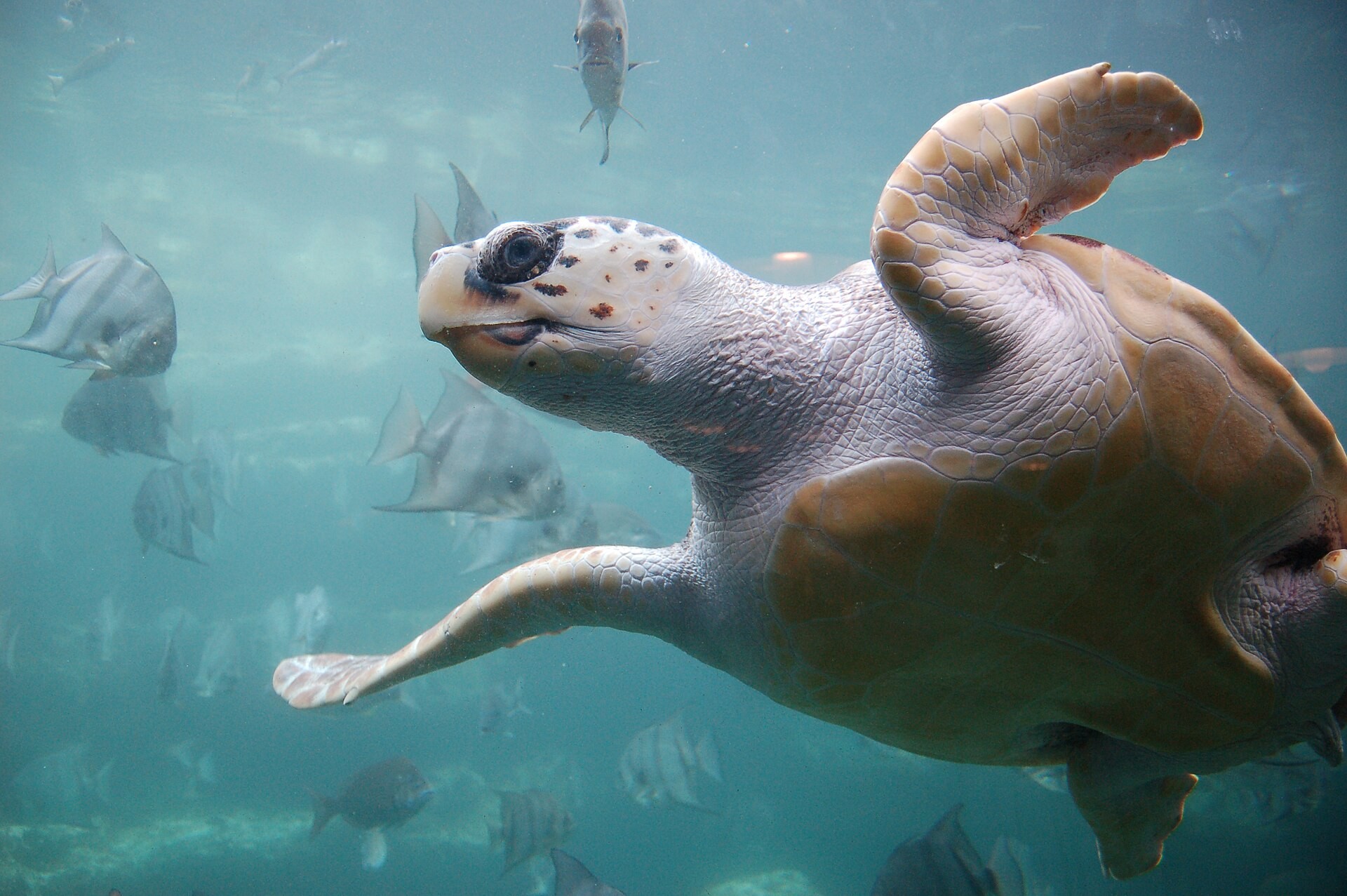
The loggerhead turtle (Caretta caretta) is the world’s largest hard-shelled turtle and the second largest extant turtle overall, behind only the leatherback sea turtle (Dermochelys coriacea). Its outsized, block-like head houses jaw muscles powerful enough to crush the shells of whelks, conch, and horseshoe crabs, a dietary strategy that sets it apart from every other marine turtle. The species ranges across subtropical and temperate waters of the Atlantic, Pacific, and Indian Oceans and the Mediterranean Sea, with adults recorded at carapace lengths up to 213 cm and body masses up to 455 kg. A single loggerhead carapace has been recorded supporting more than 100 species of animals and plants, functioning as a self-contained ecosystem adrift on the open ocean.
Key facts
- Scientific name: Caretta caretta
- Kingdom: Animalia
- Phylum: Chordata
- Class: Testudines
- Family: Cheloniidae
- Genus: Caretta
- Taxonomic rank: species
Appearance and anatomy
Adults carry a reddish-brown, slightly heart-shaped carapace and a pale yellowish plastron. The neck and flippers are dull brown to reddish brown on the upper surface and medium to pale yellow on the sides and underside. The carapace bears five or more costal scutes on each side that do not overlap one another, and the nuchal scute is in direct contact with the first costal scute on each side.
Maximum recorded carapace length is 213 cm (83.9 inches). Body mass can reach 450 kg (992 lb), with masses of up to 455 kg (1,000 lb) recorded. Size varies significantly by region: Western Atlantic adults average around 250 lb and can reach 400 lb or more, while Mediterranean residents rarely exceed 200 lb. The disparity reflects differences in foraging habitat and prey availability across ocean basins.
Range and habitat
Loggerheads inhabit subtropical and temperate oceans worldwide. In the Atlantic, the range extends from Newfoundland south to Argentina. The majority of global nesting occurs at the western rims of the Atlantic and Indian Oceans, primarily in Oman, the United States, and Australia.
Juveniles and adults are largely bottom feeders, preying on mollusks, horseshoe crabs, sea urchins, and other hard-shelled invertebrates. Hatchlings spend their first years in a different environment entirely, hunting small prey among floating mats of sargassum in the open ocean before transitioning to benthic foraging grounds as they mature.
The species is generally solitary and diurnal. It is considered slightly territorial but peaceful toward other species.
Migration and navigation
Loggerheads in the Pacific undertake one of the longest verified migrations of any reptile: approximately 7,500 miles between nesting beaches in Japan and foraging grounds off Baja California and southern California.
Research published in the journal Nature in 2025 demonstrated that loggerheads possess two distinct mechanisms of magnetoreception: a touch-based magnetic map sense that provides location information, and a separate magnetic compass sense built on a different underlying mechanism. Hatchlings are born with both — an inherited magnetic map and a magnetic compass — enabling navigation of the open ocean without any prior experience of it. The two mechanisms are not redundant; they operate independently and serve different navigational functions.
Females exhibit natal philopatry, returning to nest on the same beach where they were born. Remigration intervals most commonly fall between two and three years, though they can range from one to seven years.
Reproduction and life history
The sex of loggerhead hatchlings is determined by egg temperature during the middle third of incubation. For United States populations, the pivotal temperature producing a 1:1 male-to-female ratio is approximately 29 °C. This temperature-dependent sex determination makes nesting beach thermal conditions a direct driver of population sex ratios.
Age at sexual maturity is estimated at approximately 32 to 35 years, and lifespan is estimated at 70 years or more. An average female lays approximately 35 lbs (15.9 kg) of eggs in a single nesting season. Eggs are roughly the size and shape of a golf ball with a leathery rather than hard shell, and a nest may contain 100 or more of them. The estimated survival rate from egg to adulthood is approximately one percent.
Taxonomy and nomenclature
Carl Linnaeus assigned the loggerhead its first binomial name, Testudo caretta, in 1758. In 1814, Constantine Samuel Rafinesque established the genus Caretta but initially placed the species under the name C. nasuta. The current combination, Caretta caretta, was fixed by Leonhard Stejneger in 1904.
Molecular genetics has confirmed that Caretta caretta hybridizes naturally in the wild with at least three other sea turtle species: the Kemp’s ridley, the hawksbill, and the green sea turtle.
Salt glands
Loggerheads can drink seawater directly. Salt glands located near their eyes excrete the excess salt, producing a visible secretion that resembles tears. This is not an emotional response; it is a physiological mechanism for osmoregulation in a fully marine environment.
Conservation status and threats
The primary human-caused threat to loggerheads is bycatch in commercial fishing gear, including trawls, gillnets, and longlines. Before the introduction of Turtle Excluder Devices (TEDs), approximately 50,000 loggerheads were killed annually in shrimp nets in the Gulf of Mexico and Atlantic Ocean alone.
In 1992, the U.S. National Marine Fisheries Service finalized regulations requiring TEDs in shrimp trawl fisheries to reduce sea turtle bycatch. The device allows a turtle caught in a trawl net to exit through an escape panel before drowning, without requiring the net to be hauled.
In 2023, a genome sequencing study published in F1000Research produced a chromosomal-level assembly of the loggerhead sea turtle genome using samples from two unrelated females collected from the Fondazione Cetacea hospital in Riccione, Italy. A chromosomal-level assembly provides a more complete picture of gene arrangement than earlier draft genomes, offering a reference tool for future population genetics and conservation research.
Key nesting sites
Masirah Island in Oman, an 85-kilometer stretch of land lying 10 kilometers off the southern coast, hosts an estimated 30,000 loggerhead nests per season, making it the largest loggerhead rookery in the Indian Ocean.
The National Marine Park at Zakynthos, Greece, established in 1999, was the first sea turtle protection area in the Mediterranean Sea and remains one of the highest-density loggerhead nesting beaches in the world.
Did you know
- Masirah Island in Oman, an 85-kilometer stretch of land 10 kilometers off the southern coast, hosts an estimated 30,000 loggerhead nests per season, making it the largest loggerhead rookery in the Indian Ocean. (seaturtlestatus.org)
- The National Marine Park at Zakynthos, Greece, established in 1999, was the first sea turtle protection area in the Mediterranean Sea and remains one of the highest-density loggerhead nesting beaches in the world. (pdpoa.org)
- An average female loggerhead lays approximately 35 lbs (15.9 kg) of eggs in a single nesting season. (adfg.alaska.gov)
- Loggerhead turtle eggs are roughly the shape and size of a golf ball and have a leathery surface rather than a hard shell; while a nest may contain 100 or more eggs, the estimated survival rate to adulthood is approximately one percent. (pdpoa.org)
- Molecular genetics has confirmed that the loggerhead sea turtle hybridizes naturally in the wild with at least three other species: the Kemp’s ridley sea turtle, the hawksbill sea turtle, and the green sea turtle. (fws.gov)
Data sources
- GBIF
- Wikidata
- fws.gov
- widecast.org
- virginiaherpetologicalsociety.com
- boem.gov
- nwf.org
- fishi-pedia.com
- adfg.alaska.gov
- nature.com
- sciencedaily.com
- ncbi.nlm.nih.gov
- wwf.panda.org
- fisheries.noaa.gov
Data updated: 2026-10-31