
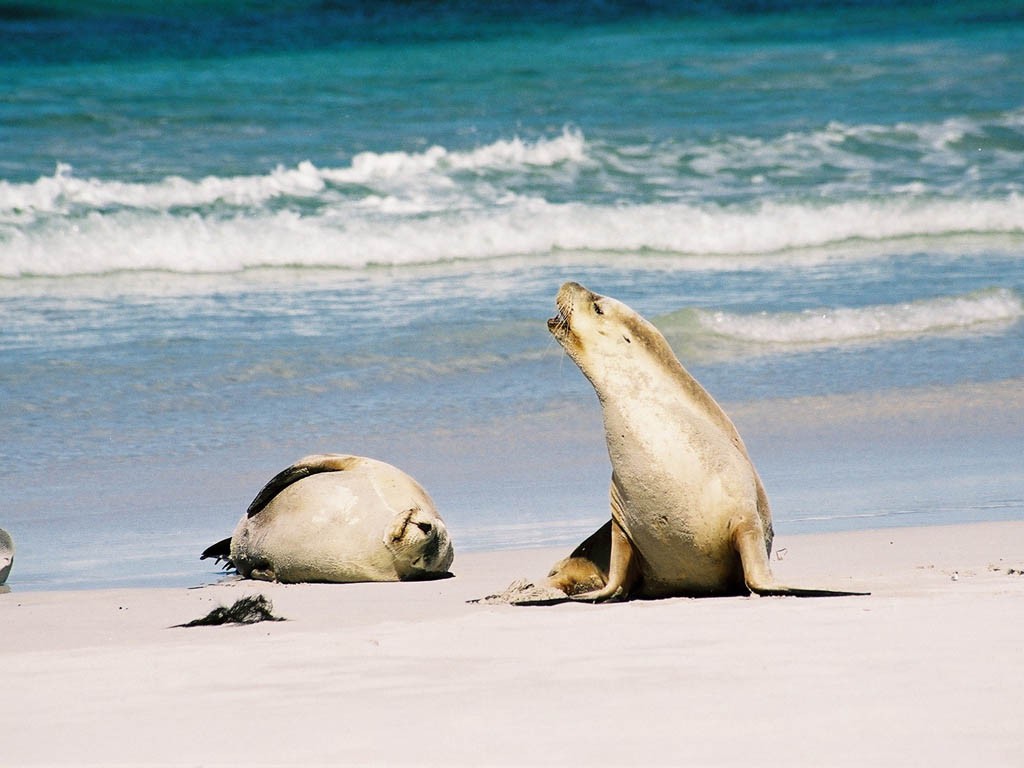
The Australian sea lion (Neophoca cinerea) is a pinniped endemic to Australian waters, breeding along a narrow arc of islands and mainland sites from Houtman Abrolhos in Western Australia to the Pages Islands near Kangaroo Island in South Australia. Adults are strikingly size-dimorphic: males reach 2.0–2.5 metres and 250–300 kg, while females top out at 1.8 metres and 104 kg. Listed as Endangered under Australia’s Environment Protection and Biodiversity Conservation Act 1999 since 23 December 2020, the species faces a combination of low reproductive rates, extreme population fragmentation, and a history of bycatch mortality that together make recovery unusually difficult.
Key facts
- Scientific name: Neophoca cinerea
- Kingdom: Animalia
- Phylum: Chordata
- Class: Mammalia
- Order: Carnivora
- Family: Otariidae
- Genus: Neophoca
- Taxonomic rank: species
- Mass: 7.2 kg
- Gestation period: 365.2 days
Appearance and size
Males and females look so different that a casual observer could mistake them for separate species. Adult males are dark brown overall, with mane-like patches of yellow on the neck and the top of the head. Adult females range from silver-gray to light tan to dark brown on the back, with creamy colouring underneath. Pups are born with a chocolate-brown coat measuring 62–68 cm in length and weighing 6.4–7.9 kg. That natal coat is moulted at approximately 4–6 months, at which point juveniles acquire the coloration of their sex.
The size gap between the sexes is among the largest recorded in any pinniped. Females at maturity weigh 61–104 kg; males weigh 250–300 kg, roughly three times as much. That disparity is directly tied to the demands of breeding competition, in which males must hold territory and fend off rivals continuously for up to four weeks at a time.
Foraging and diving
Australian sea lions are benthic foragers, working the sea floor rather than the open water column. Their prey includes octopus, cuttlefish, rock lobster, small sharks, rays, and fish such as blue-throated wrasse. One adult male was recorded reaching a depth of 245 m, demonstrating that the species is capable of foraging well below the shallow coastal shelf.
A key tool for locating prey is the vibrissae, the oval-shaped whiskers that are highly sensitive to water movements. Unlike round whiskers, the oval cross-section allows sea lions to detect the wakes left by moving prey, enabling them to track fish even in murky or completely dark water. Great white sharks are the principal natural predator of the species.
Reproduction and the non-annual breeding cycle
The breeding cycle of the Australian sea lion runs approximately 17.3–17.7 months, a non-annual schedule found in no other pinniped. Because this cycle does not align with the calendar year, different colonies breed in different seasons; a colony that pupped in autumn one year will pup in late winter roughly seventeen months later.
The breeding season itself lasts approximately five months. During that window, males hold small groups normally containing 4–6 females, spending up to four weeks ashore without returning to sea. Aggression between males is intense and sustained. Females give birth to a single pup and nurse it for up to 18 months, a lactation period long enough to overlap with the female’s next pregnancy.
Pup mortality in the first two years runs at 40–50%, with 20% of total mortality concentrated in the first six months. Much of that early loss is caused by aggression from adult males and females within the same colony, rather than by predation or starvation. Females reach sexual maturity at 4–6 years of age; males do not reach maturity until 8–9 years. The species can live up to 25 years.
Population structure and genetic isolation
Female Australian sea lions practise extreme philopatry: every breeding female returns exclusively to the colony where she was born. No female switches colonies to breed elsewhere. The result is that each colony operates as a genetically closed population, and fixed genetic differences have accumulated between colonies separated by as little as 20 kilometres.
A 2026 study published in Ecology and Evolution found that the northernmost colony, at Houtman Abrolhos, is highly genetically differentiated from all others and carries extremely low genetic diversity. That combination makes it especially vulnerable to local extinction. Because breeding females never disperse, a colony cannot be rescued by immigration from neighbouring sites; once the females of a colony are gone, the colony is gone.
Conservation status and legal protection
The Australian sea lion has been legally protected for well over a century. Western Australia extended protection in 1892, South Australia in 1964, and national Australian legislation followed in 1975. Despite that long legal history, population pressures continued and the species was uplisted from Vulnerable to Endangered under the Environment Protection and Biodiversity Conservation Act 1999, effective 23 December 2020.
Populations off South Australia declined by 67% over the last four decades. A major driver was bycatch mortality from gillnet fishing in the shark fishery. The Australian Fisheries Management Authority implemented the Australian Sea Lion Management Strategy, which imposed permanent gillnet closures around all sea lion breeding colonies in South Australian waters, covering 18,500 km². The programme shifted the shark fishery from gillnets to longlines, and the result was an estimated 98% reduction in sea lion bycatch mortality, while fishing catches returned to pre-management levels. The outcome has been characterised as an extraordinary result in the global context of managing marine mammal bycatch.
Genetic isolation means that the bycatch problem cannot be measured at the species level alone. Some Western Australian colonies have fewer than 10 breeding females. At that scale, the loss of even one breeding female carries a measurable effect on the colony’s probability of persistence, a consequence of the species’ complete reproductive philopatry.
Cultural significance
Among the Wirangu people of South Australia’s western coastal region, the Australian sea lion is known as bulgura. The name reflects a relationship between the species and Indigenous Australians that predates European legal protections by an unknown but substantial period.
Did you know
- Australian sea lions occasionally swallow small stones called gastroliths; it is believed this helps them balance their weight when diving for food. (seaworldabudhabi.com)
- Because each breeding colony is a genetically closed population and females never leave their birth site to breed elsewhere, the death of even a single female can have a measurable negative impact on a colony’s survival, and some Western Australian colonies have fewer than 10 breeding females. (marineconservation.org.au)
- Sea lion populations off South Australia declined by 67% over the last four decades, yet a decade-long management programme that shifted the shark fishery from gillnets to longlines achieved a 98% reduction in sea lion bycatch mortality, with fishing catches returning to pre-management levels — described as an extraordinary outcome in the context of managing marine mammal bycatch globally. (hsi.org.au)
Data sources
- GBIF
- Wikidata
- marinebio.org
- australianwildlifejourneys.com
- pinnipeds.org
- dcceew.gov.au
- australiangeographic.com.au
- research-repository.uwa.edu.au
- ncbi.nlm.nih.gov
- mmu.ac.uk
- environment.gov.au
- frontiersin.org
Data updated: 2026-10-30