
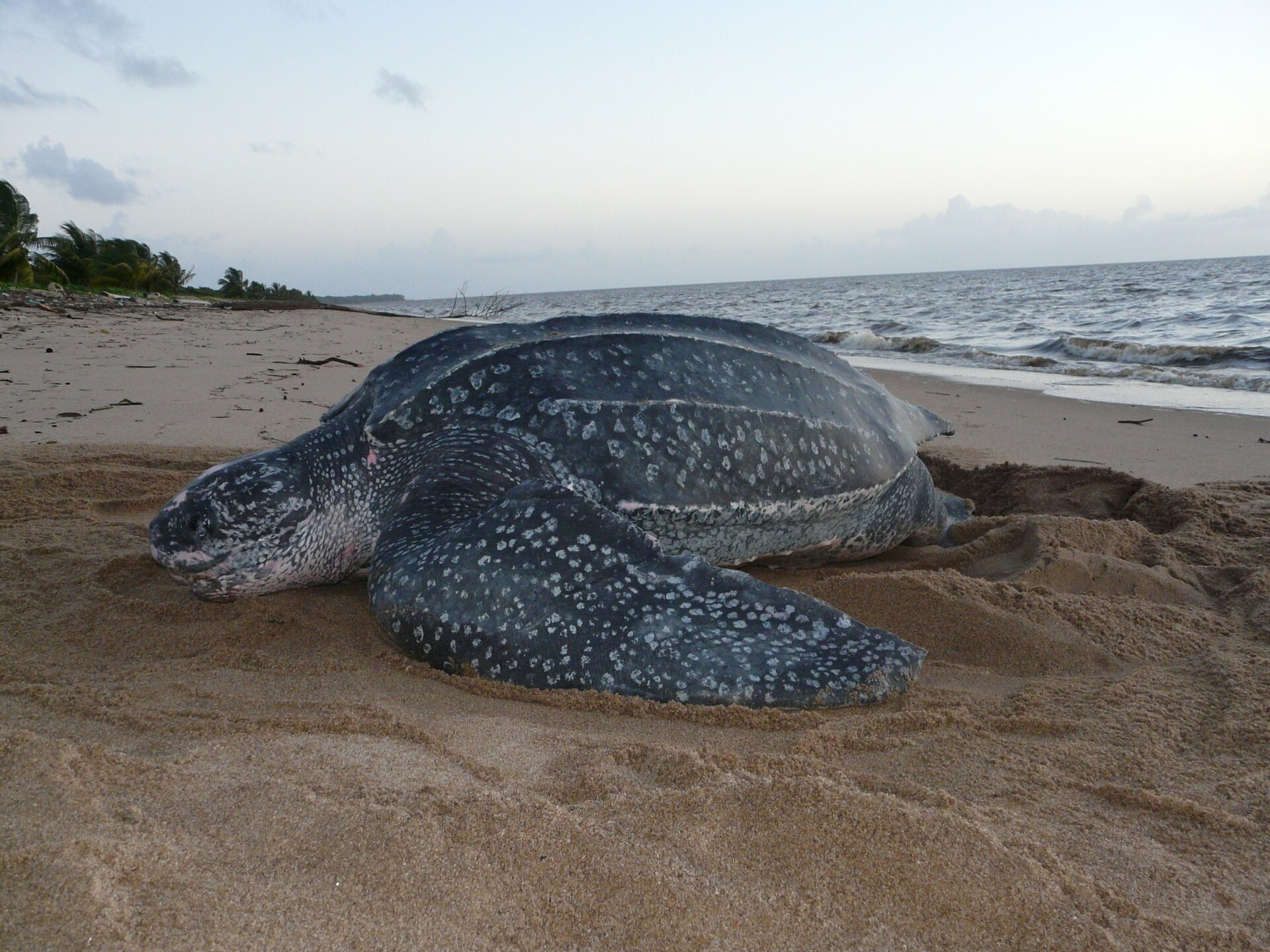
Dermochelys coriacea, the leatherback sea turtle, is the only living member of the family Dermochelyidae and the largest sea turtle species on Earth. Instead of the rigid bony shell that distinguishes all other sea turtles, it carries a carapace of small embedded bones (osteoderms) overlaid by firm, rubbery skin arranged into seven longitudinal ridges. Its range spans the Pacific, Atlantic, and Indian Oceans, reaching as far north as Alaska and Norway and as far south as the tips of Africa and New Zealand, a wider distribution than any other sea turtle species. As of 2010, global nesting abundance had fallen to an estimated 54,262 nests, roughly 40 percent below the approximately 90,599 nests recorded at the species’ mid-twentieth-century peak.
Key facts
- Scientific name: Dermochelys coriacea
- Kingdom: Animalia
- Phylum: Chordata
- Class: Testudines
- Family: Dermochelyidae
- Genus: Dermochelys
- Taxonomic rank: species
Appearance and anatomy
The absence of a hard shell is the leatherback’s most immediately recognizable trait. Where other sea turtles have a bony scute-covered carapace, the leatherback has a mosaic of osteoderms beneath skin that is predominantly black, patterned with varying degrees of pale spotting. Adults carry a notable pink spot on the dorsal surface of the head. Seven keels run the length of the back, a feature that inspired the French common name ‘tortue luth,’ because the ridges echo the seven strings of the lute.
The jaw is equally specialized for a particular diet. A toothlike cusp sits on each side of the gray upper jaw, and the lower jaw curves into a forward hook. Below the jaw, the mouth and throat are lined with backward-pointing spines that allow jellyfish to be swallowed but physically prevent them from being regurgitated. Those same spines help expel excess salt and are thought to shield the throat tissue from the stinging nematocysts of jellyfish.
Body size is extraordinary. A leatherback recorded on the coast of Wales in 1998 weighed over a ton, a mass comparable to that of a small car. That individual sits at the upper end of the range, but the species routinely dwarfs every other living sea turtle.
Thermoregulation in cold water
Reptiles are generally ectothermic, yet the leatherback maintains a body temperature measurably above that of the cold seawater it frequently inhabits. It does this through three overlapping mechanisms: gigantothermy (the combination of large body mass and a low surface-area-to-volume ratio that slows heat loss), a thick oily layer of insulating connective tissue beneath the skin, and countercurrent heat exchange systems built into the blood vessels of its flippers, where warm outgoing blood transfers heat to cold incoming blood before it reaches the core.
Diet and feeding
Leatherbacks are classified as medusavores: their diet consists specifically of jellyfish, comb jellies, and tunicates. The prey is nutritionally dilute, which partly explains the feeding rates the species must sustain. A leatherback can consume nearly 73 percent of its body weight in prey per day. Juvenile leatherbacks kept in captivity have been recorded eating twice their body weight in jellyfish daily, an intake that reflects just how little energy each kilogram of jellyfish delivers.
The species is almost entirely pelagic, spending the vast majority of its life in open ocean and entering coastal waters infrequently, primarily during breeding season.
Migration and range
Leatherbacks undertake the longest migrations between breeding and feeding areas recorded for any sea turtle species, some individuals averaging 3,700 miles each way. The range itself is the broadest among sea turtles, spanning the Pacific, Atlantic, and Indian Oceans between the subarctic waters off Alaska and Norway in the north and the southern tips of Africa and New Zealand in the south. Females require warm, tropical, sandy beaches to nest, which means the feeding grounds and the nesting grounds can sit on opposite sides of an ocean basin.
Reproduction and life cycle
The leatherback is solitary. Males never come ashore; mating occurs in the water just offshore from the nesting beach, and males play no part in the nesting process. Females return to nest every 2 to 4 years. Within each nesting season a female lays 4 to 7 clutches at intervals of 8 to 12 days, with an average clutch size of approximately 100 eggs. After an incubation period of about 60 to 65 days, hatchlings emerge.
The sex of each hatchling is not set by chromosomes but by the temperature at which the egg incubates, a process called temperature-dependent sex determination (TSD). Temperatures above approximately 29.5 degrees Celsius tend to produce females; cooler temperatures produce males. The leatherback is believed to reach sexual maturity at around 13 to 14 years of age, considerably sooner than most other sea turtle species. Lifespan is estimated at up to 90 years, a figure derived from gene promoter CpG methylation density studies.
Survival from egg to reproductive adult is low. Estimates from researchers suggested that only 1 in 1,000 leatherback eggs survives long enough to produce a mature adult, a figure that frames the population arithmetic in stark terms.
Taxonomy and scientific history
The species was first described scientifically in 1761 by Italian naturalist Domenico Agostino Vandelli, working from a specimen captured at Ostia and donated to the University of Padua by Pope Clement XIII. Vandelli assigned it the name Testudo coriacea, and the type locality was later formally restricted to ‘Laurentum, between Lido de Ostia and Tor Paterno, shore of the Tyrrhenian Sea, Italy.’
In 1816, French zoologist Henri Marie Ducrotay de Blainville coined the genus name Dermochelys and reclassified the animal as Dermochelys coriacea. Twenty-seven years later, in 1843, Leopold Fitzinger elevated the genus to its own family, Dermochelyidae, in which the leatherback remains the sole living species.
Conservation status and current research
The leatherback was federally listed as Endangered in the United States on June 2, 1970, and appears in CITES Appendix I, which prohibits its commercial international trade. The global nesting count, the primary long-term abundance metric available, stood at approximately 54,262 nests as of 2010, a decline of roughly 40 percent from the approximately 90,599 nests recorded in the mid-twentieth century.
Active monitoring continues. In September 2025, the collaborative Upwell and NOAA leatherback monitoring team tagged the first leatherback in the California Current since 2022. The individual was an adult male weighing 438 kg (almost 1,000 pounds), fitted with satellite and acoustic tags to gather data on movements and habitat use in that region.
Did you know
- One leatherback recorded on the coast of Wales in 1998 weighed over a ton, illustrating that this species can reach the mass of a small car. (nps.gov)
- The seven ridges on the leatherback’s back inspired the French common name ‘tortue luth’ (lute turtle), because the ridges resemble the seven strings of the lute musical instrument. (thainationalparks.com)
- The Seri people of the Mexican state of Sonora regard the leatherback sea turtle as one of their five main creator beings, reflecting the deep cultural significance this animal holds for indigenous communities. (madeinsea.co)
- Estimates suggest that experts once believed only 1 in 1,000 leatherback eggs survives to produce a mature adult, making the species’ persistence against such odds remarkable. (ioa.factsanddetails.com)
- The leatherback’s lifespan is estimated at up to 90 years based on gene promoter CpG methylation density analysis, making it the longest-lived sea turtle species. (pmc.ncbi.nlm.nih.gov)
- In captivity, juvenile leatherback turtles can eat twice their body weight in jellyfish every day, an extraordinary feeding rate that underlines how nutritionally dilute their jellyfish prey is. (seamap.env.duke.edu)
Data sources
- GBIF
- Wikidata
- fws.gov
- boem.gov
- seamap.env.duke.edu
- seeturtles.org
- fisheries.noaa.gov
- ioa.factsanddetails.com
- adfg.alaska.gov
- scienceinsights.org
- pmc.ncbi.nlm.nih.gov
- virginiaherpetologicalsociety.com
- thainationalparks.com
- home.nps.gov
- upwell.org
Data updated: 2026-10-31