
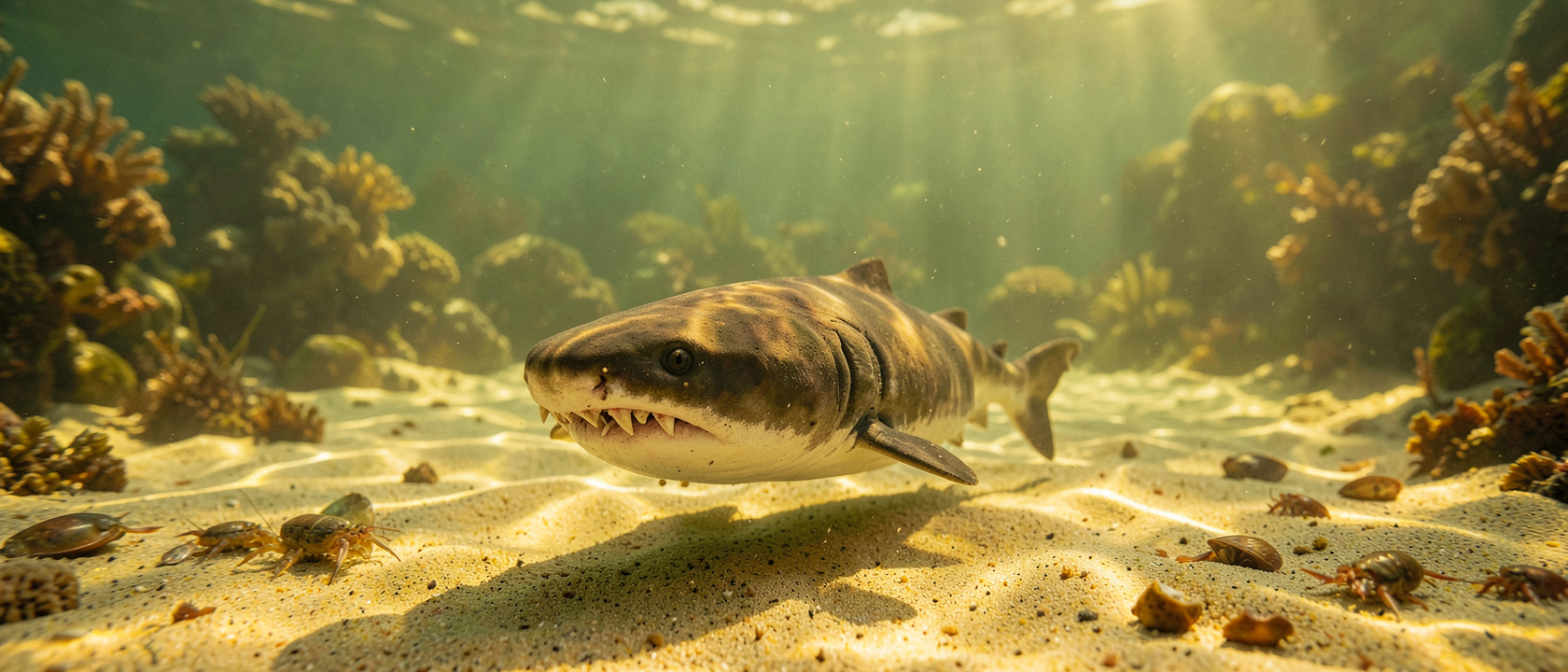
A shark you could lose in your pocket
Clavusodens mcginnisi was no longer than a human finger, 3 to 4 inches (7.5 to 10 cm) from nose to tail. It swam 340 million years ago, in a warm, shallow sea that once covered what is now Kentucky, over rock that would eventually become the ceilings of Mammoth Cave. A team led by paleontologist John-Paul M. Hodnett described the species in the Journal of Paleontology on January 24, 2024, built entirely from fossil teeth pulled out of the cave’s tightest passages. Molly Schorer, a public information officer at Mammoth Cave National Park, put the scale problem plainly for reporters: this is a very small shark, barely 3 to 4 inches long. The species name honors David McGinnis, a retired National Park Service superintendent who started his career as a Mammoth Cave guide and later, at Badlands National Park, became known for pushing fossils to be treated as a resource worth protecting. Co-author Rickard Toomey said the team was glad to put his name on a shark after decades of that advocacy.
What makes a tooth a nail instead of a blade
The “chipmunk shark” nickname belongs to the obruchevodid petalodonts, a group defined less by size than by their teeth. Picture a shark tooth and you’re probably picturing a serrated blade. These are not that. The back teeth have flat crowns sitting on long, narrow bases, shaped like old iron nails hammered partway into wood, while the front teeth are more chisel-shaped, hinting at an animal using different parts of its mouth for different jobs. That nail shape is where the group’s nickname comes from, and where half the new species name comes from too: Clavusodens joins the Latin clavus (nail) and dens (tooth). It is also the entire basis for placing the species in the group. Petalodont skeletons were cartilage, which almost never survives as fossil. Teeth do, so the identification runs on edges and bumps: the paper describes mcginnisi‘s teeth as having pointed margins running front to back and across the tongue side, with sturdier, chisel-like points on the side teeth.
The oldest member of a tiny club
The teeth came out of the Ste. Genevieve rock formation and date to between 330.9 million and 323.2 million years old, which the study identifies as the oldest known obruchevodid petalodont fossil on record. Before this find, the group’s entire known history ran through two deposits: near-complete skeletons from the Bear Gulch Limestone in Montana, and isolated teeth from the Bangor Limestone in Alabama. Mammoth Cave is the first place the group has turned up outside those two spots, stretching both the group’s timeline and its map. The cave has already produced more than 70 identified species of ancient sharks and other fish from this same rock layer, including four entirely new to science. Mammoth Cave National Park superintendent Barclay Trimble said the ongoing fossil work keeps surfacing new species and new information about sharks already known.
Why so small, why down there
The study ties Clavusodens mcginnisi‘s teeth directly to its diet: crustaceans, worms, and small brachiopods, picked off the sea floor rather than hunted in open water. Staying finger-sized was part of how that worked. According to the researchers, its small size let the animal forage along the bottom while staying too small to draw the attention of the larger predators sharing that sea. Small and ground-feeding wasn’t a limitation here; it was the strategy. A separate idea in the paper goes further, but stays clearly labeled as a proposal rather than a conclusion: that these sharks sheltered and fed around crinoids, the stalked animals that built reef-like structures on Carboniferous sea floors, in a relationship the researchers compare loosely to how modern triggerfish work coral reefs. No fossil yet places a mcginnisi tooth inside a crinoid structure, and nobody has tested whether these sharks actually lived that way or simply happened to live nearby.
Flat on their stomachs, 340 million years down
Finding any of this took more than careful digging. Mammoth Cave’s passages were carved by underground rivers through rock that had been marine sediment since the Carboniferous period, between 358.9 million and 298.9 million years ago, and researchers have been logging vertebrate fossils in the cave system since 2019. The paper describing Clavusodens mcginnisi is specific about what that work looks like: long stretches moving on hands and knees, and in places on stomachs, through passages too low to stand in, scanning the ceiling and walls overhead for teeth embedded in the rock. Nobody found a skeleton. They found a scatter of teeth the size of grit, in rock most people would walk past without a second glance, and from that alone they rebuilt an entire animal, its diet, and its place in shark history. That’s the real trick of this story: knowing a creature’s whole life, right down to how it avoided getting eaten, from nothing but a handful of teeth smaller than rice.