
Pull the queen out of a honeybee hive, and the workers simply carry on. They’re sterile; the throne was never open to them. Pull the queen out of a colony of Polistes canadensis, the tropical paper wasp, and you get something closer to a riot.
Pull the queen, watch the brawl
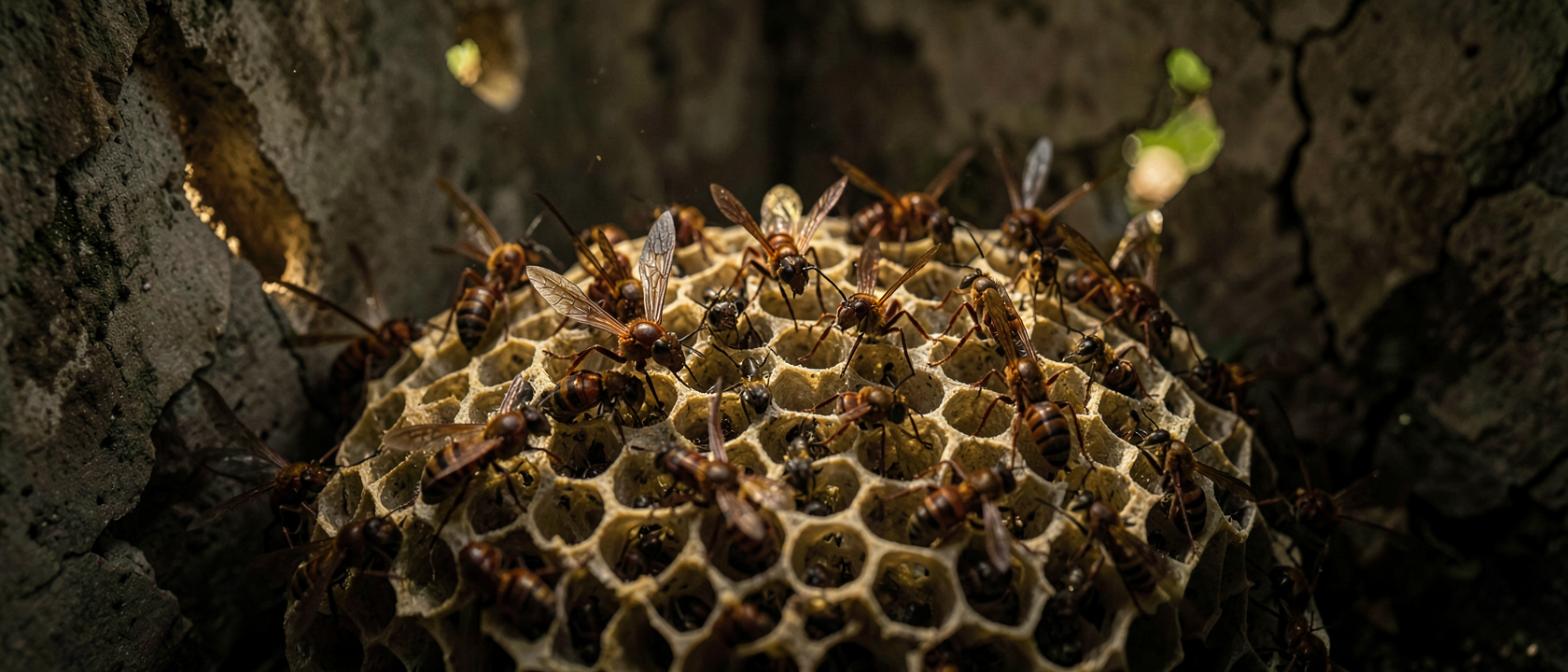
The colonies in question were nesting inside a derelict building across four sites in Panama’s Canal Zone. A research team led by Owen R. Corbett, publishing in the journal Animal Behaviour, reworked behavioral data originally gathered in the field in the early 2000s, tracking 306 individually paint-marked wasps across 19 colonies. Each wasp, mahogany-brown with the narrow waist typical of paper wasps, wore a tiny dot of colored paint so the team could follow exactly who did what once a queen vanished. There was no quiet handover. Aggressive interactions between females spiked almost immediately, the colony’s usual social order broke down fast, and multiple wasps went after the same vacant job: the right to become the next breeder.
Why there’s no heir
That scramble is the whole point, biologically. In a honeybee hive or an ant nest, workers are built without the hardware to ever become a queen, so a dead queen leaves nothing worth fighting over. Polistes canadensis is built differently. Every female keeps functioning ovaries and the physical capacity to become a breeder herself. Remove the queen and you haven’t triggered some backup succession plan. You’ve opened a real vacancy, and every female in the nest is, biologically, qualified to apply. That’s a fact about this species’ reproductive biology, not a quirk of temperament.
The ones who didn’t fight
Not every wasp joined the brawl. While some competed hard for dominance, others increased their foraging trips and stepped up feeding the larvae, so the existing brood kept getting fed while a chunk of the workforce was busy sorting out who ruled. The researchers call these wasps “compensators.” Meanwhile, the wasps actively contesting the throne tended to pull back on foraging and put their energy into aggression instead, which is exactly why the compensators mattered: without them, the whole operation would have stalled while the fighting played out. Corbett and colleagues suggest each wasp is effectively running her own calculation: fight for the throne if the odds look decent, or invest instead in raising her sisters’ young, a real alternative route to passing on genes inside a cooperative colony. It isn’t two castes doing two fixed jobs. It looks more like one kind of wasp, making different bets depending on circumstance.
No superorganism, no size chart
This kills two tidy pictures at once. First, the image of social insects as calm, conflict-free collectives, built on sterile-worker species like honeybees and ants, doesn’t survive contact with this study. Aggressive succession is usually assumed to be too costly for a colony to tolerate, yet these colonies kept running because enough individuals compensated by holding the essential jobs together. Second, drop the mental picture borrowed from meerkats or naked mole rats, where size and age usually decide who even gets a shot at breeding. The researchers found no such sorting here. Fighters and compensators didn’t differ in body size, age, or whatever status they held before the queen vanished. Same starting line, different choice. It’s also a useful contrast with other paper wasps: temperate-zone species tend to run much more orderly, rule-bound successions, while this tropical species runs something far more volatile, where any worker can claim the throne the moment it opens up.
What nobody’s figured out yet
What decides which wasp fights and which one forages is still an open question. No measured trait predicts it, so the best current guess from the study’s authors is that it comes down to something situational, a wasp weighing her own odds and her relatedness to the brood, rather than any fixed role she was born into. That’s a hypothesis the researchers propose, not something the data has nailed down. Also unresolved: whether this particular balance of conflict and compensation shows up elsewhere in the social-insect world, or whether it’s a quirk of this one wasp’s unusually chaotic succession system. Succession conflicts in other paper wasp species have been documented to collapse colonies outright, yet these Panamanian colonies held together through weeks of contested leadership. Why one system absorbs that kind of chaos and another doesn’t has not been answered, only noticed, and it’s the kind of question that makes you look twice at any “orderly” animal society you thought you understood.