
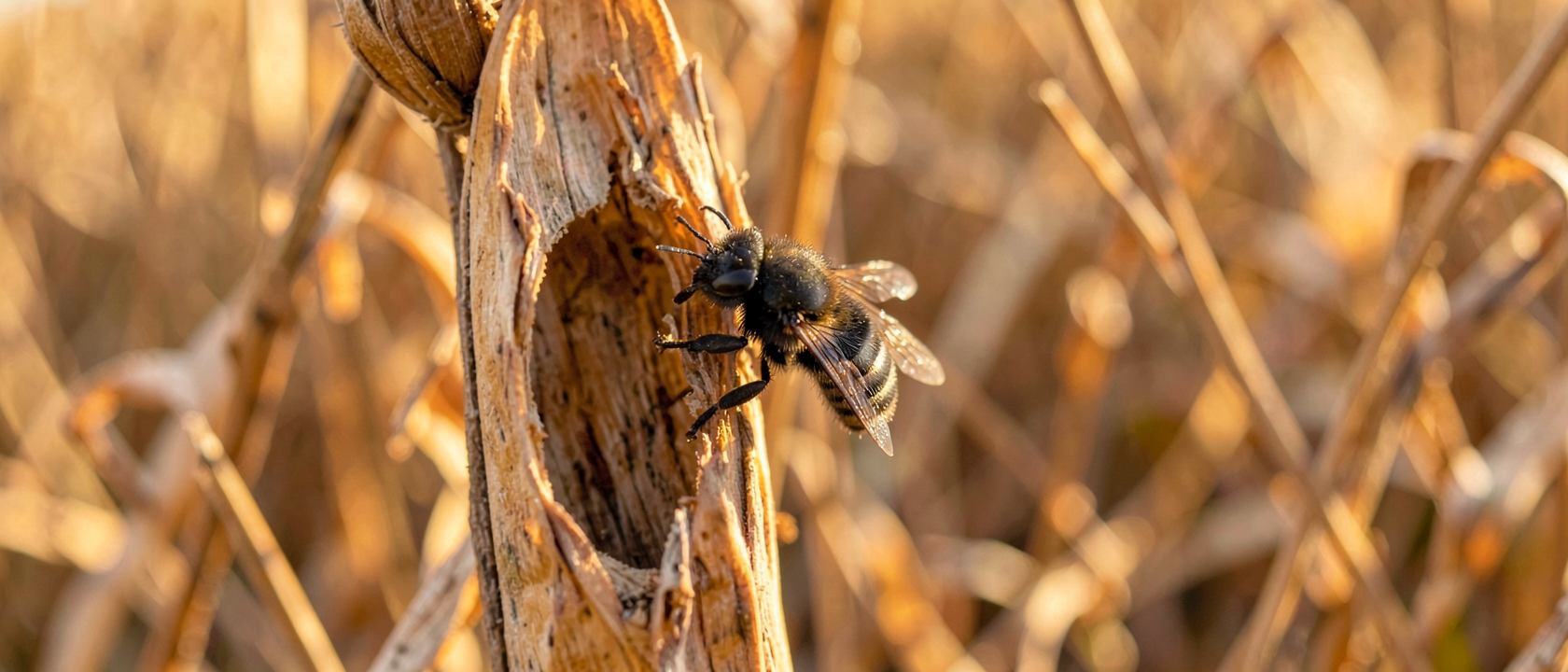
A Nest Without Her Turns Into a Fungal Graveyard
Take a small carpenter bee larva, Ceratina calcarata, and raise it without its mother present, and something specific happens inside it: it fills with fungus. A team led by Sandra Rehan at York University in Toronto, with lead author Katherine Chau, raised C. calcarata larvae with and without maternal care across four developmental stages, then screened for what pathogens had taken hold. Published September 14, 2023, in Communications Biology, the findings were stark: in motherless larvae, 85% of the pathogen load was fungal, against 8% bacterial. The fungus that dominated was an Aspergillus species, the same genus behind “stonebrood” disease in honey bees. Stonebrood does more than make a larva sick. It mummifies it, leaving a hardened fungal cast where a bee should have been.
Why This Bee Even Has a Mother to Lose
Most solitary bees never face this risk, because there is no mother left to remove. A female lays her eggs, seals the chamber, and leaves; whatever happens to the brood happens without her. Ceratina calcarata works differently. She builds one nest per year, hollowing out the soft pith inside a dead plant stem, then stays, guarding and grooming her offspring from spring through fall. That prolonged contact is unusual enough that researchers classify her as subsocial, a step short of a true colony but well past the lay-and-leave norm of solitary bees. Her presence is not only about delivering food. According to the York University team, a mother’s physical presence in the nest actively keeps fungi, bacteria, viruses, and parasites from overrunning the brood. Take her away, through a disturbance like excessive stem pruning, and nothing is left holding that microbial load down.
A Missing Mother Rewires the Larva Before It Has Eyes
The damage is not only pathogens winning by numbers. Maternal care had its strongest effect on gene expression at the earliest larval stage, the one the researchers had expected to matter least. In motherless early larvae, genes that code for transcription factors, the proteins that switch other genes on or off, were disproportionately represented among those regulating immune response, alongside genes tied to brain and eye development. The paper describes this as a cascade: tiny disruptions at the very start of life compound outward into weaker immune function and a disordered microbiome later on, which tracks with greater susceptibility to disease by later stages. The authors are careful to call these documented correlations between care status and gene expression, not a fully mapped chain of cause and effect. This means a mother’s absence shows up as measurable changes in eye- and brain-development genes before the larva has eyes to see with.
Bees Are Not One Animal
Most of what people assume about bee life comes from honey bees: a hive, a queen, workers, a waggle dance. Ceratina calcarata has none of it. No colony, no queen, just one female raising one brood alone inside a hollow stem. Solitary species make up the overwhelming majority of the roughly 20,000 known bee species worldwide, and they remain far less studied for disease and microbiome dynamics than their social, managed relatives. The stonebrood finding exists only because this team treated an unglamorous wild bee as worth studying on its own terms, instead of folding her into “bees” as one generic animal that behaves like the species humans happen to keep in boxes.
What Nobody Has Measured Yet
The paper documents the pathogen shift and the early gene dysregulation, but it does not report how large the comparison groups actually were, and it does not track what becomes of the motherless larvae that survive to adulthood. The authors describe fitness consequences in general terms, without pinning down exactly what those consequences look like or how severe they are. A separate study from the same research group, published in 2018, found that bees stripped of maternal care during development grew up more aggressive and more avoidant, alongside changes in the expression of more than a thousand genes. Whether the larvae that outlast an Aspergillus-heavy nest in the 2023 study pay a comparable price as adults, and how steep that price is, has not been measured yet.