
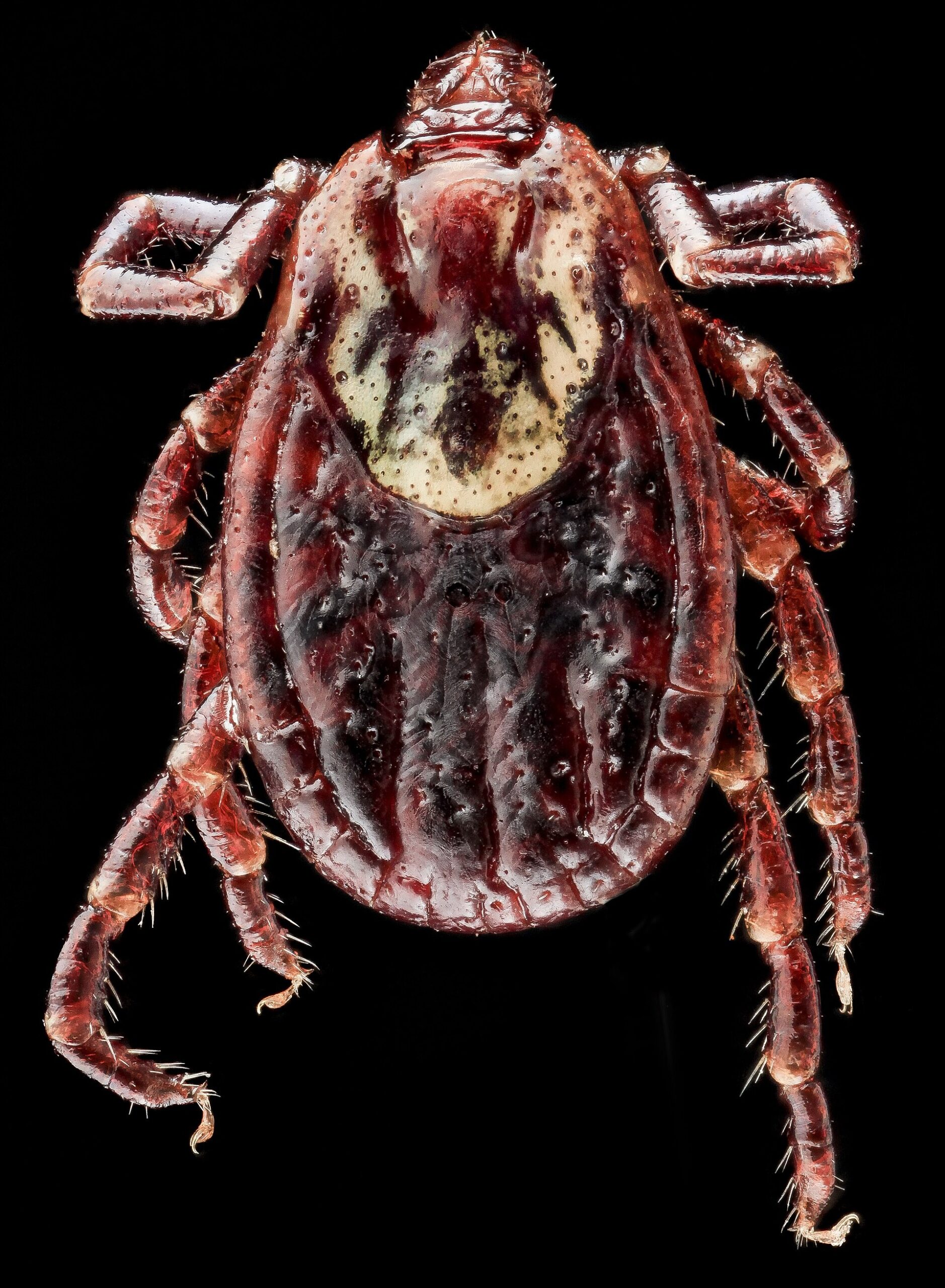
Dermacentor variabilis, the American dog tick, is a hard-shelled arachnid in the family Ixodidae, native exclusively to North America and one of the continent’s most medically significant tick species. It is a primary vector of Rickettsia rickettsii, the bacterium responsible for Rocky Mountain spotted fever, and of Francisella tularensis, the cause of tularemia, transmitting both pathogens while feeding on human or animal hosts. An unfed adult female measures about 5 mm, roughly the size of a sesame seed, yet after a blood meal she can swell to approximately 15 mm, tripling her linear dimensions. Thomas Say first described the species in 1821 in the Journal of the Academy of Natural Sciences of Philadelphia, placing it initially in the genus Ixodes under the name Ixodes variabilis.
Key facts
- Scientific name: Dermacentor variabilis
- Kingdom: Animalia
- Phylum: Arthropoda
- Class: Arachnida
- Order: Ixodida
- Family: Ixodidae
- Genus: Dermacentor
- Taxonomic rank: species
Appearance and Identification
When unfed, the body is oval and flattened, brown in base color, with whitish to gray markings. The clearest way to distinguish the sexes by sight is the scutum: adult females carry a creamy-white dorsal shield behind the head that covers only the anterior portion of the back, leaving the enlarged abdomen visible; adult males display a mottled cream-and-brown pattern that extends across nearly the entire dorsal surface. As a member of Ixodidae, D. variabilis possesses festoons — the scalloped projections along the posterior margin — and simple eyes positioned on the scutum above the second pair of legs.
Size changes dramatically between life stages and feeding states. Unfed adult females average about 5 mm in body length; unfed adult males average about 3.6 mm. After 5 to 14 days of feeding, an engorged female reaches 1/2 inch or longer. Immature stages are far smaller: larvae measure approximately 0.6 mm and nymphs approximately 0.9 mm, placing both below the reliable threshold of naked-eye detection.
Senses and Sensory Organs
D. variabilis locates hosts using the Haller’s organ, a structure unique to the Acari (mites and ticks) found on the first pair of legs. The organ operates through a G-protein coupled receptor signal cascade that is distinct from the olfactory mechanisms used by insects, and it is also capable of detecting carbon dioxide, infrared radiation, and heat. The capsule portion of the Haller’s organ has a highly reflective interior surface that amplifies sensitivity to infrared radiation, enabling ticks to detect the radiant heat of a potential host from several meters away — a capacity demonstrated experimentally in published research.
Life Cycle and Behavior
D. variabilis is a three-host tick. Each of its three motile life stages — larva, nymph, and adult — feeds on a separate individual host before dropping off to either molt (larvae and nymphs) or lay eggs (mated females). The complete cycle requires a minimum of 54 days but can extend to over two years when hosts are scarce or temperatures are unfavorable.
Seasonal activity is staggered across the stages. Larvae are active from approximately March through July, nymphs from June to early September, and adults from around mid-April to early September, with adults overwintering in the soil. An unfed tick can remain dormant without a host for at least two years, becoming active again each spring; larvae alone can persist without feeding for up to 11 months.
After completing her blood meal over 5 to 14 days, an engorged female drops from the host, digests the meal over 4 to 10 days, then deposits 4,000 to 6,500 eggs on the ground before dying. Those eggs hatch approximately 26 to 40 days later, with temperature governing the pace. The species favors habitats with little or no tree cover: grassy fields, forest edges, roadsides, trails, and brushy areas near waterways. It does not survive well indoors.
Pathogens acquired by larvae or nymphs during feeding are not lost at molting; they are maintained across life stages through a process called transstadial transmission. This means an immature tick that picks up Rickettsia rickettsii while feeding as a larva can still transmit the pathogen as a nymph or adult — contributing to the species’ role as a reservoir host between feeding events.
Medical and Veterinary Significance
East of the Rocky Mountains, D. variabilis is the dominant vector of Rocky Mountain spotted fever; the CDC reports that more than 60% of cases come from just five states: North Carolina, Oklahoma, Arkansas, Tennessee, and Missouri. The species also transmits Francisella tularensis, the agent of tularemia, to human and animal hosts during feeding.
D. variabilis is one of the two most common species associated with tick paralysis in North America. The condition is caused by a salivary neurotoxin produced by engorged females during feeding; the toxin interrupts sodium flux across axonal membranes, impairing motor nerve transmission. Crucially, the paralysis caused by D. variabilis typically resolves rapidly after tick removal, a contrast with the paralysis caused by the Australian species Ixodes holocyclus, where neurological symptoms can worsen for hours after the tick has been removed.
The species also harbors internal microbial communities of its own. A 2025 genome study using nanopore sequencing identified a Francisella-like endosymbiont (FLE) as a near-ubiquitous component of the D. variabilis microbiome, alongside Rickettsia montanensis.
Range and Expansion
D. variabilis is found extensively east of the Rocky Mountains in the United States. In Canada, the species occurs from eastern Saskatchewan east to Nova Scotia, primarily in the southern portions of each province, and has been expanding northward and westward since the 1970s. A 2023 study published on October 13, 2023, in PLOS ONE, drawing on passive surveillance data from 2012 to 2021, documented the species’ northward range expansion into the Canadian Maritime province of New Brunswick; dogs were the most common host from which ticks from the expanding population were recovered.
Taxonomy and Discovery
Thomas Say, an American naturalist, described the species in 1821 under the name Ixodes variabilis, based on specimens from the United States; the description appeared in the Journal of the Academy of Natural Sciences of Philadelphia, volume 2, pages 59 to 82. The species was later moved to the genus Dermacentor, where it now sits within the family Ixodidae, order Ixodida, class Arachnida, phylum Arthropoda, kingdom Animalia.
Genomics
The genome of D. variabilis, published in August 2025, spans 2.15 gigabases. Sixty-one percent of that sequence consists of repetitive elements, dominated by LINEs (long interspersed nuclear elements) and LTR retrotransposons. The same 2025 study used nanopore sequencing not only to characterize the genome architecture but also to detect the tick’s internal symbionts — the Francisella-like endosymbiont and Rickettsia montanensis — within tick tissue samples.
Did you know
- Although its common name references ‘Rocky Mountain,’ D. variabilis is not the primary tick vector of Rocky Mountain spotted fever in the Rocky Mountain region. That role belongs to Dermacentor andersoni, the Rocky Mountain wood tick; D. variabilis is the dominant vector east of the Rockies. (cdc.gov)
- Despite its name, the American dog tick is an obligate ectoparasite native only to North America. A case documented in 2022 described a male D. variabilis found on a traveler returning to Brazil from Pennsylvania in 2012, a rare recorded instance of the species being carried internationally by a human host. (ncbi.nlm.nih.gov)
- Researchers showed in a published study that D. variabilis ticks can locate a human host from several meters away using radiant heat detected by the Haller’s organ capsule, a covered pit organ whose highly reflective interior surfaces increase sensitivity to infrared radiation. (irbe.library.vanderbilt.edu)
- The paralysis caused by D. variabilis can resolve rapidly after tick removal. The paralysis caused by the Australian species Ixodes holocyclus behaves differently: symptoms may worsen for hours after the tick is removed. (pedemmorsels.com)
- The American dog tick’s genome, published in August 2025, is 2.15 gigabases in size, with 61% of the sequence made up of repetitive elements dominated by LINEs and LTR retrotransposons. (ncbi.nlm.nih.gov)
- D. variabilis larvae can survive without feeding for up to 11 months. Across all three active stages, the complete life cycle requires three separate host animals and may take as little as 54 days under ideal conditions or extend beyond two years when conditions are unfavorable. (ticksafety.com)
- More than 60% of Rocky Mountain spotted fever cases in the United States are reported from just five states: North Carolina, Oklahoma, Arkansas, Tennessee, and Missouri — all east of the Rockies, where D. variabilis is the dominant vector. The CDC identifies Dermacentor andersoni as the primary vector in the Rocky Mountain region itself. (cdc.gov)
- A single engorged female American dog tick can swell from about 5 mm to approximately 15 mm in length, tripling her linear dimensions. Unfed, she is roughly the size of a sesame seed; fully engorged, she is comparable in size to a small grape. (lonestarmap.com)
Data sources
- GBIF
- Wikidata
- extension.umaine.edu
- pestworld.org
- lonestarmap.com
- wcvm.usask.ca
- ticksafety.com
- ncbi.nlm.nih.gov
- zenodo.org
- cdc.gov
- journals.plos.org
- capcvet.org
Data updated: 2026-10-29