
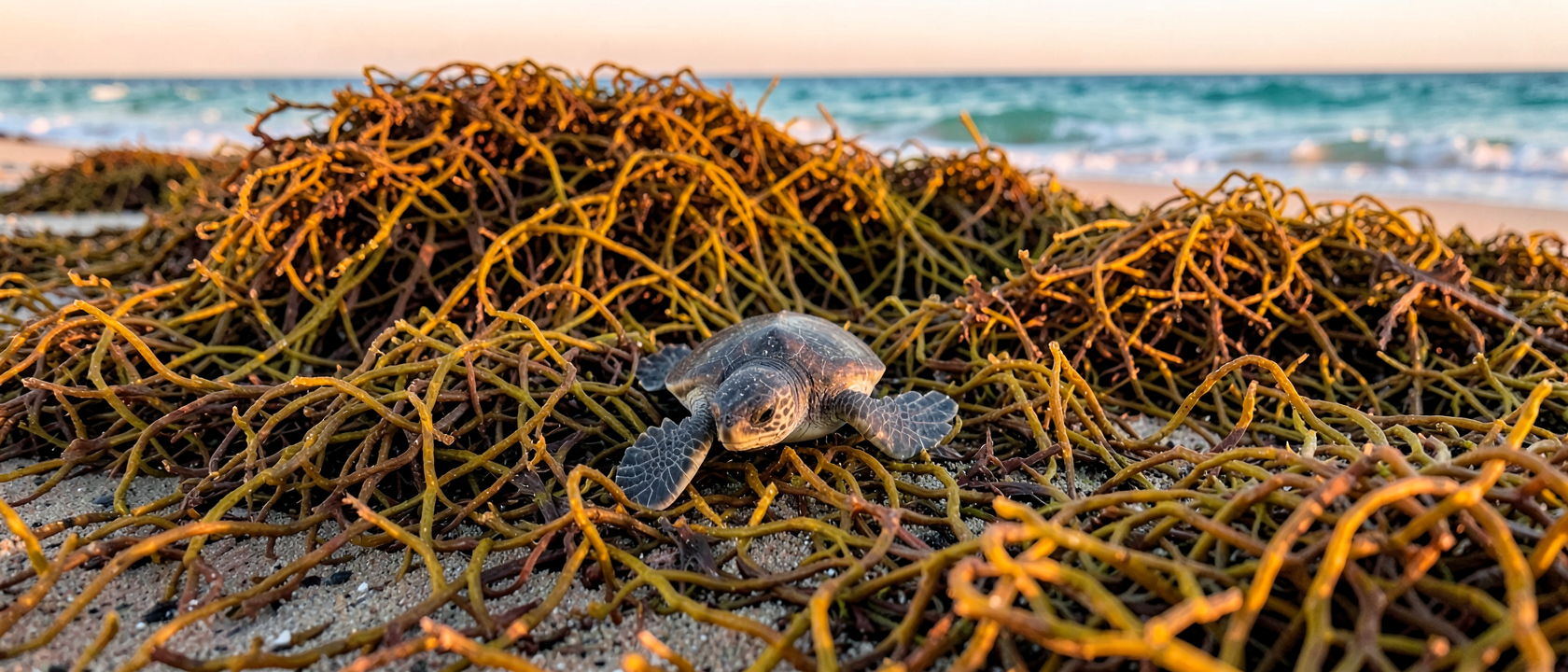
On Florida beaches, a sargassum pile only 7.5 inches (19 centimeters) high can nearly triple how long it takes a sea turtle hatchling to reach the water. A 2025 study in the Journal of Coastal Research by Florida Atlantic University researchers Abbey M. Appelt and Sarah L. Milton put hatchlings from three species, leatherback (Dermochelys coriacea), loggerhead (Caretta caretta), and green turtle (Chelonia mydas), through crawlway trials with and without seaweed. Loggerheads crawled up to 175% slower against the tallest piles, leatherbacks 158% slower, green turtles 159% slower. Not a detour. A near standstill.
Why they can’t just walk around it
Hatchlings don’t navigate by memory or smell. They crawl toward the brightest patch of horizon, which on an undisturbed beach is the open sky over the ocean. A rock they could skirt. Sargassum they can’t, because it doesn’t sit still. Appelt and Milton built a 50-foot (15-meter) crawlway, 43 feet (13 meters) of plain sand feeding into about 6.6 feet (2 meters) of loose seaweed, with a dim light standing in for the ocean glow. The pile collapsed under the hatchlings as they climbed, pitching them onto their backs again and again. One hatchling flipped more than 20 times fighting a single pile in one attempt, a detail the researchers recorded as an extreme case, not an average. Even piles only 2.8 to 3.5 inches (7 to 9 centimeters) tall were enough to stop some hatchlings from finishing the climb at all within the test window. The instinct to go straight for the light doesn’t bend. The obstacle has to.
Time is the actual predator
Nothing about a stuck hatchling is fatal by itself. What’s fatal is the clock. Every extra minute spent flipped over on open sand is a minute visible to gulls and ghost crabs working the dune line, and a minute closer to the heat that builds on Florida sand once the sun is up. The beach crossing is widely understood to be the most dangerous leg a sea turtle ever makes, which is exactly why hatchlings are built to do it in one unbroken sprint. Sargassum doesn’t have to touch a hatchling to put it at risk. It only has to keep it in place long enough for something else to find it, or for the sand to get too hot first. Milton notes that sargassum mats on South Florida beaches can pile over 3 feet (1 meter) high in summer and run for hundreds of yards (meters), which turns a single thirty-minute ordeal into a real possibility of several, back to back.
The myth the glucose killed
Watch footage of a hatchling getting overturned twenty-plus times and the obvious assumption is that it’s burning through its energy reserves, that all that flailing has a fuel cost it can’t afford before it’s even hit the surf. Appelt and Milton tested that directly, drawing blood to measure glucose, a stand-in for how much energy an animal has spent. The result: no significant difference in glucose between hatchlings that crossed sargassum and hatchlings that crossed clear sand, in any of the three species. The only group that stood out was leatherbacks that never crawled at all, sitting in a no-crawl control, which showed noticeably higher glucose than the ones that had crawled, sargassum or not. That suggests the crawl itself is the metabolic event. The seaweed doesn’t add to the bill. It just stretches out how long the hatchling is exposed while nothing shows up on a blood panel.
What the lab can’t tell you yet
These numbers come from a built crawlway with a measured pile at a known height, timed against a clock, not from an actual nesting beach at 3 a.m. with real gulls and real crabs working the line. That means nobody yet knows what fraction of hatchlings delayed this way in the wild actually die versus simply arrive at the water late and fine. It also means the study is probably the gentler version of the problem: a single controlled pile, not the stacked, shifting wall of seaweed that can run for hundreds of yards on a real beach in summer. Whether a hatchling forced through three or four of those walls in sequence shows the same flat glucose line as one that crossed a single test pile is a question nobody has run yet, in a lab or on the sand.