
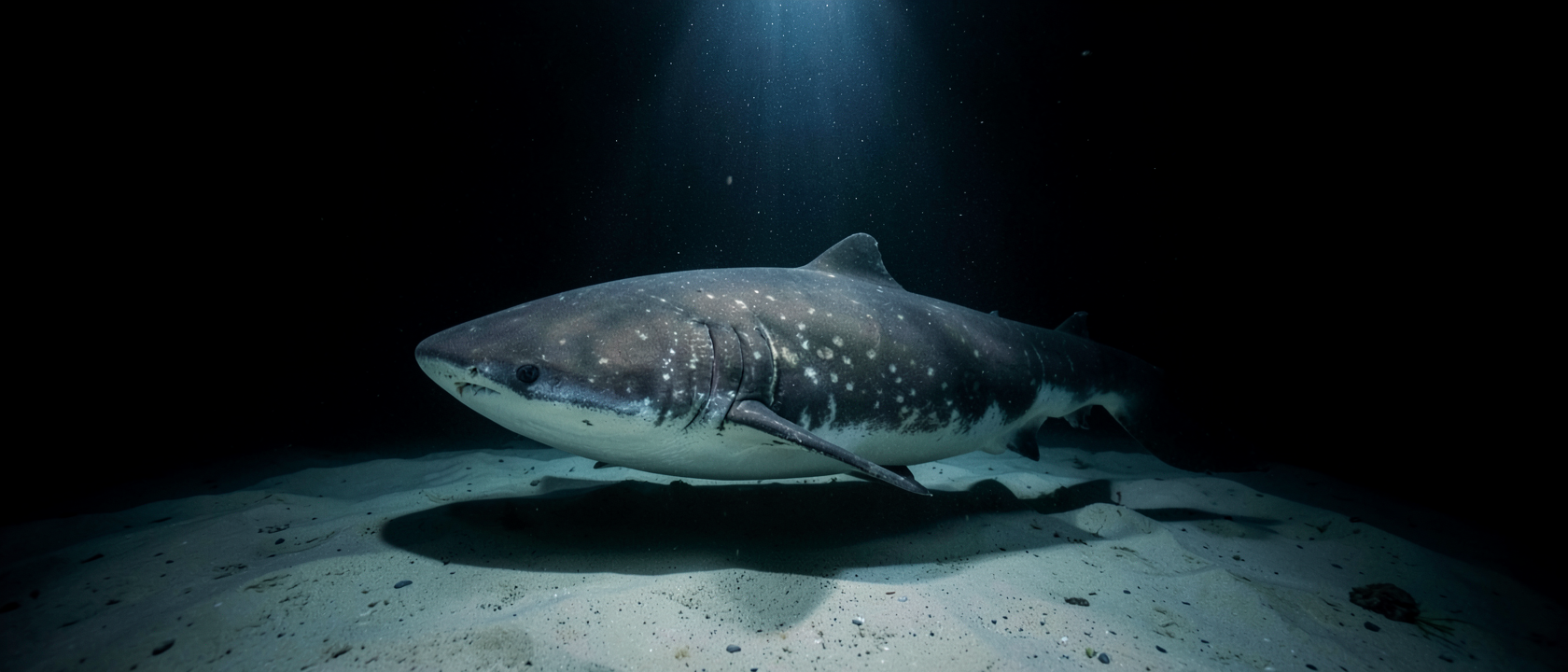
Nobody had ever filmed a shark in Antarctic waters until a baited camera caught one swimming calmly at 1,608 feet (490 m) deep, in water measuring 34.29°F (1.27°C), off the South Shetland Islands near the Antarctic Peninsula, in January 2025. The shark, estimated at 10 to 13 feet (3 to 4 m) long, was recorded by the Minderoo-UWA Deep-Sea Research Centre at the University of Western Australia. Alan Jamieson, the center’s founding director, says he could find no earlier record of a shark anywhere in the Antarctic Ocean. Peter Kyne, an independent conservation biologist at Charles Darwin University, agrees: this is the southernmost shark ever recorded, full stop.
Researchers think it is most likely a southern sleeper shark, Somniosus antarcticus, sometimes called Whitley’s sleeper shark, though the footage alone couldn’t confirm the species: sleeper sharks resemble each other closely enough that DNA testing is still pending. The animal appears to be female, identified by the absence of claspers, the paired structures male sharks carry near the pelvic fins to transfer sperm. “It’s not even a little one,” Jamieson said. “It’s a hunk of a shark. These things are tanks.”
Why 1,608 Feet
The Antarctic Ocean is not one uniform block of cold water from surface to seafloor. Down to roughly 3,280 feet (1,000 m), it is stratified into layers, with colder, denser water sitting below fresher meltwater near the top, the two resisting easy mixing. Jamieson’s read on the footage is that the shark wasn’t parked at a random depth. At 1,608 feet, it had found the warmest shelf available in that stacked column, while following a seafloor that kept sloping deeper beneath it. That single detail reframes the whole sighting: this wasn’t an animal washed up somewhere it didn’t belong. It was an animal reading the water the way a hiker reads a map, and picking the most comfortable line through it.
The Seafloor as a Dinner Table
Sleeper sharks, as a family, are not built for chasing anything through open water. Somniosidae are slow-moving, small-finned sharks, and the group’s biology points toward scavenging: fish, squid, and carrion that sink out of the water column above. Jamieson expects other Antarctic sleeper sharks sit at similar depths for the same reason, feeding on the carcasses of whales, giant squid, and other animals that drift down once they die. The depth and the cold aren’t an obstacle this shark has to put up with. They mark where its food settles. A slow shark that barely swims doesn’t need to be fast. It just needs to be patient, and patient is exactly what evolution built it to be.
The Rule Everyone Worked By
For as long as deep-sea surveys have covered this region, the working assumption has been straightforward: sharks do not occur in Antarctic waters. “We went down there not expecting to see sharks because there’s a general rule of thumb that you don’t get sharks in Antarctica,” Jamieson said. This wasn’t a soft guess with quiet exceptions filed away somewhere. There was no earlier documented case of a shark this far south. Not one. A single clip overturned an assumption that deep-sea researchers had carried into every expedition to the region.
What Nobody Can Say Yet
Two explanations sit on the table, and neither is confirmed. One is that warming Southern Ocean waters are pushing sharks toward the pole, a climate-driven range shift researchers genuinely wonder about but can barely test, since range data this far south has always been thin. The other is that sleeper sharks have been living at these depths around Antarctica all along, simply slow enough and remote enough to have gone unnoticed. Kyne leans toward the second idea: a shark that barely moves is a shark that’s easy to miss. Either way, the cameras that could settle the question only run during the Southern Hemisphere summer, December through February. For the other three-quarters of the year, in this exact habitat, nobody is watching at all.
The shark nearly made that case for itself. It turned up buried inside roughly 400 hours of recorded footage, the kind of volume a team scans rather than watches frame by frame, and it only got noticed when marine geoscientist Heather Stewart asked, “What is that that sneaks on in the background?”
The Skate Nobody Blinked At
The same footage shows a skate, a flat-bodied shark relative that looks like a stingray, lying motionless on the seabed a short distance away, apparently unbothered by the shark passing overhead. Nobody blinked at the skate. Scientists already knew skates range this far south, so its presence confirmed nothing and surprised no one. The shark is the only reason anyone is still watching this particular clip, and the only reason you’d have known, instantly, which animal in the frame actually mattered.