
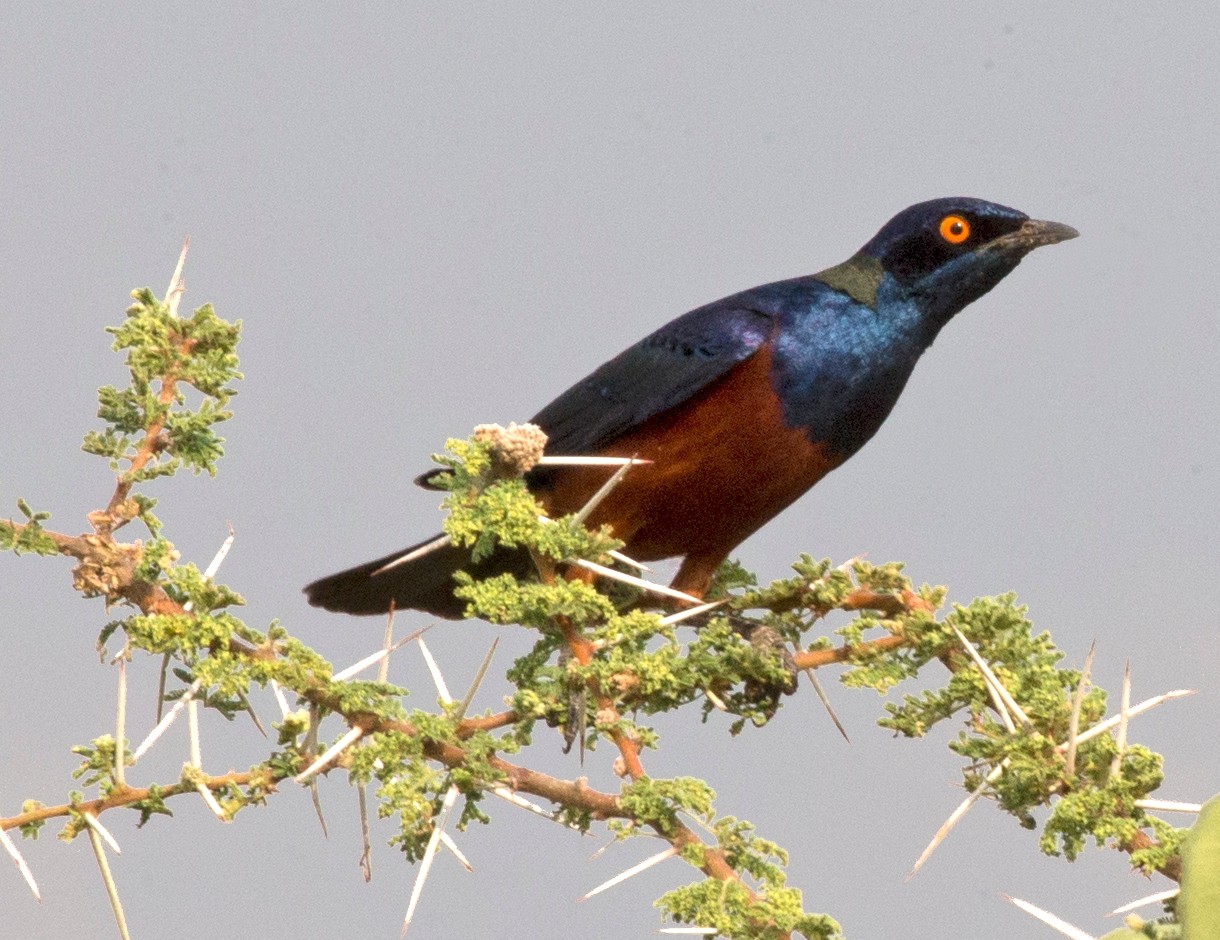
Shelley’s Starling (Lamprotornis shelleyi) is a small passerine bird in the family Sturnidae, originally described by Sharpe in 1890 under the name Spreo shelleyi before being reclassified into the genus Lamprotornis. Measuring about 16 cm in body length and weighing just 4.2 g, it occupies dry thorn savanna and thorn scrub across its East African range. Its iridescent upperparts, chestnut underparts, and yellow-orange eye set it apart from the several similar starlings it shares its habitat with, though telling them apart in the field takes careful attention to size and colour contrast.
Key facts
- Scientific name: Lamprotornis shelleyi
- Kingdom: Animalia
- Phylum: Chordata
- Class: Aves
- Order: Passeriformes
- Family: Sturnidae
- Genus: Lamprotornis
- Taxonomic rank: species
- Mass: 4.2 g
Appearance and field identification
The upperparts of Shelley’s Starling are dark and iridescent, with a blue sheen concentrated on the head and green covering most of the wing. The underparts are chestnut, and the eye is yellow-orange, a combination that provides the clearest marks for field identification. Body length is about 16 cm.
Two species cause consistent confusion in the field. Hildebrandt’s Starling is closely similar but slightly larger and paler overall, with a less deeply rufous belly and a more contrasting green wing panel. The Superb Starling is also reminiscent of Shelley’s, but carries a white chest band that Shelley’s Starling never shows. Relative to Hildebrandt’s, Shelley’s is slightly smaller and darker, with a deeper rufous belly and a less contrasting green wing, details that require a good look in reasonable light.
Vocalisation
Shelley’s Starling produces mewing calls, typically delivered in a long, continuous series. This vocal pattern is a useful secondary cue when the bird is partly obscured by thorn scrub, where its dark coloration can make visual identification difficult.
Habitat and behaviour
The species is tied to dry environments: dry thorn savanna, thorn scrub, and subtropical or tropical dry shrubland. Within these habitats it is usually encountered in small wandering flocks rather than as solitary individuals or in large aggregations. Flocks regularly associate with other starling species, a pattern common among Lamprotornis starlings sharing overlapping ranges.
Taxonomy and original description
The species was first formally described by Sharpe in 1890 under the original combination Spreo shelleyi. Subsequent taxonomic revision moved it into the genus Lamprotornis. Its full classification places it in the kingdom Animalia, phylum Chordata, class Aves, order Passeriformes, and family Sturnidae.
Data sources
Data updated: 2026-11-26