
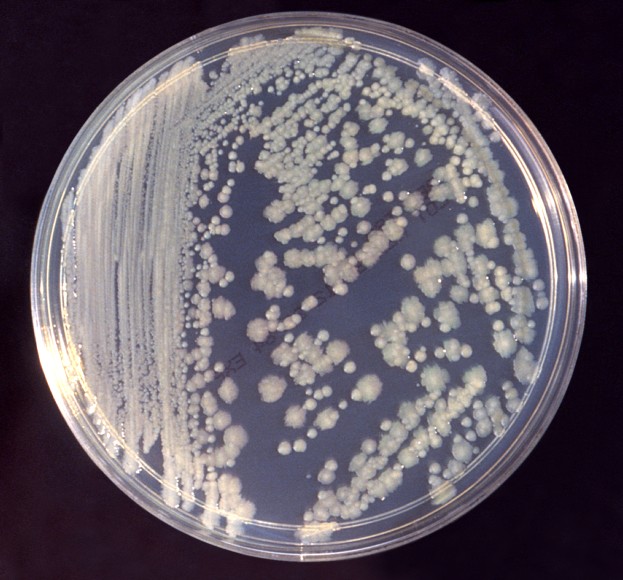
Enterobacter cloacae is a Gram-negative, rod-shaped, facultatively anaerobic bacterium in the family Enterobacteriaceae, widely distributed in soil, water, plants, and the intestinal tracts of humans and animals. It is a member of the ESKAPE group, a set of pathogens recognized as leading causes of antibiotic-resistant hospital-acquired infections. Clinically, it accounts for up to 5% of hospital-acquired sepsis cases and up to 10% of postsurgical peritonitis cases. In the WHO Bacterial Priority Pathogens List 2024, released on May 17, 2024, carbapenem-resistant and third-generation-cephalosporin-resistant Enterobacterales were classified in the critical priority tier.
Key facts
- Scientific name: Enterobacter cloacae
- Kingdom: Bacteria
- Phylum: Proteobacteria
- Class: Gammaproteobacteria
- Order: Enterobacterales
- Family: Enterobacteriaceae
- Genus: Enterobacter
- Taxonomic rank: species
Physical characteristics and cell structure
Enterobacter cloacae cells are rod-shaped and generally motile, appearing under the microscope singly, in pairs, in short chains, or in clusters. The bacterium is Gram-negative. Some strains of Enterobacter cloacae may produce a protective capsule outside the cell wall, but the species is not known to produce endospores.
The species is facultatively anaerobic, capable of growth both in the presence and absence of oxygen.
Taxonomic history
The species was originally described in 1890 by E. O. Jordan under the name Bacillus cloacae, in a report on bacteria isolated from sewage published in the Massachusetts Board of Health’s Report on Water Supply and Sewerage. The species epithet cloacae derives from the Latin genitive feminine noun meaning “of a sewer,” reflecting its original isolation source. Over its taxonomic history the species has carried at least five different scientific names, including Bacterium cloacae and Cloaca cloacae, before settling as Enterobacter cloacae.
Enterobacter cloacae belongs to the Enterobacter cloacae complex (ECC), which also includes Enterobacter hormaechei, Enterobacter kobei, Enterobacter asburiae, Enterobacter cancerogenus, Enterobacter nimipressuralis, and Enterobacter mori. The broader complex is widely spread in nature and is found in soil, sewage, and the human gastrointestinal tract.
Ecology and natural distribution
Enterobacter cloacae is widely distributed in nature and can be found in soil, water, plants, and the intestinal tracts of humans and animals. The broader Enterobacter cloacae complex is also found in soil, sewage, and the human gastrointestinal tract.
Clinical significance
Enterobacter cloacae causes infections across multiple body sites. A molecular study in Ningxia, China found that Enterobacter cloacae can cause infections in the wound, urinary tract, lower respiratory tract, and skin and soft tissues. Clinically, it accounts for up to 5% of hospital-acquired sepsis cases, 5% of nosocomial pneumonias, 4% of nosocomial urinary tract infections, and 10% of postsurgical peritonitis cases.
The species belongs to the ESKAPE group, an acronym covering Enterococcus faecium, Staphylococcus aureus, Klebsiella pneumoniae, Acinetobacter baumannii, Pseudomonas aeruginosa, and Enterobacter species, which are recognized as leading causes of antibiotic-resistant nosocomial infections. Despite being best known as a hospital pathogen, Enterobacter cloacae has caused a severe case of community-acquired sepsis in a 25-month-old child in rural Gambia, showing it can also strike outside clinical settings.
Antibiotic resistance mechanisms
Enterobacter cloacae carries a chromosomally-encoded, inducible AmpC beta-lactamase gene that confers intrinsic resistance to many beta-lactam antibiotics and can be further induced by certain cephalosporins. A study of military trauma patients found that Enterobacter cloacae infections in battlefield wounds were associated with prior exposure to first-generation cephalosporins, which are potent inducers of AmpC resistance.
A 2022 genomic study found that prevalence of key AmpC beta-lactamase genes, specifically blaCMH and blaACT, were the main chromosomal AmpC genes identified across global Enterobacter cloacae isolates. Beyond AmpC, the species has acquired carbapenem-resistance genes. The carbapenem resistance gene blaNDM-1 was found to be the most common carbapenem-resistance determinant in a study of nosocomial Enterobacter cloacae infections in southwestern China. Researchers investigating IMP-4-producing Enterobacter cloacae identified the organism as the predominant species among more than 11 carbapenemase-producing Enterobacteriaceae species carrying this particular resistance gene.
In Enterobacter cloacae strain ATCC 13047, resistance to the antibiotic colistin is conferred through modification of lipid A by addition of 4-amino-4-deoxy-L-arabinose, a mechanism controlled by the PhoPQ regulatory system.
Carbapenem-resistant Enterobacter cloacae complex (CREC) is currently the third most common type of carbapenem-resistant Enterobacteriaceae in China, after Escherichia coli and Klebsiella pneumoniae. In a 2017 study of carbapenem-resistant Enterobacter cloacae from a Chinese hospital, the isolates could be sorted into six distinct genetic clusters using an 80% genetic similarity cutoff.
WHO priority classification
In the WHO Bacterial Priority Pathogens List 2024, released on May 17, 2024, carbapenem-resistant and third-generation-cephalosporin-resistant Enterobacterales (the order containing Enterobacter) were classified in the critical priority tier.
Research into new treatments
Current antimicrobial research includes testing of NOSO-502, the first preclinical candidate from a novel antibiotic class called odilorhabdins, against Enterobacter cloacae complex species with cluster-dependent resistance patterns.
Did you know
- Enterobacter cloacae was first scientifically described in 1890 from a report on bacteria found in sewage, giving rise to its species name “cloacae,” Latin for “of a sewer.” (lpsn.dsmz.de)
- Across its taxonomic history the species has carried at least five different scientific names, including “Bacillus cloacae,” “Bacterium cloacae,” and “Cloaca cloacae,” before settling as Enterobacter cloacae. (ncbi.nlm.nih.gov)
- Despite being best known as a hospital pathogen, Enterobacter cloacae has caused a severe case of community-acquired sepsis in a 25-month-old child in rural Gambia, showing it can also strike outside clinical settings. (ncbi.nlm.nih.gov)
- In a 2017 study of carbapenem-resistant Enterobacter cloacae from a Chinese hospital, the isolates could be sorted into six distinct genetic clusters using an 80% genetic similarity cutoff. (ncbi.nlm.nih.gov)
Data sources
Data updated: 2026-11-24