
The tooth with three points
Every surviving tooth of Threordatoth chasmatos carries three separate points, a shape that shows up in no other procolophonid, a group of small, lizard-like reptiles from the Triassic, except for one close relative from the same quarry, Hwiccewyrm trispiculum. Dr. Luke Meade and colleagues, including Dr. Marc Jones, curator of fossil reptiles at the Natural History Museum, described the new species on December 6, 2024, in the journal Papers in Palaeontology. The genus name comes from Old English for “three-pointed teeth.” The species name, chasmatos, borrows a Greek word for a yawning chasm, a nod to the ancient fissure fills at Cromhall Quarry in South Gloucestershire, England, where the jaws turned up.
The fossils are partial jaws, nothing more, and they did not even stay in one place. The material is split across the Natural History Museum, National Museums Scotland, the University of Aberdeen and the University of Cambridge. The holotype, the single specimen officially tied to the name, is a partial left upper jaw bone cataloged as UMZC 2023.122, carrying four teeth. Earlier researchers had mentioned some of these bones in passing over the years; nobody had worked through exactly what they were until this study. Two procolophonids with triple-pointed teeth, both from the same quarry, roughly 220 million to 210 million years ago, and nowhere else on record.
A jaw held together by rubber bands, basically
Threordatoth had only four teeth on each side of its jaw, the most extreme tooth reduction recorded in any Late Triassic procolophonid. The stranger detail sits at the front of the lower jaw: the two halves show no sign of ever fusing into one piece of bone. There is no ridge, no suture, nothing where a mandibular symphysis, the joint where a lower jaw’s two halves normally lock together, would be expected.
Jones has suggested that ligaments held the two halves together instead of bone. A ligament joint flexes. A fused bone joint does not. That difference matters when an animal is grinding a handful of teeth against each other to process food: a flexible midline lets each side of the jaw absorb its own share of the impact rather than sending the full force across to the other side. Fewer teeth, doing more of the work, on a jaw built to take the hit without cracking.
Why a reptile would throw away its teeth
Procolophonids as a group spent the Triassic losing teeth and simplifying the ones they kept, trending toward fewer teeth with a plain two-cusped shape. Their tooth enamel, unusually thick for a reptile, points in the same direction: an animal working through tougher, more fibrous plant material needs teeth that can survive more wear per bite.
Threordatoth sits at the far end of that trend. Four teeth per side is the lowest count on record for any Late Triassic procolophonid, a group that was already shedding teeth across the board. But its teeth break the pattern instead of following it: three cusps, not two. The rest of the family solved “tougher food, fewer teeth” by simplifying. Threordatoth solved it by making the teeth it had left more complicated.
Looks like a lizard, isn’t one
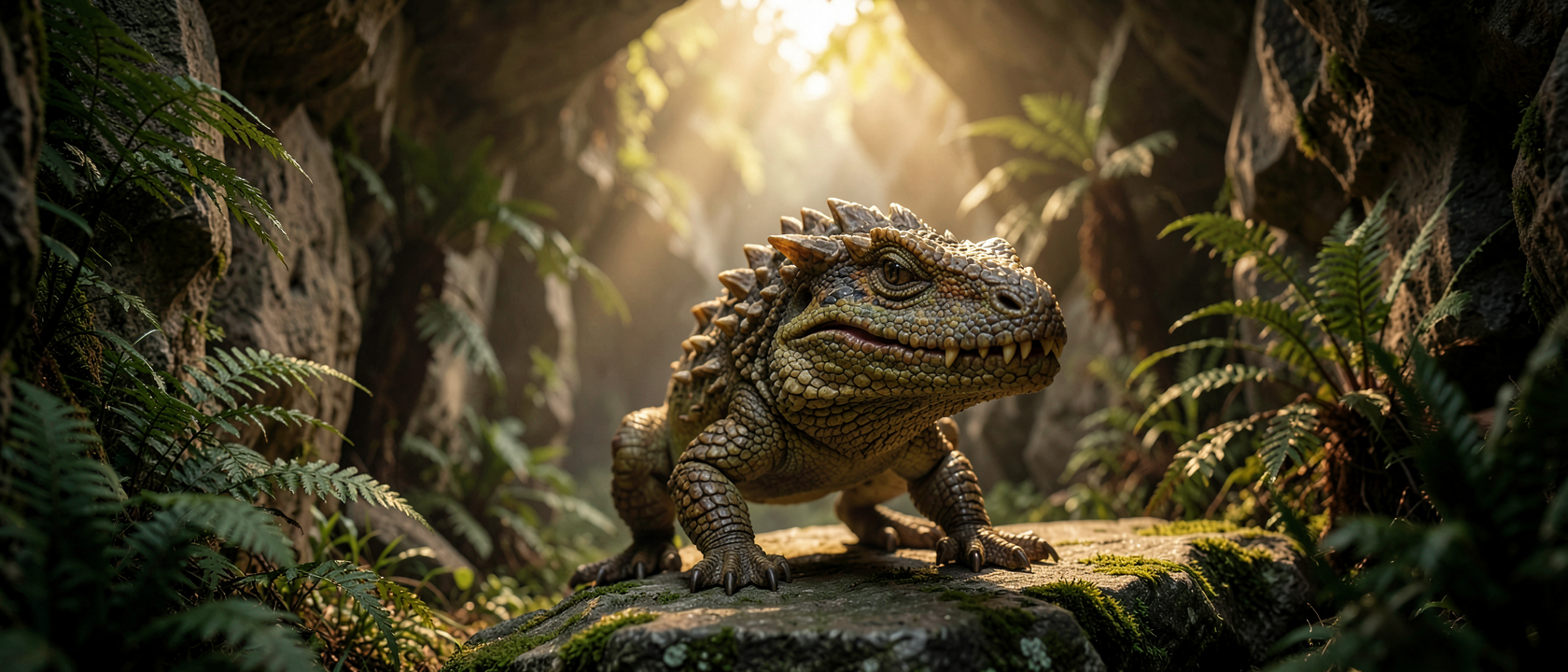
Meade has described Threordatoth as an animal that probably resembled a modern horned lizard: small, spike-headed, armored across the body, a picture built from more complete procolophonid relatives rather than from this species’ own skeleton. That resemblance is exactly the kind of thing that gets a fossil reptile mistaken for an early, primitive lizard.
It would be a mistake. Procolophonids are parareptiles, a branch of the reptile family tree that split off early and sits as a distant cousin to lizards, birds and every other living reptile group, not a close one. The lizard-shaped body is a product of convergent evolution: an unrelated lineage arriving at a similar shape because that shape works for a similar life, not because of shared ancestry. It looks the part. It is not the part.
The animal nobody has seen below the neck
Every piece of Threordatoth recovered so far is a jaw fragment: a maxilla here, a dentary there, the upper and lower jaw bones, never a skull, a limb or a single vertebra. Its size, its build, how much of that horned-lizard-style armor it actually carried, all of it is unknown, because small Triassic reptiles like this one rarely leave behind more than teeth and jaws.
Meade and his co-authors note that a large amount of fossil material from Cromhall Quarry has still not been examined. Procolophonids as a whole are currently known from just two fissure-fill sites, Cromhall and Ruthin Quarry in Wales, which means the group’s range and diversity are thinly sampled to begin with. More of Threordatoth, or something related to it, may already be sitting in a drawer.
A sinkhole, 200-odd million years ago
Meade has sketched out, by his own account a piece of speculation rather than a documented finding, what the scene might have looked like: Threordatoth scurrying through fissures and sinkholes in the rock of what is now South Gloucestershire, picking through plants and insects while keeping clear of early dinosaur relatives sharing the same Late Triassic landscape.
It is a picture built from four teeth and an unfused jaw joint, nothing more. The distance between a handful of fossil fragments split across four institutions and a small animal threading its way through a Triassic sinkhole is the whole story of what a jaw bone can and cannot tell you.
—
**Changes made:**, “Cromhall quarry” → “Cromhall Quarry” (and “Ruthin quarry” → “Ruthin Quarry”) for consistent capitalization of proper nouns, applied each instance. “points the same direction” → “points in the same direction” (missing preposition). “The lizard-shaped body is convergent evolution” → “The lizard-shaped body is a product of convergent evolution” (minor clarity/grammar fix, not altering meaning). No relative-to-today date references were present; all dates are already absolute, so no changes needed there. No subject–verb agreement, tense, homophone, or spelling errors found beyond the above.