
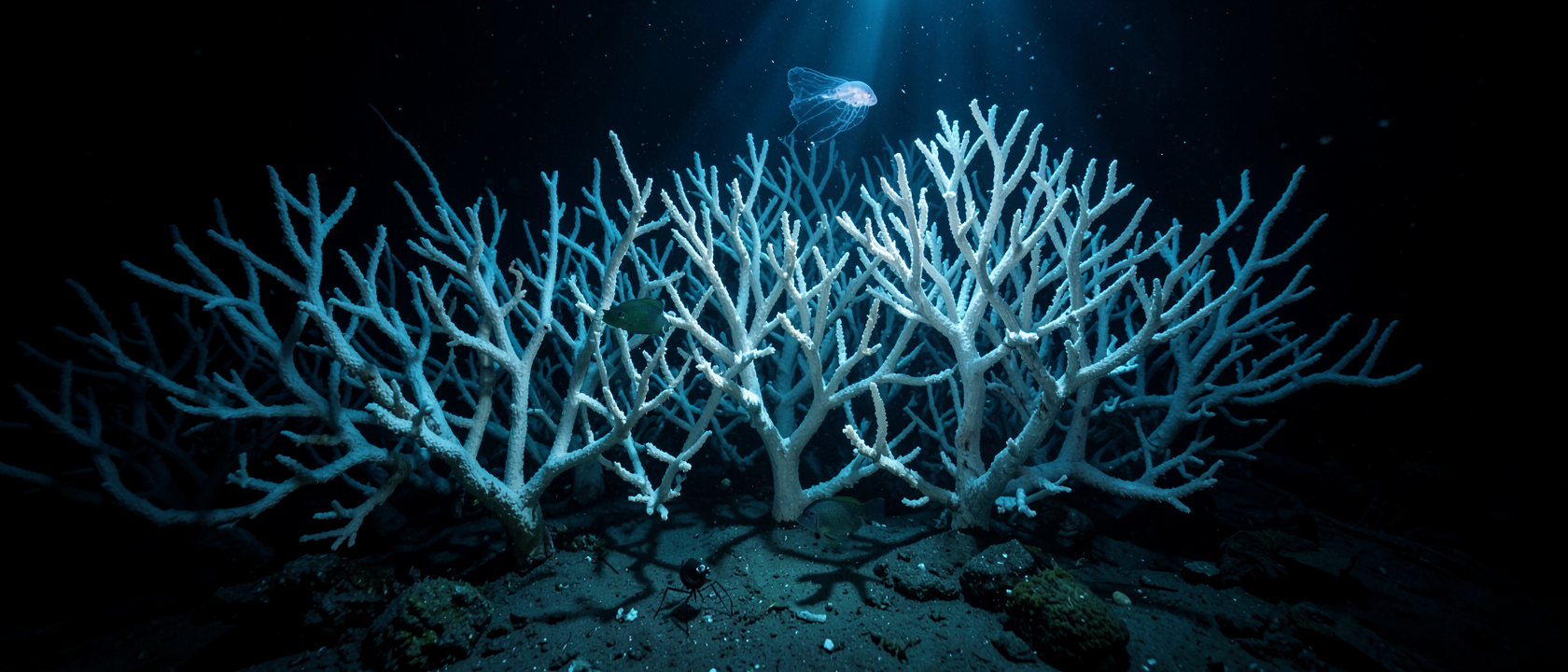
A Coral Mound the Size of 180 Football Fields, 984 Feet Down
Off Uruguay’s Atlantic coast, at a depth of 984 feet (300 meters), a single coral mound rises 131 feet (40 meters) out of the seafloor, part of a reef complex spanning roughly 0.5 square miles (1.3 square kilometers), an area the Schmidt Ocean Institute compares to more than 180 FIFA football fields laid end to end. The team that confirmed it, led by Dr. Alvar Carranza of the Universidad de la República and the Centro Universitario Regional del Este, found the structure using the ROV (remotely operated underwater robot) SuBastian, deployed from the research vessel R/V Falkor (too) on the institute’s 100th expedition, which ended September 19, 2025. Sonar mapping back in 2010 had hinted the reef was down there. Nobody had actually laid eyes on it until this dive. The coral building it, Desmophyllum pertusum, formerly classified as Lophelia pertusa, carries an official listing as vulnerable to extinction.
Two Feeding Systems Sharing One Reef
The reef sits exactly where warm and cold ocean currents collide, a mixing zone that pulls in temperate and subtropical species that would not normally cross paths. Desmophyllum pertusum feeds the ordinary coral way, filtering drifting particles out of the water above it. But right next to those mounds, the team found tube worms of the species Lamellibrachia victori living on a cold seep, a spot where methane leaks up through the seafloor. These worms run on an entirely different fuel: bacteria living inside their tissue convert that methane into usable energy, no sunlight or plankton required. Dr. Erik Cordes described this pairing, filter feeding tied to sunlight growing beside methane-powered chemosynthesis (energy built from chemical reactions instead of light), as the clearest example of the two systems side by side that he has seen outside the Gulf of Mexico.
A Giraffe in Antarctica, and 30 Species With No Name Yet
That same mixing zone produced a sighting Carranza still describes as startling: an ovulid sea snail caught feeding on gorgonian soft coral, a warm-water, tropical-style predator-prey relationship with no obvious business happening in cold Uruguayan water. Carranza compared it to finding a giraffe in Antarctica, his own phrase for something not impossible, just entirely off the map for where it turned up. The same 29-day expedition logged at least 30 species suspected to be new to science, among them sponges, snails, and crustaceans, plus hundreds of species, including crystal squids, the dumbo octopus, and tripod fish, never before recorded in Uruguayan waters at all. The mixing zone does not just let two feeding systems share a mound. It scrambles species distributions enough to put animals somewhere they statistically should not be.
“Vulnerable” Was Supposed to Mean Sparse
Desmophyllum pertusum was assessed as globally Vulnerable in the first-ever IUCN Red List evaluation of cold-water corals, published in the journal Marine Biodiversity in June 2025. Of 22 cold-water coral species reviewed across the Northeast Atlantic, it was the only one to land in that category. Bottom trawling has damaged an estimated 30 to 50 percent of regional reefs built by species like it, and because the coral grows slowly, its recovery is slow too, which is most of why its extinction risk is rated high. A listing like that suggests a population barely hanging on: thin, patchy, struggling. This one is the opposite. It is dense enough to build a 131-foot mound, wide enough to cover 0.5 square miles, and rich enough to host dozens of species nobody has formally described yet. A species can be globally at risk and locally thriving in the same year. Neither fact cancels the other.
One Confirmed Reef Just Became Two
Before this expedition, Uruguay had exactly one confirmed vulnerable marine ecosystem, or VME (a seafloor habitat protected for its fragility and ecological value), on the books. This reef is the second one now confirmed by direct observation. Researchers read that as a sign more are probably waiting to be found, since the 2010 sonar data only hinted at this reef and it took 15 years to actually send an ROV down to see coral instead of a shape on a screen. That is a working hypothesis, not a tally. No third reef has been confirmed. The roughly 30 candidate new species collected on the dive sit in the same spot: specimens with a strong hunch attached, waiting on the formal taxonomic work that would make any of them official.
A President at the Dock, a Country Watching the Seafloor Live
Before the R/V Falkor (too) left port, Uruguay’s President Yamandú Orsi came aboard to see the crew off, a detail Schmidt Ocean Institute Executive Director Dr. Jyotika Virmani later recounted as a head-of-state send-off for a science vessel, not a naval one. Once at sea, Dr. Leticia Burone pointed out that a live video feed from the ROV, called a divestream, let the Uruguayan public watch the coral, the tube worms, and the snail on the gorgonian appear on screen as SuBastian found them, rather than reading about it after the ship came home. It is the story of one voyage, not a description of how ocean science usually runs. The same expedition also spent a full day on the wreck of the ROU Uruguay, a World War II-era destroyer once the USS Baron, transferred to Uruguay in 1952 and sunk in a training exercise in 1995, now serving as its own reef, with checks for contaminants on that site still being worked through.