
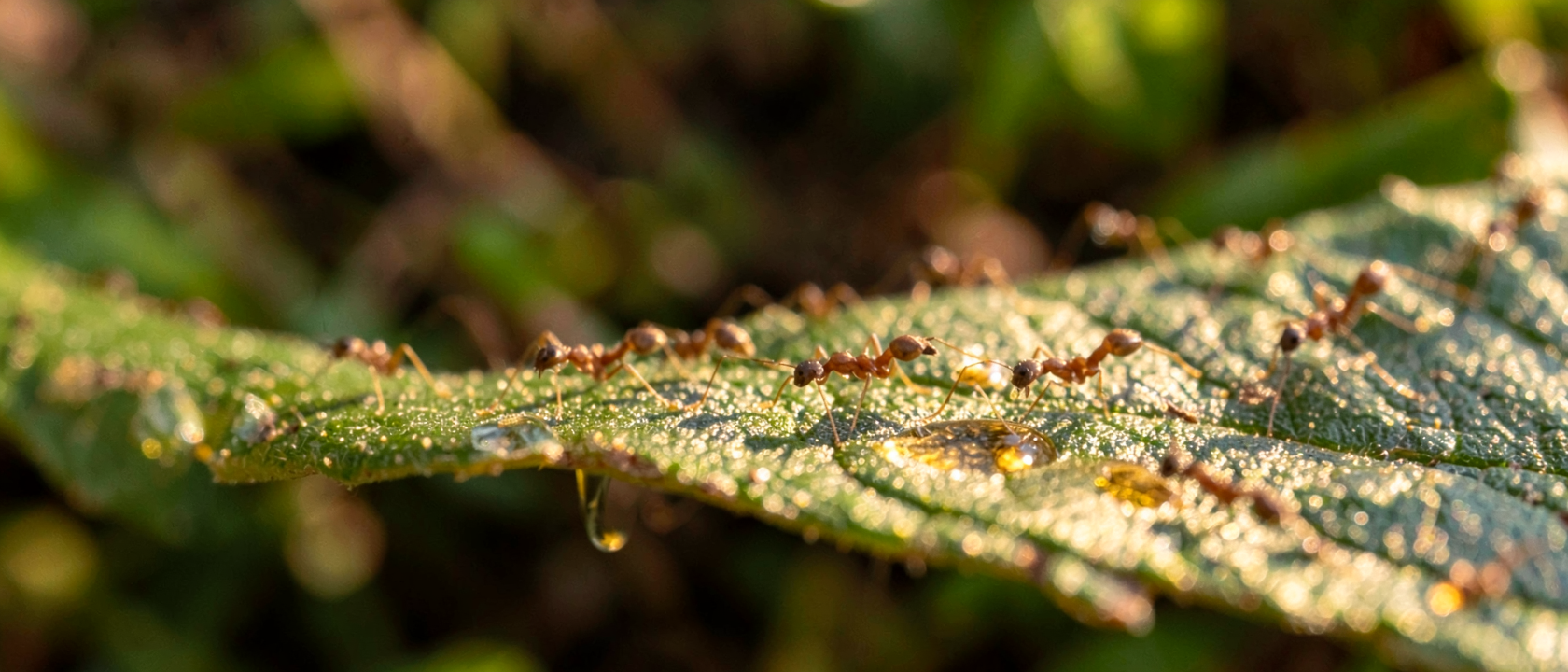
An Argentine ant (Linepithema humile) in a lab at the University of Regensburg took 300 seconds to find a drop of sugar water on its first crossing of the test arena. By its fourth crossing, after drinking the same sugar water laced with caffeine, it got there in 54 seconds. It did not run faster. It just stopped getting lost.
That single ant’s result sits inside a larger experiment. Henrique Galante and colleagues at the University of Regensburg, publishing in iScience in 2024, ran 142 Argentine ants through four trials each, sending them down a small Lego drawbridge onto a test surface to find a sucrose reward. Between trials, researchers let the ants offload their food and swapped out the paper surface, so no ant could just follow its own scent trail back. Some ants drank plain sugar water. Others got sugar water dosed with 25 parts per million (ppm) of caffeine, roughly what you’d find in a natural plant source, or 250 ppm, closer to an energy drink. Across the four trials, the 25 ppm group cut their foraging time per visit by 28%, and the 250 ppm group cut it by 38%. Ants drinking plain sugar barely improved at all over the same four runs.
Not faster. More precise.
The obvious guess is that caffeine revved the ants up, the way a shot of espresso makes a person twitchy and quick. The data says otherwise. Walking speed was identical across every dose. What changed was the shape of the route: caffeinated ants wandered less and took straighter, more direct paths to the reward as the trials went on. They weren’t covering ground faster. They were covering less of it.
The researchers found something else worth noting: the dose only mattered on the way out. Return trips to the nest showed no caffeine effect at all, and every ant, caffeinated or not, improved slightly at finding its way home over the four trials. That split points to caffeine acting on outbound learning specifically, the phase where an ant is building a mental map of a new food source, rather than on general alertness or movement. “What we see is that they’re not moving faster, they’re just being more focused on where they’re going,” Galante said. “This suggests that they know where they want to go, therefore, they have learned the locations of the reward.” In other words, the straighter paths look to the researchers like the signature of a memory doing its job, not a nervous system running hot.
Why a faster learner is a bigger threat to its own colony
Here’s the part that turns a tidy lab result into a pest-control strategy. An ant that locates a food source quickly lays its pheromone trail back to the nest sooner, which recruits nestmates to that source faster too. Galante and colleagues propose that in real bait, this could mean a toxicant spreads through an Argentine ant colony before the colony has had time to register it as dangerous and start avoiding it. Control efforts against this invasive species often fall short for exactly that reason: ants don’t keep eating the bait long enough for it to take down the colony. Caffeine, in this framing, isn’t a treat mixed in for its own sake. It’s a way to get the toxicant consumed and shared faster than the colony can learn to reject it. That’s the researchers’ proposed application, built on the foraging-time data. It is not yet a tested outcome in the field.
The myth this kills
The assumption that a stimulant makes an animal move faster, jitterier, more energetic on its feet, is exactly what this dataset contradicts. Pace never changed at any dose. Return-trip efficiency never changed either. The entire 28% to 38% drop in foraging time came from straighter paths and fewer wasted turns, a change in what the ants had learned, not in how hard their legs were working. “Sharper” and “quicker” look like the same word. In an Argentine ant’s nervous system, caffeine only touched one of them.
What’s still open
At the highest dose tested, 2,000 ppm, roughly the dose at which half of fed honeybees die (their LD50), the learning benefit disappeared entirely. Nobody has yet explained why; it may be that toxicity at that concentration overrides any cognitive gain, but that remains unconfirmed. Field trials of caffeine-laced bait are underway in Spain, according to the research team, testing whether a result built on a Lego drawbridge and a sheet of paper holds up outdoors, with real colonies and real competition for food. One question hasn’t been touched at all: how caffeine behaves chemically once it’s mixed with whatever actual poison goes into a working bait. Until that’s studied, the gap between a faster-learning ant in a lab and a dead colony in the field stays exactly that: a gap.
Which is the part worth remembering next time someone calls an animal “hyped up” on something. Speed and focus feel like the same trait from the outside. Inside a 2-to-3-millimeter ant’s brain, and maybe inside yours, they are not.