
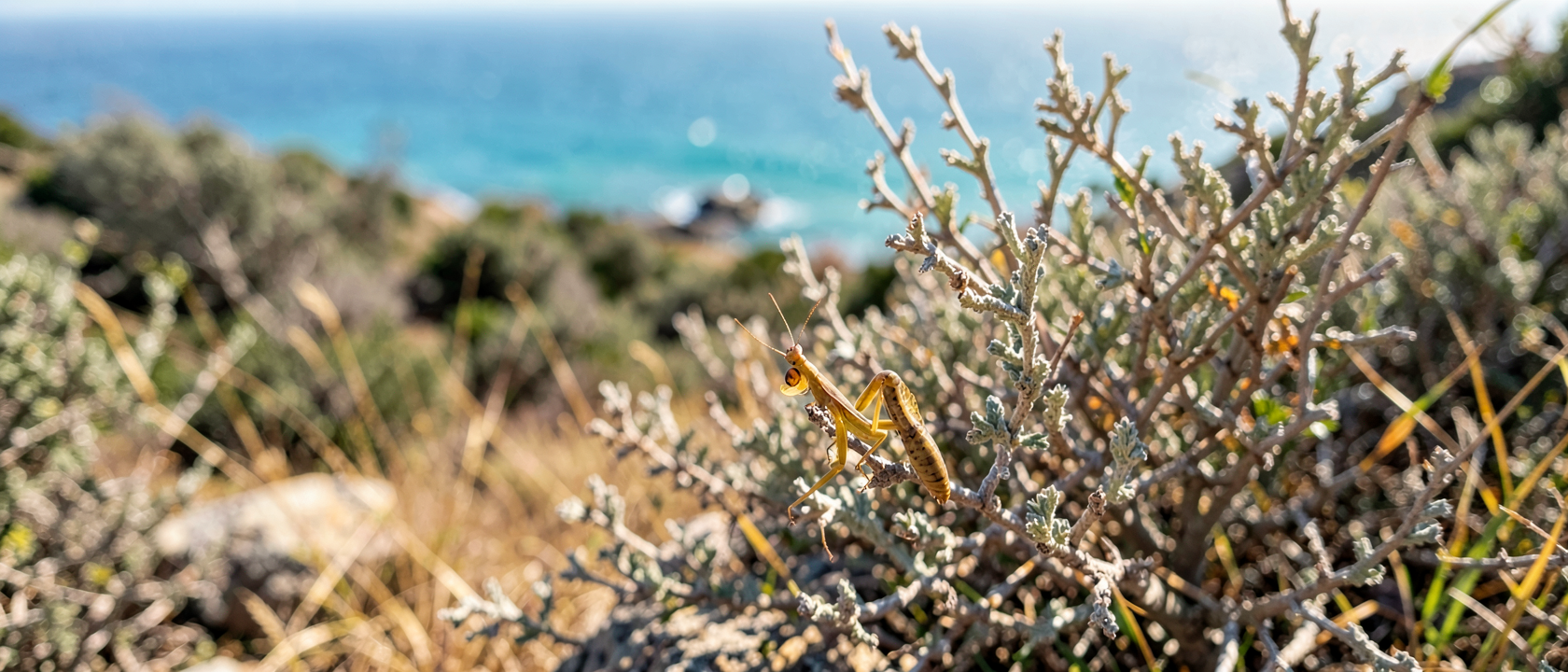
Everyone “knows” the mantis rule: she mates, then she eats him. A newly described Sardinian species just broke it. In lab trials of the snake-tail mantis (Ameles serpentiscauda), the female never once turned her partner into lunch.
A hunch on a beach towel
The species exists on paper because someone was paying attention on vacation. In summer 2024, Oscar Maioglio, a colleague of mantis researcher Roberto Battiston at the Museo di Archeologia e Scienze Naturali “G. Zannato” in Montecchio Maggiore, Italy, was on a remote stretch of Sardinia’s southwestern coast when he spotted dwarf mantises resting on shrubs. They looked like Ameles andreae, a known local species, except their wings were noticeably too small. He collected a few and brought them home for the lab to raise.
Genetic testing, paired with detailed body measurements and direct observation of behavior, confirmed it wasn’t andreae at all. It was a new species, body about 1 inch (2.5 cm) long, found along only a few hundred yards (a few hundred meters) of that one coastline. Oddly, the DNA still placed it as andreae’s closest known relative despite the wing difference, a sign that wing shape can shift fast within this group of mantises.
Zero bites
Sexual cannibalism is the one fact almost everyone knows about mantises: the female eats the male, during or after sex. It happens in plenty of species. It did not happen here. Battiston, Maioglio, and co-authors Simona Corneti, Giobbe Forni, and Andrea Luchetti reared Ameles serpentiscauda in the lab and watched it mate repeatedly, publishing the results in the journal Ethology Ecology & Evolution. Across every trial recorded, the female never ate the male.
The snake dance
Before approaching, the male performs something researchers had not documented in any other mantis species. He bends his abdomen up and down in a slow coil, snake-style, or jerks it in short bursts like a rattlesnake shaking its tail. The timing is specific, not random: the slow bending showed up in 10% of trials, and only when the female was already facing him. A different move, trembling his front legs, also turned up in 10% of trials, but it never led to mating. It led to the male backing off instead.
Other Ameles species manage the same risk a cruder way, just by how they move: mounting the female from behind, or creeping toward her slowly from the front, lets a male go unnoticed until it’s too late for her to react. The dance looks like a version of that same trick, built for a species in which the female watches the entire approach.
What nobody has proven yet
Two explanations are on the table, and neither is confirmed. The display might let the female check that the male belongs to her own species before she lets him near. Or it might work as a distraction, holding her attention long enough for him to get into position safely. Lohitashwa Garikipati, a mantis researcher at the American Museum of Natural History who was not involved in the study, notes that it is still unclear why natural selection favored this particular routine, since no close relative of Ameles serpentiscauda does anything like it.
A related question is just as open. Across Ameles species studied so far, nobody has identified what, if anything, a male actually reads on a female to judge how dangerous she is. Researchers suspect that mantises, built for camouflage and built to vanish, are simply hard to watch closely in the wild, which is likely a big part of why so much of their courtship behavior has gone undocumented until now.
There is no such thing as “the mantis”
Most people carry one image: a green insect, patient, guaranteed to eat whoever it mates with. Christopher Oufiero, who runs the Mantis Lab at Towson University, puts the real number at more than 2,400 described species worldwide. Dwarf mantises alone span huge variation in camouflage, size, and courtship behavior, some built to vanish as leaves, twigs, flowers, or moss. Sexual cannibalism is not a universal rule inside that group; rates swing wildly between species, and even between lab setups within the same species. Ameles serpentiscauda is one new data point in a genus that researchers are still in the middle of sorting out.
The entire known population lives along that same short Sardinian coastline, partly inside a protected area. Battiston, who coordinates the mantis section of the IUCN Red List, has proposed listing the species as critically endangered: rising tourism and grazing sheep and goats are pressing on the only ground it has.