
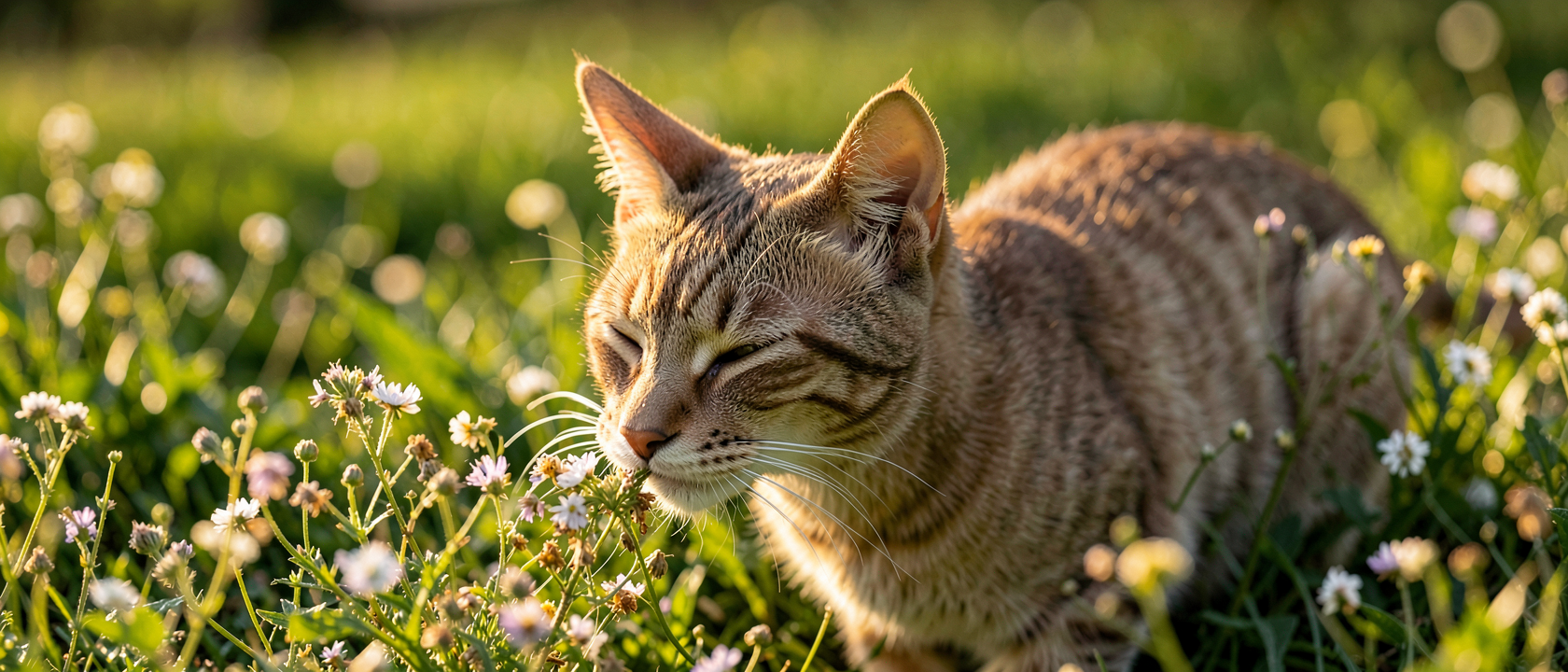
A single inhale from a house cat doesn’t travel through its nose as one sheet of air. It splits, immediately, into two separate streams: one slow current that gets cleaned and humidified before it ever reaches the lungs, and one fast, direct stream that shoots straight to the smell-processing tissue at the back of the skull. Researchers at Ohio State University, led by Zhenxing Wu with senior author Kai Zhao and co-authors from the Monell Chemical Senses Center, Waltham Petcare Science Institute, and the University of Pennsylvania, built the first detailed 3D micro-CT reconstruction of a domestic cat’s (Felis catus) nasal airway and modeled how air actually moves through it, publishing the work in PLOS Computational Biology on June 29, 2023. Their headline number: this two-stream layout makes the cat nose over 100 times more efficient at capturing odor than a straight, amphibian-like nasal tube of similar size.
A Nose Built Like a Chromatograph
The scans reveal a maze of thin, coiled bones called turbinates, lining the nasal cavity and branching over and over like the fins of a car radiator, packing in surface area. One stream of inhaled air runs across this grid on its way to the lungs, getting filtered and warmed. A second stream skips that slow process entirely, routed through a separate duct straight to the olfactory region in the rear of the nasal cavity, where the smell receptors live. And once odor-carrying air arrives there, it doesn’t just pass through once. It recirculates through parallel channels, giving the olfactory tissue a longer, repeated exposure instead of one quick pass. “It’s like you take a sniff, the air is shooting back there and then is being processed for a much longer time,” Zhao and colleagues explain. The gas-chromatography comparison for animal noses is not new; it dates to the 1960s, but earlier work focused on amphibians, whose nasal structure is far simpler. This is the first study to actually quantify that efficiency in a mammal and compare it across species. A smell neuroscientist not involved in the study, Luis Saraiva of Sidra Medicine in Qatar, noted after seeing the work that cats appear to pack in far more turbinate structure than rats or humans do.
Speed Over Dilution
The researchers propose a reason for the split: routing odor straight to the receptors, bypassing the slower filtering stream, lets a scent register before it gets diluted or degraded by mixing with conditioned air. They also tie the design to skull shape. A cat’s head is short and compact, with no room for a long, straight nasal passage the way a dog’s or an alligator’s skull allows. So instead of adding length, the turbinates appear to have coiled into a labyrinth, packing more processing surface into less space. The olfactory mucosa, the tissue lining that actually detects odor molecules, covers about 3 square inches (20 cm2) in the cat, some four to five times the area found in humans and only about half that of the average dog. By the same modeling, the researchers rank the structural complexity of the cat’s nose above a rodent’s and roughly on par with a dog’s, despite the cat’s much shorter snout. They even draw a comparison to the mammalian cochlea, the coiled inner-ear structure, noting that the ethmoid turbinates fold in a strikingly similar way. Coiling is known to sharpen hearing range in the cochlea; here, the authors argue it does something equivalent for smell.
Short Nose, Not a Small Nose
The obvious assumption is that a flat-faced, short-snouted animal must be a smell lightweight next to something like a dog with its long muzzle, or an alligator with its long, straight nasal passage. The model contradicts that directly. It suggests the alligator’s long-and-straight route and the cat’s short-and-coiled route land at comparable odor-processing efficiency, just by entirely different architecture. Length isn’t the variable that decides how well an animal smells. Internal complexity is, and a compact skull turns out to be no obstacle to it at all. Every cat curled up on a lap, looking like it has no room in that flat little face for much of anything, is carrying a nose engineered as carefully as a lab instrument.
What Still Isn’t Known
Every finding above comes from micro-CT imaging and computer simulation built around a single cat’s head, not from watching or measuring a live cat sniffing something in real conditions. There is no live-animal airflow data here, no behavioral test, no second cat for comparison. Whether this two-stream, recirculating design behaves the same way when an actual cat is working an actual scent trail hasn’t been measured. More broadly, Zhao points out that smell has simply had less attention than the other senses: “We know so much about vision and hearing, but not so much about the nose.” Whether the alligator’s convergence with this same chromatography-like efficiency reflects a shared ancestral trick or two unrelated solutions arriving at the same answer is also not settled by this study.
The Dog Aside
In discussing the findings, Zhao made a passing comparison to dogs’ reputation for tracking scent, the kind of remark that a dog can take one sniff and read what has passed through an area. It’s a rhetorical aside about smell in general, not a measurement, and not a claim tested in this cat study. The two-stream, coiled architecture described above belongs to the cat’s nose specifically; nobody scanned a dog’s turbinates here to check.