
**Corrected issues:**
1. “grew up and avoided music outright”, awkward phrasing, tightened to “avoided music outright as adults” for clarity (they were already described as adults).
2. “fewer/less”, “The more strongly a female’s auditory cortex responded… the less she liked it” is correct (uncountable liking), no change needed.
3. Minor comma and flow fix in the “Myth” section.
Otherwise, the text is clean: no subject–verb agreement errors, no article errors, tense is consistent (past tense for study description, appropriately used), no homophone errors, spelling is consistently American, punctuation and capitalization are correct, and there are no relative-to-today date violations (dates are given in absolute form: “accepted September 30, 2025 and posted online October 17, 2025”).
Here is the lightly corrected text:
Two Pups, Two Soundtracks, Two Adults
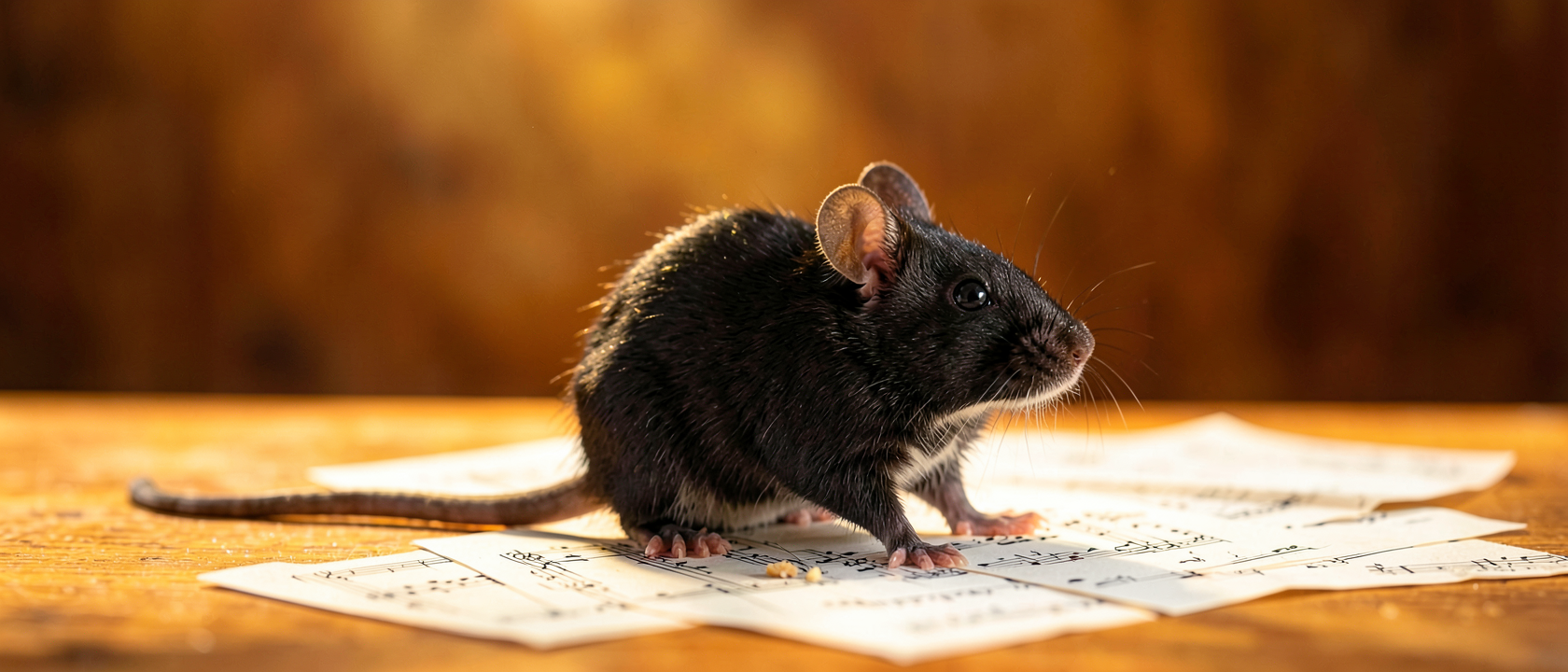
What a mouse pup hears in its first weeks appears to decide what it will call “music” for the rest of its life, and the effect splits hard by sex. A team at the Hebrew University of Jerusalem raised C57BL/6 house mice (Mus musculus), a black-coated laboratory strain about 3 to 4 inches long (7.5 to 10 cm), on one of three soundtracks during infancy: the first movement of Beethoven’s Ninth Symphony, a set of artificial non-music sounds, or silence. Kamini Sehrawat and Prof. Israel Nelken published the results in Cell Reports, accepted September 30, 2025 and posted online October 17, 2025. As adults, males raised on silence or artificial sound avoided music outright. Males raised on Beethoven split down the middle: a fair number of them actually came to prefer it.
Why It Only Shows Up in the Males
The two sexes told very different neural stories. In males, activity in the auditory cortex, the brain region that processes incoming sound, barely tracked whether an individual liked or avoided the symphony as an adult. Whatever was making that decision, it wasn’t happening in real time in that part of the brain. In females, the pattern reversed: auditory cortex activity did correlate with behavior, but backward from what most people would guess. The more strongly a female’s auditory cortex responded to the sound, the less she liked it. The study reports this negative correlation as robust in females and essentially absent in males. Same species, same stimulus, same yes-or-no choice to approach or avoid, and two decoupled routes getting there.
Two Strategies for Deciding What Sounds Good
Sehrawat and Nelken read this asymmetry as two different strategies for building a preference. In males, the researchers propose, preference gets shaped mostly by early familiarity: what a pup heard becomes the baseline of “safe,” and anything foreign later gets treated with suspicion, largely independent of what the cortex is doing at the moment of choice. In females, preference looks like it is generated live, from how intensely the cortex engages with the sound as it happens, rather than from a memory laid down in infancy. Nelken has said the findings suggest sound preference relies on mechanisms that operate differently by sex, and that understanding those differences could reveal how early sensory experience shapes emotional and cognitive development. Sehrawat, who ran the experiments, put it more directly: what looks like the same experience on the surface can trigger completely different neural adaptations depending on which sex is having it. Read that way, sex stops being a variable to average out of a dataset. It can be two separate mechanisms wearing one identical behavior as a disguise.
The Myth This Kills: “Animals Don’t Have Musical Taste”
This kills a lazy assumption that circulates constantly in pet-care content: that animal responses to sound are either uniform across individuals or fixed and instinctive for life. C57BL/6 mice exposed to the identical stimulus in the identical lab still ended up with individual variation, a developmental window that mattered, and a divergence by sex sharp enough to be the entire point of the paper. None of that is a claim about dogs, cats, or anything marketed as calming for a pet. This is mouse behavioral and neural data, specific to Mus musculus pups exposed during a window between postnatal day 7 and day 40.
What Nobody Knows Yet
The paper leaves real gaps open. It does not explain why male behavior and male cortical activity come apart in the first place, or why higher cortical activity in females tracks with less liking instead of more. It does not report exact sample sizes, the precise age at which adult preference was tested, or how long these preferences hold as the mice continue aging. And it does not say whether any of this generalizes beyond the C57BL/6 strain, or beyond Beethoven’s Ninth Symphony and the artificial sounds actually used. Sehrawat and Nelken are describing an operating difference between the sexes, not a fully mapped circuit.
From the Cage: Two Siblings, Two Opinions on Beethoven
Picture two littermates. The brother, raised in silence, hears the symphony come through a speaker and treats it like a car alarm: an intrusion, to be avoided at four paws’ distance. He isn’t being a critic. He’s defending the acoustic status quo he grew up with. His sister, a few cages over, has an auditory cortex lit up like a switchboard through the entire first movement, and by the study’s own numbers, that fireworks show correlates with her liking the piece less, not more. She is, arguably, the more sophisticated listener in the room. She is also, provably, the least impressed.