
The Restless Widow
When a rhesus macaque (Macaca mulatta) mother on Cayo Santiago, Puerto Rico, loses her infant, she doesn’t shut down. She speeds up. A 2025 study in Biology Letters, led by Emily A. Johnson at University College London with Flóra Talyigás and Alecia Carter, followed 11 rhesus macaque mothers on the island after each lost an infant, comparing them against 11 non-bereaved mothers over the following 16 days. The bereaved mothers rested significantly less than the controls did, not more. That is the opposite of what a “grieving animal” is supposed to look like, and it’s the opposite of what the researchers themselves expected to find.
What They Actually Counted
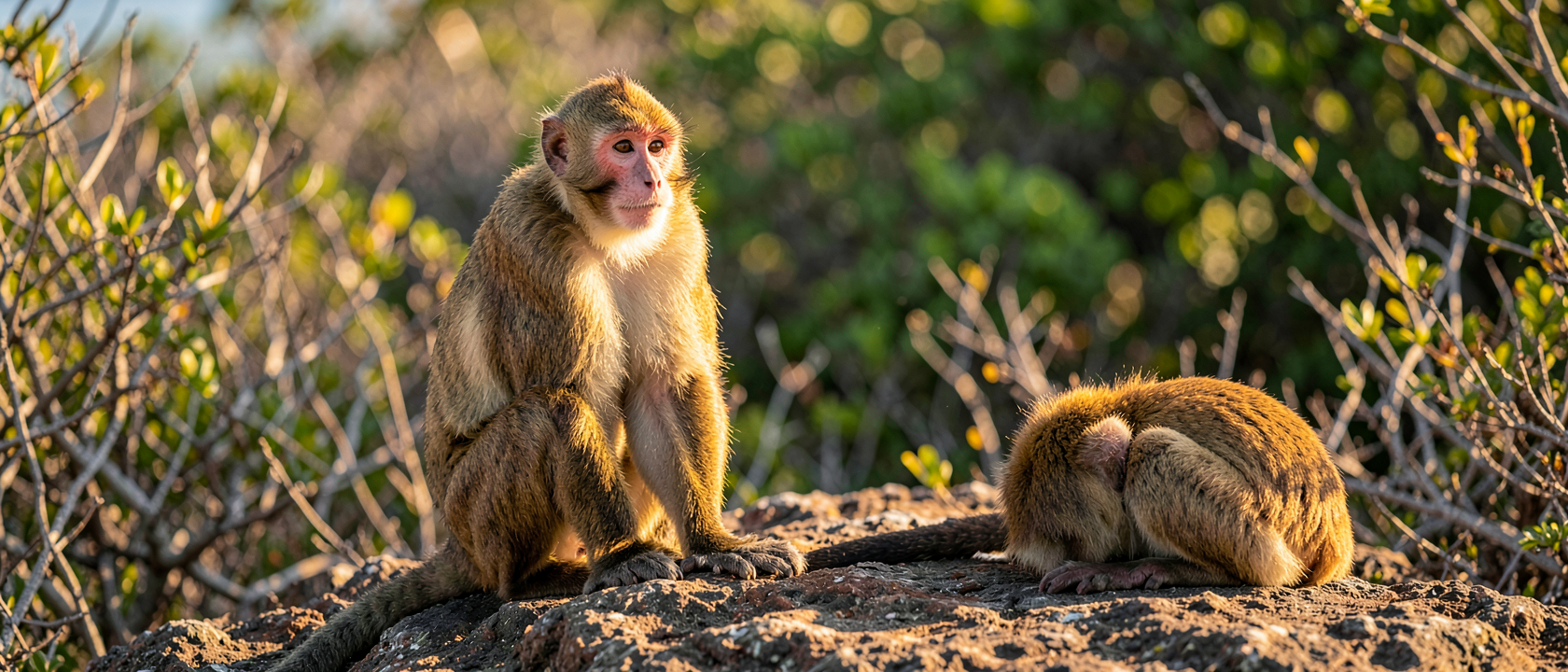
Cayo Santiago is a free-ranging, provisioned colony run by the Caribbean Primate Research Center, home to rhesus macaques with brown-to-golden fur and bare pinkish-red faces. These are wild-living animals, not a domestic line, so there’s no breed to speak of. Researchers walked the island with smartphones running CyberTracker software, logging each mother’s behavior into four categories: resting (sleep, relaxed posture, sitting still), feeding, grooming, and displacement behaviors. That last category covers the macaque equivalent of fidgeting: pacing, self-touching, extra self-grooming, restless movement. Across the full 16-day window, only one of those four categories separated the two groups: feeding, grooming, and displacement behavior all matched between bereaved and non-bereaved mothers, while resting time was the single measurable difference, and it ran lower in the bereaved group. Nothing collapsed across the board. One specific behavior dropped, and everything else held steady.
A Short, Loud Protest
The authors read this restlessness as an early “protest” phase, a pattern already documented in decades of primate research on mothers separated from their infants: an initial burst of agitation, movement, searching. What makes the Cayo Santiago result notable is what didn’t follow. In classic separation studies, protest that runs on too long can tip into a “despair” phase, marked by exactly the lethargy people expect from grief. That never showed up here. By the end of the 16-day observation period, roughly two weeks after most of these mothers lost their infants, their behavior looked statistically the same as the non-bereaved mothers’. Feeding never dropped. Energy levels never sank and stayed there. The restlessness was loud, and then it was over. The authors’ reading, offered as an interpretation rather than a settled fact, is that rhesus macaques may run through a loss on a shorter behavioral clock than humans do, not a fainter version of the same clock.
Your Cat Is Not Doing This
Here’s the assumption this study actually breaks: that animal grief has to look like human grief, meaning lethargy, appetite loss, withdrawal, the dog lying by the door, the cat that won’t eat. Those stories are real, and the researchers don’t dispute what owners have seen with their own eyes. But they raise a pointed caution alongside it: such reports usually come from people who are themselves grieving, and a surviving pet’s drop in activity could just as easily track the loss of a playmate, or a quieter house, or a broken routine, as it could anything resembling grief in the human sense. Consider it as a purely illustrative example: a dog goes off its food for a week after a companion animal dies. That may be an entirely accurate description of what happened in the house. It is not, by itself, evidence of what people usually assume it proves. In the one primate species where this has actually been measured against a control group, the signature of loss ran the other way: more movement, not less.
The Question Nobody Can Answer Yet
Johnson and her coauthors describe this as the first systematic test of human-like grief markers in a primate, which also means there’s barely anything else to check it against. Earlier work points in different directions rather than converging toward one answer. A study of wild chacma baboons found a spike in fecal glucocorticoids, a stress hormone marker, in the month after a female lost a close relative to predation. A separate retrospective study of 18 bonnet macaque (Macaca radiata) mothers found more self-directed behavior and more vocalizing after infant deaths, not less. Three primate species, three different behavioral pictures. The Cayo Santiago study measured outward behavior only; it says nothing about whether a rhesus macaque mother feels anything resembling loss inside that restlessness. Johnson herself frames the open question plainly: is grief a uniquely human experience? Restlessness without a despair phase could mean a fast recovery. It could also mean scientists have been looking for the wrong markers in a species that never grieves the way the word was built to describe. Both possibilities stay on the table, and that gap between what an animal does and what it feels is exactly the part worth sitting with the next time a video promises to show you an animal in mourning.