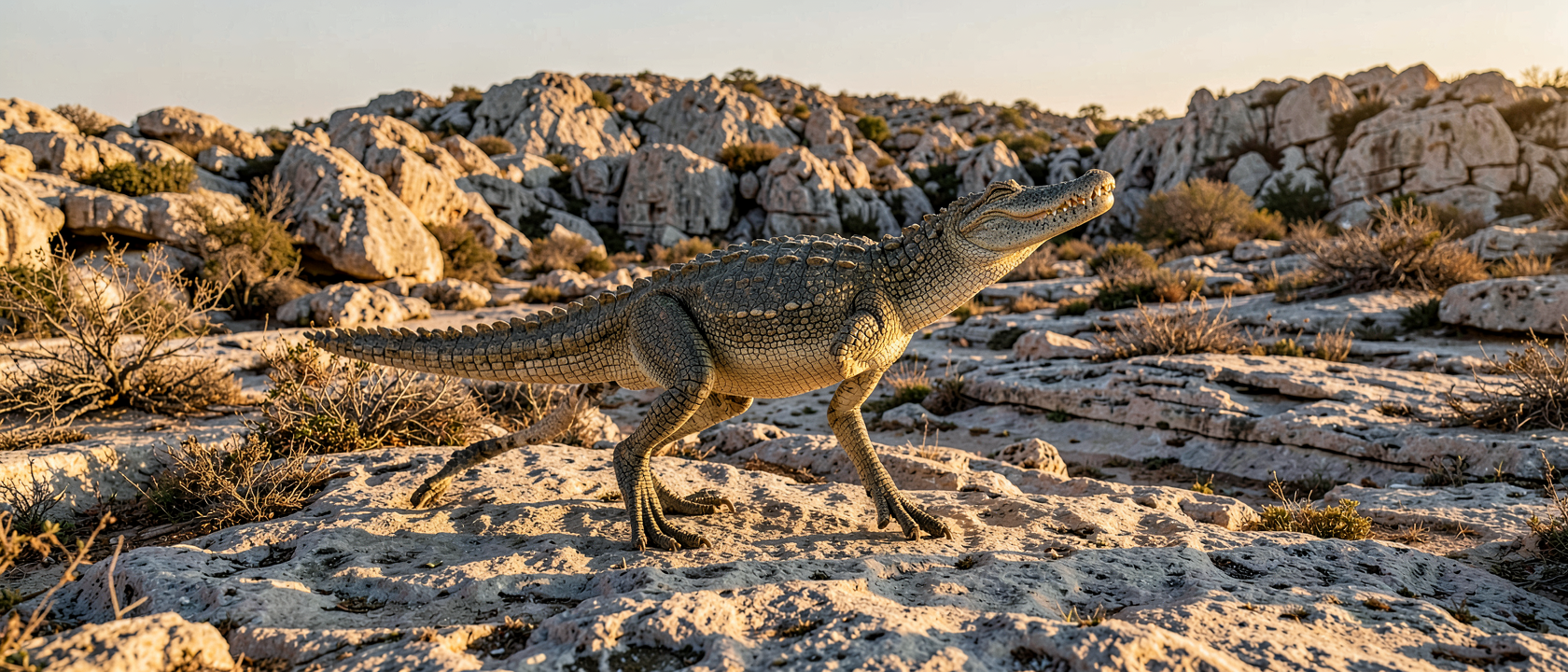
A greyhound with scales, 215 million years old
Galahadosuchus jonesi ran on long, slender legs across dry ground 215 million years ago, built more like a greyhound than anything you would call a crocodile. Ewan Bodenham, a PhD researcher at the Natural History Museum in London and University College London, has formally named it as a new species in a paper in the journal The Anatomical Record, co-authored with Stephan Spiekman, Susannah Maidment, Paul Upchurch, and Philip Mannion. The bones came out of Late Triassic fissure deposits on both sides of the Bristol Channel, cracks in limestone in southern Wales and southwest England where animals that died on the surface washed in and were buried, in this case at Cromhall Quarry in Gloucestershire. The skeleton itself was pulled from the ground back in 1969 by collector Ron Croucher and has sat in the collections ever since, cataloged as NHMUK PV R 10002. Galahadosuchus belongs to Crocodylomorpha, the group that contains modern crocodiles and every one of their closest fossil relatives, but for most of a century nobody knew this particular skeleton had a new species inside it.
Built to run, not to crawl
The specimen preserves most of the hind limbs, a nearly complete forelimb, and a run of tail vertebrae. The limbs are slender and elongated, and they sat upright under the body rather than sprawled to the sides the way a modern crocodile’s do, a stance built for covering ground fast rather than dragging a belly through mud. For decades this exact skeleton was filed as another example of Terrestrisuchus, a similarly built crocodylomorph known from the same fissures; the two look alike enough at a glance that the mismatch went unnoticed until Bodenham reviewed it for his doctoral research. What he found was 13 specific anatomical differences, several of them in the wrists, where Galahadosuchus carries carpal bones that are shorter and stockier than Terrestrisuchus’s. The team also ran the skeleton through a phylogenetic analysis alongside 39 other operational taxonomic units scored across 138 skeletal features; under the standard method for building family trees from anatomy, it came out as Terrestrisuchus’s sister species, the two of them grouping with a German species, Saltoposuchus connectens, in a family called Saltoposuchidae. Thirteen measured differences, checked against a known relative bone by bone, is what actually separates a new species from a mislabeled one.
What the running was for
Bodenham’s team reads Galahadosuchus as a fast-moving predator, chasing down small reptiles, amphibians, and early mammals across an upland landscape bordered by hot, arid plains, the setting reconstructed from the fissure deposits themselves. That reading reaches past one skeleton. It says the earliest crocodylomorphs were not a single design waiting to become “the crocodile.” They split early into different ways of making a living, and agile land-hunting was one of them, well before the branch that became slow, semi-aquatic ambush hunters ever broke off. Knowing that changes what a fossil like this one is worth looking at for: not a smaller, older crocodile, but evidence that the group tried out several body plans before any one of them became familiar.
Why “crocodile relative” doesn’t mean crocodile
Say “crocodylomorph” and most people picture armor plating, a low sprawl, and a body parked in water waiting to ambush something. Galahadosuchus contradicts that on every point. Its osteoderms, the small bony plates set in the skin, carry only a scattering of shallow pits around a low ridge, nothing close to the heavy armor of other early crocodylomorphs, and its stance was upright, not sprawled. Long, slender legs, held under the body, with no feature suited to a life in the water: that is the actual animal. Belonging to Crocodylomorpha is a position on a family tree. It is not a body plan, and it never predicted one.
What Bodenham doesn’t know yet
Bodenham’s PhD research is still working out exactly where Galahadosuchus and its close relatives sit on the broader crocodylomorph family tree. Genuinely unresolved too: whether the anatomical gaps between Galahadosuchus and Terrestrisuchus, in the limbs and especially the wrists, reflect real differences in how each animal actually moved. The paper raises that possibility without claiming to have proven it. Also open is how these fast-legged, land-hunting crocodylomorphs fared through the Triassic-Jurassic mass extinction that followed their time, an event tied to volcanic activity and climate upheaval; the fissure deposits capture the landscape just before that event, not what happened after it. Even the animal’s overall size is not pinned down, since the skeleton preserves only the limbs and tail, not enough to give a full-body measurement.
A knight, and a physics teacher from Cardigan
The name carries two stories at once. “Galahado-” nods to Sir Galahad, the Arthurian knight remembered for standing tall and upright, a reference to the animal’s stance rather than its temperament. “-jonesi” honors David Rhys Jones, who taught physics to Bodenham at Ysgol Uwchradd Aberteifi, a secondary school in Cardigan, Wales. In Bodenham’s own telling, Jones was funny, genuinely into the subject, and part of why a physics class in Cardigan turned into a career spent reading 215-million-year-old wrist bones.