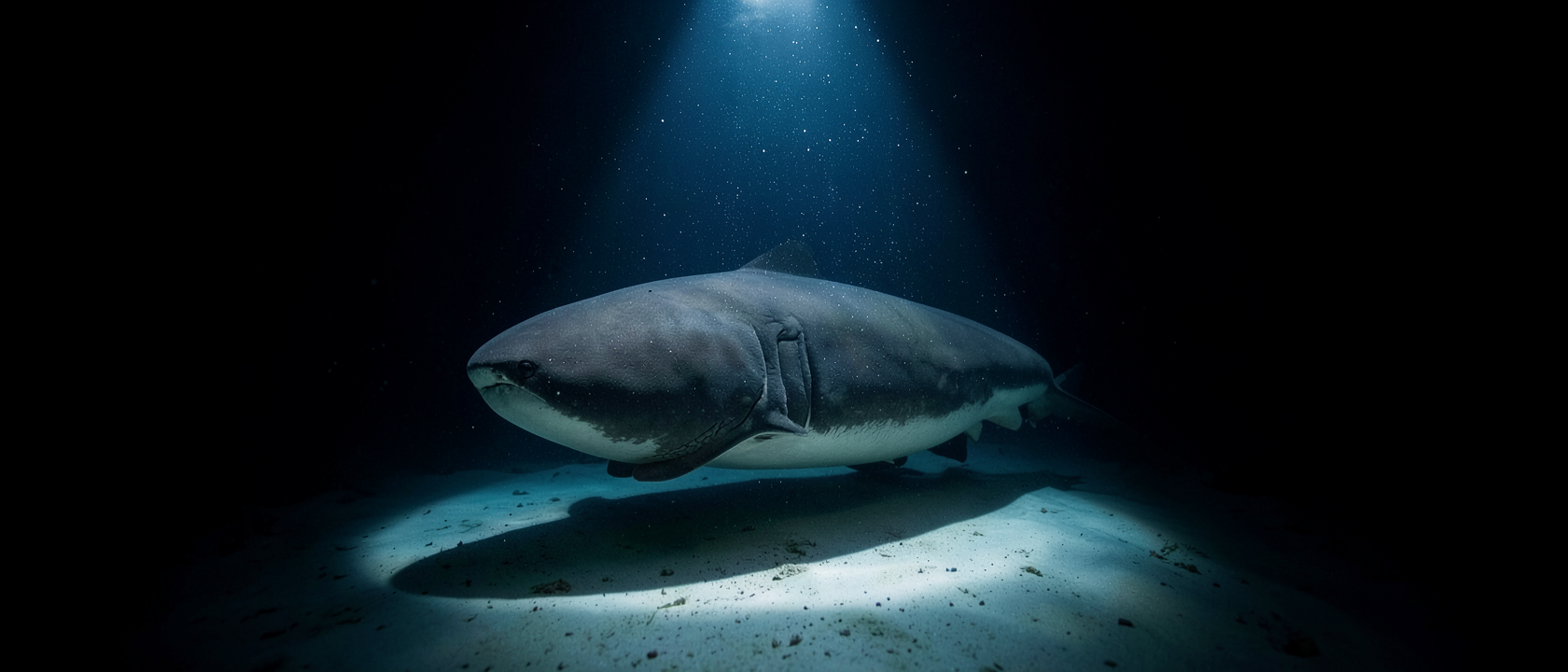
The Shark That Wasn’t Supposed to Be There
In January 2025, a baited camera dropped by Alan Jamieson’s team hit the seafloor 1,608 feet (490 meters) down, off Antarctica’s South Shetland Islands, in water sitting at a near-freezing 34.29°F (1.27°C). A shark crossed into frame: 10 to 13 feet (3 to 4 meters) long, gliding low over the mud. No shark had ever been recorded in Antarctic waters before this, not a tooth dredged from sediment, not a fossil, not a fin spotted from a boat. This was a living animal, filmed on the bottom of the Southern Ocean.
The footage came out of a 64-day research cruise run by the Minderoo-UWA Deep-Sea Research Centre at the University of Western Australia, which logged 840 hours of seafloor video across 63 camera drops in the trench. Jamieson’s team sat on the recording for more than a year before releasing it in February 2026. Peter Kyne, a conservation biologist at Charles Darwin University who had no part in the expedition, reviewed the footage independently and agreed: nobody had ever documented a shark this far south.
Their best guess is Somniosus antarcticus, the Antarctic sleeper shark, a species known from only a handful of collected specimens and never filmed alive in its own ocean before now. Environmental DNA collected on the same cruise may eventually confirm the identification.
How to Run a Body at Freezing
Somniosus antarcticus belongs to the sleeper shark family, Somniosidae. Its best-studied relative, the Greenland shark (Somniosus microcephalus, same genus), cruises at under 1.9 mph (3 km/h) and adds less than 0.4 inches (1 cm) of length a year, one of the slowest metabolisms ever measured in a vertebrate.
That slowness runs on a chemical fix shared across the family. Sleeper sharks carry unusually high concentrations of urea in their tissues to hold their internal fluids in balance with seawater, but urea destabilizes proteins at high concentrations, making the molecular machinery inside a cell come apart. Every shark carries some trimethylamine N-oxide (TMAO), a compound that keeps folded proteins stable. Sleeper sharks carry far more of it, enough to cancel out their own urea load and keep their cells running in water that would seize up most other animals’ chemistry.
The Chemistry That Also Stops Time
In the Greenland shark, that same biochemical setup seems to do double duty. Genome research on Somniosus microcephalus has found duplicated genes tied to DNA repair, immune defense, and protection against oxidative stress, the kind of cellular wear that builds up with age. Those genes are the leading explanation for why Greenland sharks can live past 400 years, longer than any other known vertebrate.
That finding belongs to the Greenland shark, not yet to the animal filmed off the South Shetland Islands. But the two are close relatives in the same genus, and the pattern is hard to ignore: whatever keeps a sleeper shark’s proteins intact at 34.29°F might be part of the same system slowing the damage that adds up to old age. Cold tolerance and an almost unheard-of lifespan may not be two separate adaptations in this family, they may be one system, doing two jobs.
Antarctica Was Supposed to Be Shark-Free
For decades, the working assumption in marine biology was that sharks were temperate-to-tropical animals, full stop, and that the Southern Ocean sat outside their range entirely. That is the myth this footage kills. Jamieson’s team went looking for something else and did not expect a shark to show up at all; one sighting was enough to overturn the assumption outright.
Jamieson is careful not to push the conclusion further than the evidence allows. The Antarctic Ocean is stratified down to roughly 3,280 feet (1,000 meters): cold, dense water sits below meltwater and lighter layers above, and the layers resist mixing. The shark held steady around 1,640 feet (500 meters), on a seabed sloping down into much colder water, in what happened to be the warmest band in that stack. Jamieson’s reading is that the shark found a localized pocket of warmer water to travel through, not that sleeper sharks live in the Southern Ocean as a matter of course.
One Shark, or a Whole Hidden Population?
The species identification is still a guess. Somniosus antarcticus is the best match for what the footage shows, but video alone cannot confirm it; that will depend on the environmental DNA samples collected on the same cruise.
Nobody knows whether this shark was a single wanderer that pushed farther south than its species usually goes, or a sign of a resident population nobody had noticed. Kyne has floated the idea that warming oceans could be pushing sharks toward colder southern waters generally, while also pointing out how thin the range data for this region is, simply because it is so hard to reach. A slow-moving sleeper shark could have lived around Antarctica for a long time without ever crossing a camera’s field of view. And if a population is really there, whether it is confined to this one trench near the South Shetland Islands or spread around the rest of the continent is a question nobody can currently answer.
Twenty-Five Years, Four Sharks
Jamieson told the Associated Press his team went in with a working rule: no sharks in Antarctica. “It’s not even a little one either,” he said. “It’s a hunk of a shark. These things are tanks.” Over 25 years of deep-sea fieldwork around the world, Jamieson has personally come across only four sleeper sharks. By his own account, this one, in a place none were supposed to be at all, is astronomically rare, not just a first for the continent, but a rare event for someone whose entire job is finding rare things at the bottom of the ocean.