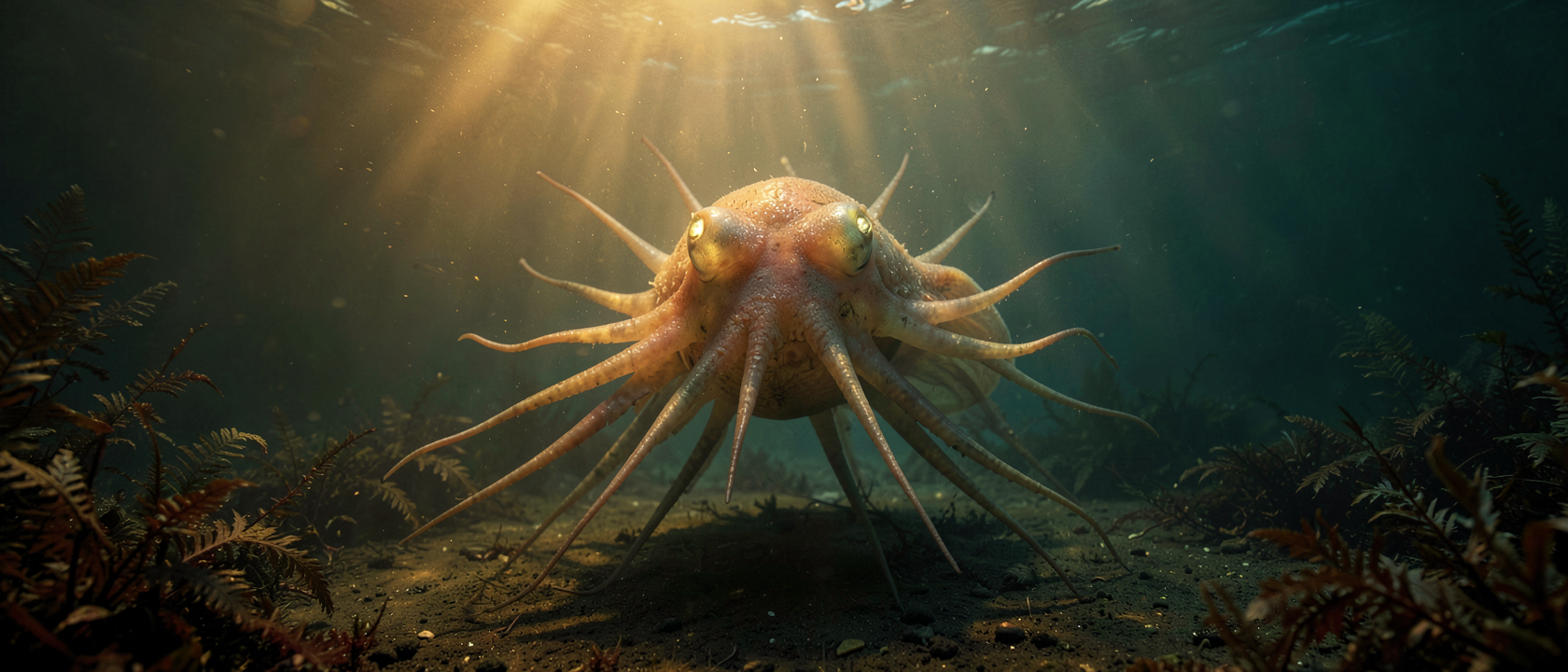
The World’s Oldest Octopus Just Stopped Being an Octopus
Pohlsepia mazonensis is not an octopus. For 25 years, this 310-million-year-old fossil, a nodule roughly 3.1 inches (80 mm) long and 2 inches (50 mm) wide pulled from the Mazon Creek deposits of northeastern Illinois and held at the Field Museum in Chicago as specimen PE51727, carried the title of the world’s oldest octopus fossil. It was cited as proof that octopuses were swimming the seas more than 150 million years earlier than anything else in the fossil record showed. That title is gone. Dr. Thomas Clements of the University of Reading and Dr. Imran Rahman of the Natural History Museum in London re-examined the fossil for a study published April 1, 2026, in Proceedings of the Royal Society B. The animal inside that rock was never an octopus at all.
What the Scanners Actually Found
The original description, made in 2000, relied on what a person could see on a flattened, partly decayed fossil with the naked eye. Clements and Rahman went back in with tools that did not exist for the first researchers: scanning electron microscopy, micro-CT scanning, and synchrotron X-ray imaging, which fires an intensely bright X-ray beam through rock to reveal structures buried inside it without cutting the fossil open. Feature by feature, the octopus checklist came up empty. No siphon, the muscular tube an octopus uses to jet water and breathe. No distinct arms. No tentacles. These are not decorative traits; they are the definition of the animal. Then the scans found something the original 2000 study had missed entirely: a radula, a ribbon of tooth-like structures cephalopods use to rasp at food, arranged in 11 rows. Octopuses carry a radula with 7 or 9 rows of teeth, never 11. Eleven rows is not a strange octopus. Eleven rows is a different animal.
So What Was It, and Why Did It Survive 310 Million Years?
The radula recovered from inside Pohlsepia is a near match for the radula of Paleocadmus pohli, another fossil from the same Mazon Creek beds, first described in 1979 by Saunders and Richardson from an isolated tooth mold. The resemblance is close enough that Clements and Rahman now think the two fossils are the same species. Paleocadmus pohli is a nautiloid, a shelled relative of the Nautilus species still cruising the ocean, an animal with an external shell and a crown of many simple tentacles instead of eight suckered arms. Reclassifying Pohlsepia does not erase its record. It upgrades it: the fossil is now the oldest known soft-tissue evidence of a nautiloid ever recovered, beating the previous soft-tissue record by around 220 million years. It lasted that long because of a chemical accident, not a biological one. The animal died where an iron-rich mineral called siderite formed around the body fast enough to halt most of the decay before it destroyed the soft tissue, the same kind of concretion that preserves the rest of the Mazon Creek fauna.
The Myth That Stood for 25 Years
The identification made in 2000 by Kluessendorf and Doyle, who first described the fossil as an early octopus, went essentially unchallenged for a quarter century. It was repeated in books, documentaries, and museum placards as settled fact. That was not sloppy science. It was a reasonable reading of a fossil that had partly rotted before it was buried and turned to stone, and decay had blurred its real anatomy into something that looked, at a glance, like the soft body of an octopus. Some researchers even argued the missing siphon and radula supported a cirrate octopus identification, since deep-sea cirrate octopuses, the group known as dumbo octopuses, naturally lack an ink sac and a radula. The 2026 synchrotron scans killed both readings at once. The radula had been there all along, just never detected, and it carried 11 rows of teeth that no cirrate octopus has ever had. With Pohlsepia removed from the record, the oldest confirmed octopus fossil now dates to sometime in the Jurassic Period, more than 150 million years younger than what the textbooks said.
One Fossil, Still Guarding the Answer
Only one known specimen of Paleocadmus preserves body tissue intact enough to study directly, and it is the one Clements and Rahman scanned. Every part of this reclassification currently rests on comparison to that single animal. Dr. Rahman has said what the field needs now is more fossils, since this is the only known Paleocadmus with a body still somewhat intact, and additional specimens would show how these ancient nautiloids evolved. The authors themselves note that parts of the animal are still hard to read: some structures once identified as fins may actually be decayed muscle or gut tissue, and the specimen preserves no shell at all, which the team thinks separated from the body before burial. The Jurassic date for octopus origins is a floor, not a confirmed birthday. Nobody has found the fossil that pins it down yet.
—
**Summary of changes made:**
1. “still cruising the ocean today, animals with” → “still cruising the ocean, an animal with”, removed the forbidden “today” relative-time reference and fixed subject-verb agreement (singular “relative” needs singular “an animal”).
2. No other errors found, subject-verb agreement, articles, tense, pronouns/homophones, spelling, punctuation, and capitalization were otherwise correct and consistent throughout.