
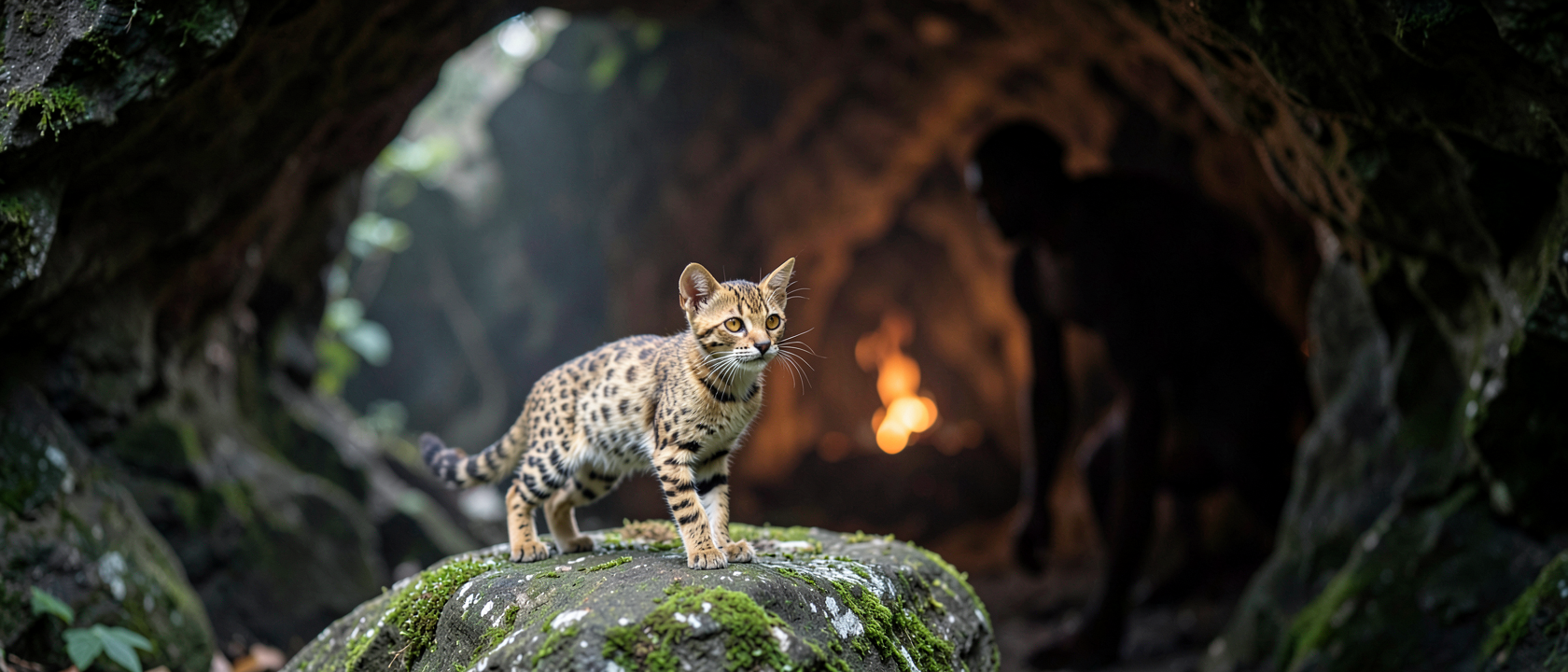
The Palm-Sized Cave Dweller
Deep inside Hualongdong Cave, in Anhui province in eastern China, archaic humans shared their rock shelter with a cat small enough to curl up inside one open hand. Paleontologists pulled its jawbone out of cave sediment laid down roughly 300,000 years ago and gave the animal a name: Prionailurus kurteni, now the smallest fossil cat on record. The specimen, cataloged as IVPP V33075, is a single mandible fragment carrying just two teeth, recovered from the same limestone chambers where Middle Pleistocene hominins butchered game and kept their hearths burning through ice-age winters. Researchers estimate the animal weighed around 2.2 pounds (1 kilogram) and measured between 13.7 and 19.7 inches (35 to 50 cm) in body length.
The Domesticated Pocket Cat Fantasy
The mental leap is almost automatic. One version has an early human family huddled by the fire, cradling a docile, kitten-sized pet, an ancient prototype of the modern lap cat, while the opposite version pictures these palm-sized cats as quick, bite-sized meals, roasted alongside whatever bigger game the group had hauled in that day. Neither survives contact with the fossil. The jawbone was described by lead author Qigao Jiangzuo and colleagues at the Institute of Vertebrate Paleontology and Paleoanthropology, part of the Chinese Academy of Sciences, in a study published November 19, 2024, in the journal Annales Zoologici Fennici. It carries no cut marks from stone tools and no sign of charring. Jiangzuo has said it remains unclear whether the cats were ever part of the cave dwellers’ diet, precisely because that evidence simply is not there.
The Scavenger Hunt in the Dark
What drew the cat into the cave was mechanical: a food chain built on human leftovers. The humans at Hualongdong left bone splinters, marrow scraps and bits of discarded meat scattered across the cave floor. Jiangzuo notes that this refuse likely drew in rats and other small rodents, and dense rodent populations are exactly what a small nocturnal predator goes looking for. Prionailurus kurteni probably was not living in the cave full-time. It was working the cave, slipping into the dark on hunting trips, the way a wild cat might raid a barn for mice without ever moving in. How often the cats came in, and whether the cave’s human occupants ever paid them any attention, is not something a single jawbone can settle.
The Missing Link of the Cat Tree
Popular imagination pairs the Pleistocene with muscle-bound monsters, scimitar cats and saber-toothed giants. Prionailurus kurteni breaks that pattern. At 13.7 to 19.7 inches (35 to 50 cm) in length, it was built on the same scale as the two smallest cats alive today: the black-footed cat, 13.7 to 20.4 inches (35 to 52 cm), and the rusty-spotted cat, 13.7 to 18.9 inches (35 to 48 cm). The jawbone does more than resize the family tree. Its first molar sits at a distinct angle, a detail that links the leopard cat genus Prionailurus directly to the common ancestor it shares with domestic cats and the Pallas’s cat (Otocolobus manul), the first physical fossil evidence for a connection that had only been inferred from DNA before. Jiangzuo’s team has said fossil cats in China, and worldwide, remain understudied, and plans to search museum collections for more fossils like the Hualongdong jaw fragment: proof that small cats had already split into distinct lineages while modern humans were still taking shape.