
Squatters in the Jawbone
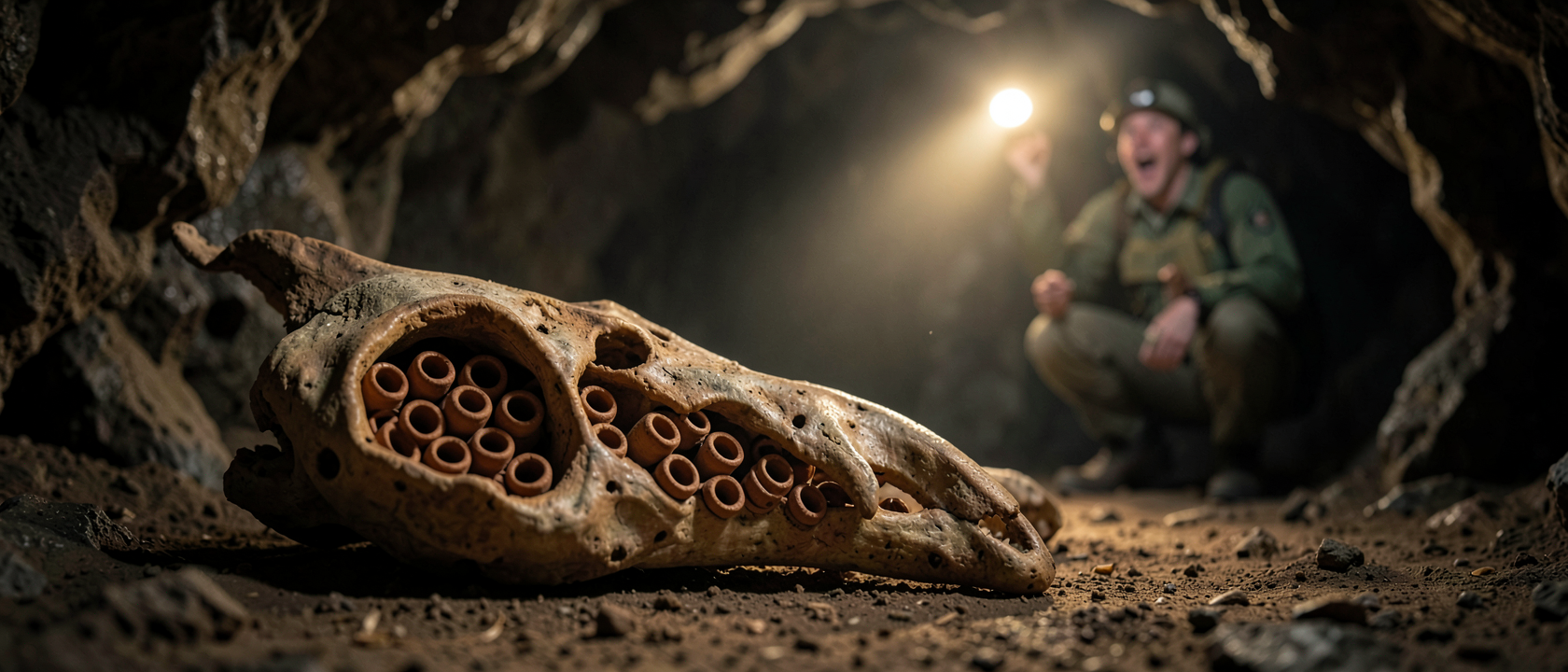
More than 5,000 years ago, in a cave in the southern Dominican Republic, bees laid their eggs inside the teeth of dead rodents. Digging through Cueva de Mono, a limestone cave on Hispaniola, paleontologists found the skulls and vertebrae of hutias, stout native Caribbean rodents identified in the fossil record as Plagiodontia araeum, holding tiny fossilized nurseries packed directly into their hollow tooth sockets and the canals of their backbones. The structures are a trace fossil, the preserved record of a behavior rather than a body, named Osnidum almontei after Juan Almonte Milán, the geologist who first found the cave. Each nest was smaller than the eraser on a pencil.
No Living Victims Required
A claim like that conjures one picture: a living hutia under attack, bees chewing through gum and bone to deposit eggs. The hutias of Cueva de Mono were long dead and fully skeletonized before a single bee arrived, their bones sitting in cave sediment for who knows how long before anything with wings came looking for real estate. Nothing in that skull was bitten or stung while it still had a pulse.
How Owl Pellets Built an Insect Nursery
The chain starts with a predator. Around 20,000 years ago, Hispaniolan giant barn owls (Tyto ostologa), now extinct, roosted in Cueva de Mono and hunted hutias across the surrounding karst, terrain of porous, weathered limestone. Owls cough up what they cannot digest, and pellets packed with bone and teeth piled onto the same patch of cave floor for generations, eventually folded into damp clay by incoming sediment. Long after the owls left, female Osnidum almontei bees tunneled down to their usual nesting depth and found tooth sockets, called alveoli, and hollow vertebral canals built almost to the dimensions of their own brood cells. A study led by Lázaro W. Viñola-López of the Field Museum of Natural History and Mitchell Riegler of the University of Florida, published December 17, 2025, in Royal Society Open Science, recorded as many as six mud cells stacked inside a single tooth socket, one generation nested inside the last.
The Karst Housing Shortage
Viñola-López and Riegler point to a practical reason: a shortage of nesting ground outside the cave. The karst around Cueva de Mono is mostly bare, jagged limestone, stripped of the loose topsoil burrowing bees need to dig a nest chamber on their own. Inside the cave, the clay stayed moist and shaded from tropical heat, and the buried hutia bones came with chambers already the right shape to move into. That makes the find unusual twice over: these bees normally build in open ground, and the paper records Cueva de Mono as only the second known case of the behavior happening inside a cave at all.
Bone-Borers or Opportunistic Tenants?
Insect brood cells found inside fossil bone have long been read as proof that the insect chewed its own tunnel with its mandibles, the hard mouthparts many insects use to cut through material. The Cueva de Mono tooth sockets, the study found, carry no bite marks, nothing but the smooth surface the bone already had in life: Osnidum almontei moved into cavities the skeleton had already provided. The find nearly became a different story altogether. Viñola-López had studied insect cocoons preserved with dinosaur bones in Montana in 2014, and his first read on an oddly smooth patch of hutia jawbone was that he was looking at wasp nests again. He drafted a short paper on wasps before closer work with Riegler turned up walls too smooth and fine for a wasp, which builds with chewed plant fiber rather than a bee’s finer lining. How far the behavior reaches is still unresolved: much of the material pulled from Cueva de Mono sits unprocessed in storage, and Viñola-López has said he hopes to survey the area again to see whether the bees still nest there, and whether other Caribbean caves hide the same habit.
Saved from the Septic Tank
None of this would exist on paper if a local infrastructure project had gone ahead on schedule. Plans had been filed to convert Cueva de Mono into an underground septic storage tank, and once researchers learned of it, they treated the cave as a site on a deadline, hauling out as much fossil-bearing sediment as they could before equipment arrived. The septic project was later dropped and the cave stands intact, but the fossils behind this study exist only because the team did not wait to find that out.