
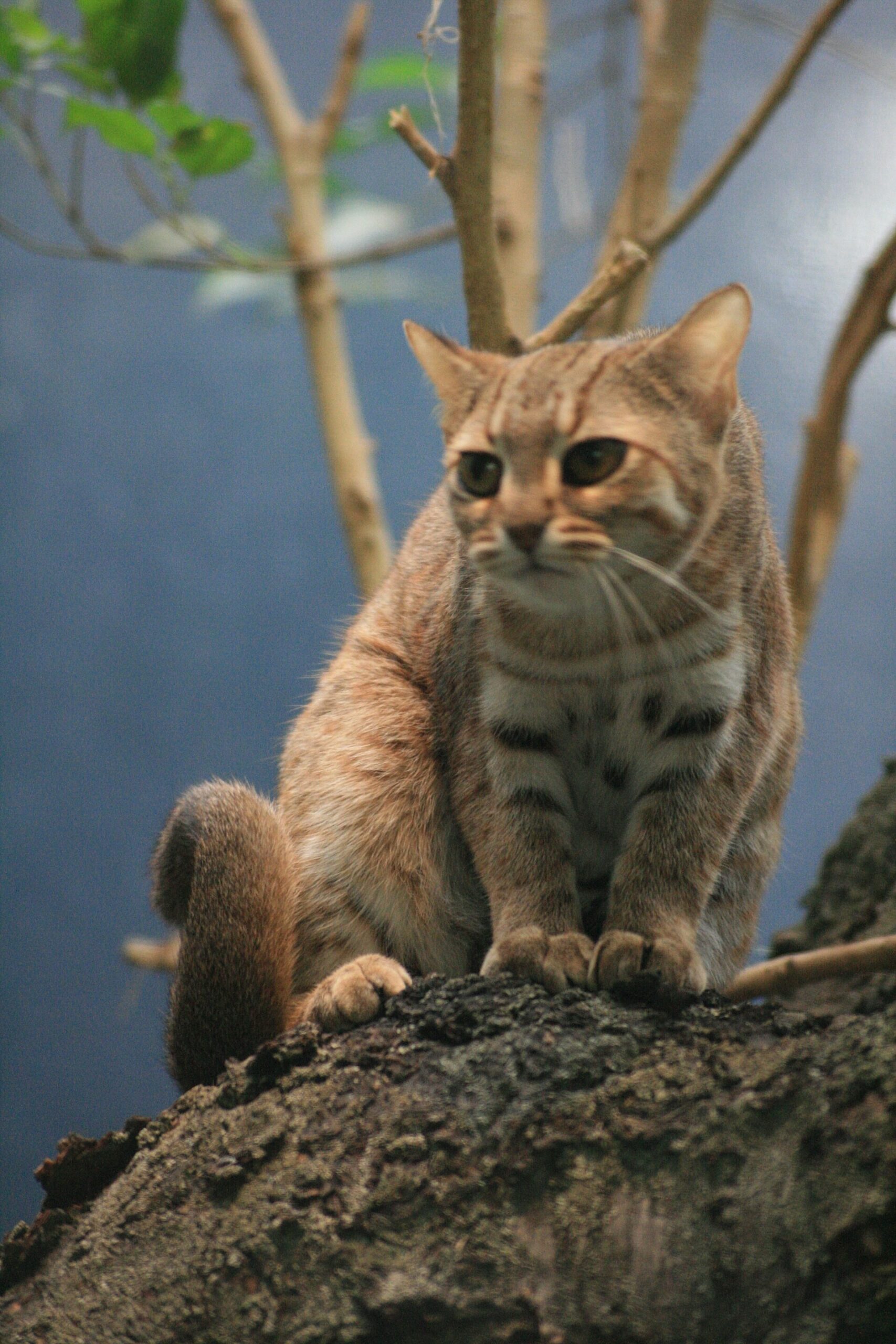
The rusty-spotted cat (Prionailurus rubiginosus) is a small felid native to India and Sri Lanka, weighing around 1.5 kg, which places it among the smallest wild cats on Earth. Isidore Geoffroy Saint-Hilaire gave it its scientific name in 1831, working from a specimen collected in Pondicherry, India. Two subspecies are recognised: Prionailurus rubiginosus rubiginosus on the Indian subcontinent and Prionailurus rubiginosus phillipsi on Sri Lanka, and their conservation standing differs under CITES. Though easily overlooked, the species turns up across a wide range of habitats and has shown a broader distribution in India than surveys had previously confirmed.
Key facts
- Scientific name: Prionailurus rubiginosus
- Kingdom: Animalia
- Phylum: Chordata
- Class: Mammalia
- Order: Carnivora
- Family: Felidae
- Genus: Prionailurus
- Taxonomic rank: species
- Mass: 1.5 kg
Physical description
At roughly half the size of a domestic cat, Prionailurus rubiginosus rivals the black-footed cat and the kodkod as the world’s smallest wild cat. The head is rounded and carries relatively large eyes, each marked by a white streak along the inner edge. That streak is thought to aid nocturnal vision, though the mechanism has not been isolated experimentally. Kittens are born with rows of black spots and light blue irises; the signature rusty coat pattern develops only as they mature.
Habitat and range
The rusty-spotted cat inhabits moist and dry deciduous forests, scrub, and grassland, with a preference for dense vegetation and rocky terrain. It is likely absent from evergreen forest. A national small-cat assessment released by the Wildlife Institute of India in 2025 found the species widely distributed across surveyed tiger-range forests, with particularly high occupancy in mixed deciduous forest, extending the documented range further than earlier records had suggested.
The tribal Yanadi people near Sriharikota island described the cat as locally common, adding that it stays within the forest and does not raid villages or take poultry there, a contrast with reports of poultry predation elsewhere in its range.
Behaviour and senses
Rusty-spotted cats are apparently mainly nocturnal, spending daylight hours resting in hollow logs, trees, or thick scrub-jungle thickets. When first brought to Frankfurt Zoo, keepers presumed the species strictly nocturnal simply because most sightings occurred after dark or at dawn and dusk, an assumption that observation in the field has since complicated. The cat is described as very active and agile and a capable climber, though it probably hunts mainly on the ground.
Communication between individuals appears mostly scent-oriented. The species is solitary, and no wild predators of the rusty-spotted cat have been recorded. During the monsoon season, larger jungle cats move into rusty-spotted cat habitat to prey on amphibians, and the smaller cats keep their distance from these relatives.
In 2012, two rusty-spotted cats were sighted near the Sariska Tiger Reserve in Rajasthan, drawing attention from wildlife activists and officials given that the reserve is primarily known for its tigers.
Reproduction
Rusty-spotted cats mate year-round. About 50 percent of young are born between July and October, so the species is not classified as a strict seasonal breeder. A litter typically contains one to three kittens, with single-kitten births the most common outcome.
Mating itself is brief, lasting one to five minutes per episode, though it can be repeated numerous times in a day. In captivity, males have averaged 7.64 mounts per hour, with each mount lasting less than a minute, and mating activity can span 1 to 11 days.
Conservation status
The two subspecies sit in different CITES appendices: the Indian population (Prionailurus rubiginosus rubiginosus) is listed under Appendix I as threatened with extinction, while the Sri Lankan population (Prionailurus rubiginosus phillipsi) falls under Appendix II, meaning its trade is strictly controlled but not banned outright.
Did you know
- At about half the size of a domestic cat, the rusty-spotted cat rivals the black-footed cat and the kodkod for the title of world’s smallest wild cat. (catit.com)
- Despite its tiny size, the cat reportedly hunted a young gazelle by seizing it by the neck and would not let go until pulled off by its owner. (catit.com)
- During the monsoon season, larger jungle cats moved into rusty-spotted cat habitat to prey on amphibians, and the smaller cats kept their distance from these bigger relatives. (wildcatconservation.org)
- In 2012, a rusty-spotted cat sighting excited activists and wildlife officials after two were seen wandering near the Sariska Tiger Reserve in Rajasthan, a reserve otherwise known for its big cats. (bigcatrescue.org)
- When first brought to Frankfurt Zoo, the cats were presumed nocturnal simply because most sightings occurred after dark or at dawn and dusk. (animaldiversity.org)
- The tribal Yanadi people near Sriharikota island reported the cat as common locally, noting it stays in the forest and does not raid villages or prey on poultry there, unlike elsewhere in its range. (catsg.org)
- Kittens are born with rows of black spots and light blue irises, only developing the signature rusty coat pattern as they grow. (wildcatconservation.org)
Data sources
Where it appears
- Palm-sized wild cat prowled a cave full of archaic humans, hunting rats November 25, 2026
Data updated: 2026-11-15