
Fifteen Million Years in Goethite
A small school of freshwater fish sank into an iron-rich swamp in what is now central New South Wales, and the rock that swallowed them did something fossils almost never manage: it kept their last meal in place. Paleontologists led by Matthew McCurry, of the Australian Museum and UNSW Sydney, identified the fish as a new species, Ferruaspis brocksi, from specimens excavated at the McGraths Flat site, according to a study published March 17, 2025, in the Journal of Vertebrate Paleontology. The fossils formed between 11 million and 16 million years ago, during the Miocene epoch, entombed in goethite, an iron oxide mineral that locks soft tissue down to a cellular level instead of letting it rot or flatten. Inside the gut cavity of one specimen, the team found the remains of phantom midge larvae, two insect wings, and a small freshwater bivalve, a last meal still sitting roughly where the fish had swallowed it. McCurry has said phantom midge larvae were by far the most common item in the diet, with wings and mollusks filling out the rest. The species name honors Professor Jochen Brocks, who found several of the specimens and has said having the fish named after him is a real joy, and that collecting fossils at the site is a highlight for him every year.
Pigment Under the Microscope
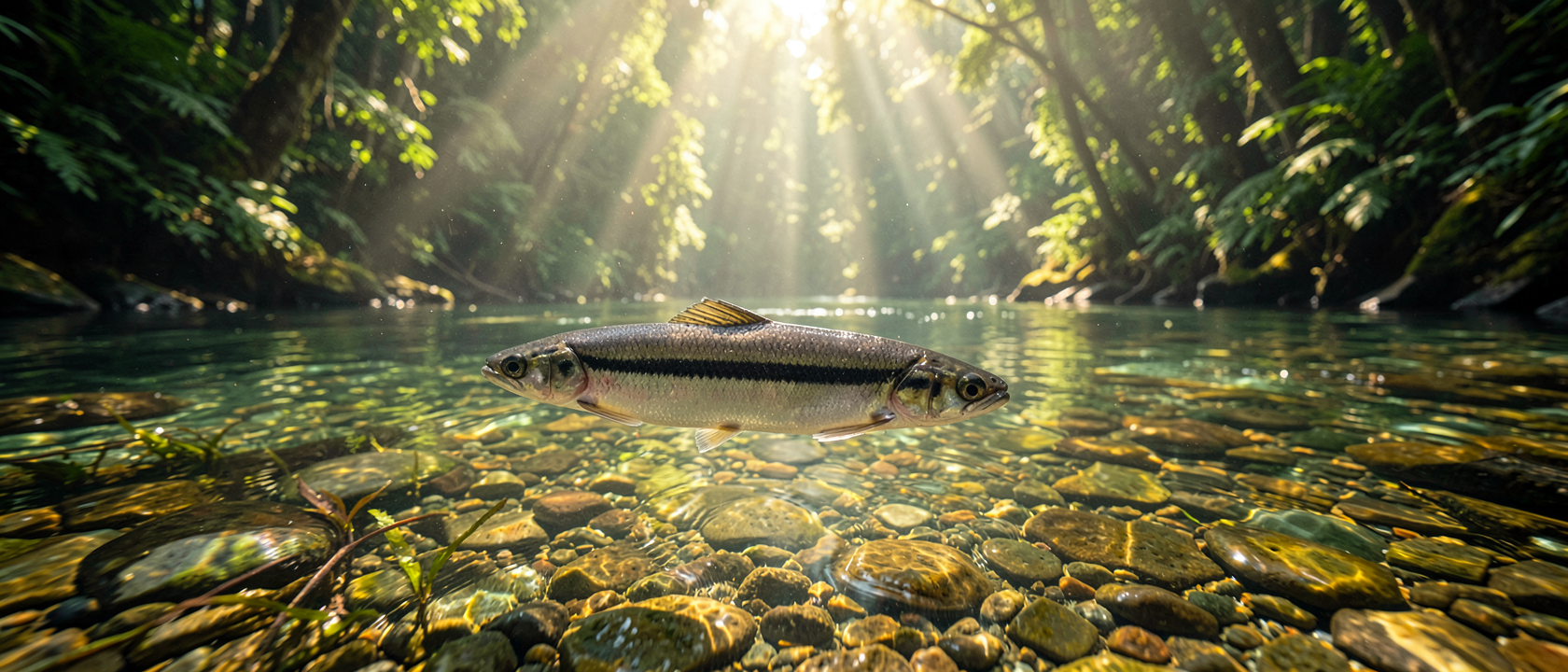
Scanning electron microscopy of the mineralized skin turned up something rarer still: fossilized melanophores, the pigment-producing cells that give a fish its color pattern, still holding their internal melanosomes, the sub-cellular packets that actually store the melanin. Study co-author Michael Frese, of the University of Canberra and CSIRO, mapped where those melanosomes sat thick and where they thinned out across the fossilized body. The pattern that emerged is known as countershading, a dark top and pale underside that cancels out an animal’s own shadow, and here it showed up as a melanosome-dense back, a nearly melanosome-free belly, and two distinct dark stripes running the length of each flank. The color scheme was read directly from the fish’s own preserved pigment cells, mapped cell by cell across skin that had sat in the ground for fifteen million years.
Why Australia Needed Smelts
Ferruaspis brocksi is the first fossil freshwater smelt of the order Osmeriformes ever found in Australia, a group that today includes the Australian grayling and the Australian smelt. Before this fossil, researchers had no direct physical evidence of when ancestral smelts reached Australian rivers or how long they had been there. The fossils turned up west of the Great Dividing Range, a location that suggests this particular fish, unlike most living Osmeriformes, may have spent its entire life in fresh water rather than moving between river and sea. McCurry’s team dated the McGraths Flat site to between 11 million and 16 million years ago, a time when the Central Tablelands were a wet, temperate rainforest rather than today’s drier open country, with life described by the team as rich and abundant throughout the region. In sunlit, plant-choked streams like those, a dark back and pale belly would have broken up the fish’s outline from above and below, and the two lateral stripes would have blurred it further against drifting weed, letting it close in on phantom midge larvae without announcing itself to whatever was hunting from the surface.
Pigment Fossils Aren’t Just for Dinosaurs
Melanosome mapping built its reputation on feathers. The technique first proved itself reconstructing the color of fossil dinosaurs and early birds, and many observers assumed that fish skin, softer and less structured than a feather, could never hold pigment cells with the same fidelity across geologic time. Ferruaspis brocksi contradicts that assumption directly. Goethite mineralization froze its melanophores and the melanosomes inside them down to a scale fine enough for researchers to map stripe edges and the gradient from dark back to pale belly, on a fish that never grew a feather. Stripe patterns and structural color in an extinct aquatic vertebrate can survive fifteen million years in the right mineral, with no amber and no feather required.
The Blank Map Before the Rainforest
Ferruaspis brocksi settles the Miocene end of the story and leaves the earlier chapters open. Nobody has yet found fossil evidence of when the ancestral lineages of Osmeriformes first entered Australian fresh water, or which marine or estuarine fish gave rise to them, because older Cenozoic freshwater deposits across the continent are rare. It is also unclear whether Ferruaspis was one population or two: the species may have included fish that moved between river and sea alongside fish, like the McGraths Flat specimens, that stayed landlocked in fresh water for their entire lives. McCurry has said that before this discovery, there was no concrete evidence to pin down when this group of fish arrived in Australia or how they changed over time. The fish recovered from the goethite were not large; the study gives no precise length or weight, only enough preserved tissue to show what one of them had eaten for its last meal and what pattern ran down its sides.