
The Pile Nobody Could Explain
At the Changma Basin fossil site in Gansu Province, China, researchers have pulled more than 100 bird fossils out of Lower Cretaceous lake sediment, part of the Xiagou Formation laid down between 124 and 120 million years ago. Mixed in with them were smaller clusters of bone that had been shattered and packed down into something closer to an owl pellet than an ordinary fossil: clear evidence of an animal eating other animals. For years nothing at the site matched the damage. No predator skeleton turned up to go with the bodies.
Then came a single bone: a 4-inch (10 cm) upper arm fragment, the first non-avian dinosaur body fossil ever recovered at Changma. It had actually been collected back in 1981 and sat unidentified for decades. Researchers Ling-Qi Zhou, Matthew Lamanna, Ashley Poust, Da-Qing Li, Hai-Lu You, and senior author Jingmai O’Connor finally described it in the Annals of Carnegie Museum, published June 4, 2026, and gave it a name: Jian changmaensis.
What One Arm Bone Can Tell You
A partial humerus and shoulder girdle does not sound like much to build a species on, but bone carries signatures. The coracoid, a blade-shaped bone that anchors the wing to the chest, is unusually elongated on this specimen and shaped in a way no bird’s ever is. That single feature told the team they were looking at a dromaeosaur, the family that includes Velociraptor, and specifically a member of its smaller subgroup known as the microraptors.
From the proportions of that one bone, the team estimated a wingspan around four feet (1.2 m), putting Jian in barn-owl territory. That is a big number for a microraptor. Most members of the group, per the describing paper, topped out at crow-sized. By O’Connor’s own account, Jian is one of the largest microraptor specimens ever found. The discovery also marks the first clear evidence of microraptors living outside northeastern China, stretching the group’s known range across the region.
Four Wings, No Flapping
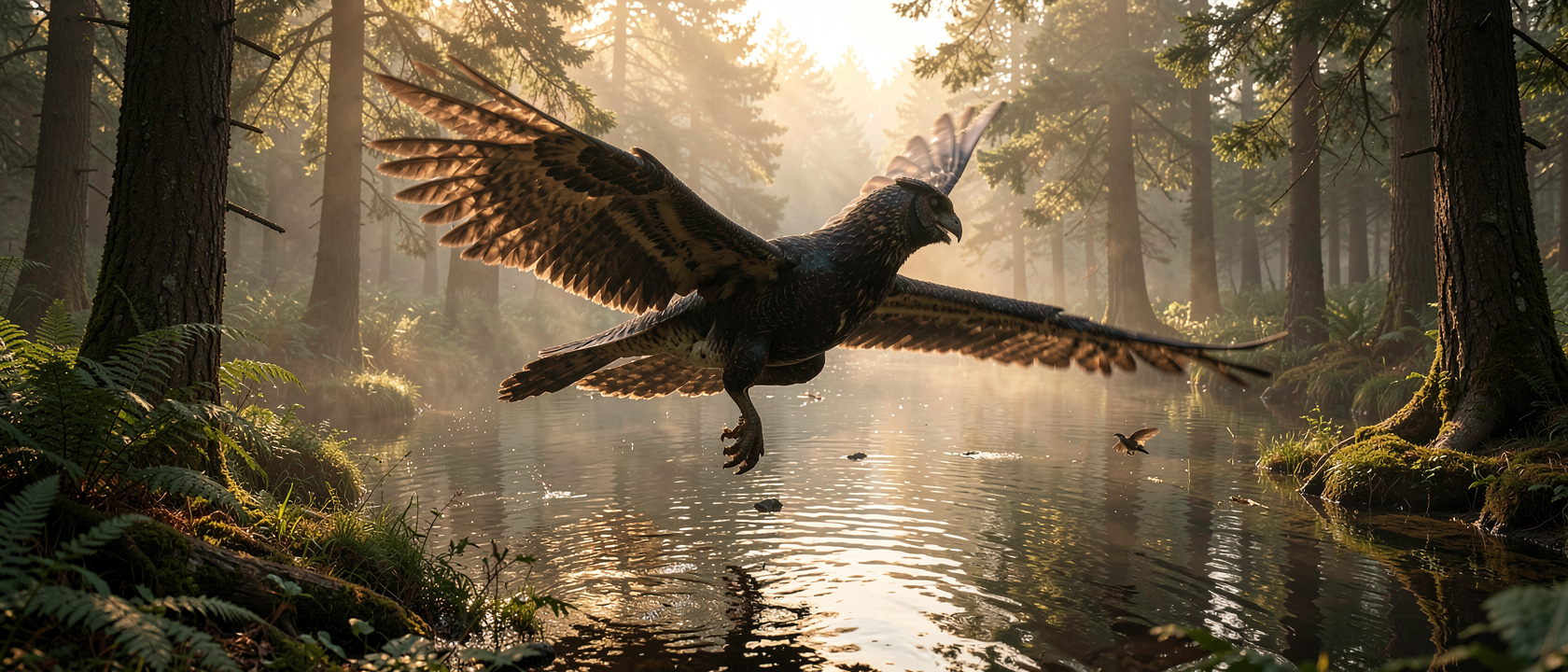
Like its microraptor relatives, Jian likely carried long feathers on both its arms and its legs, not just its arms the way a bird does. That builds a four-winged silhouette rather than a two-winged one. The microraptor group as a whole shows no clear anatomy for powered flight; the working picture is a glider, something closer to a flying squirrel coasting down from a height than a bird climbing into the air under its own power.
That build fits a specific hunting shape. A short, quiet, controlled glide would let a predator drop in on a bird feeding or roosting nearby rather than chase it down in open air, which lines up neatly with a pile of bird bone crushed in place rather than scattered along a flight path. Exactly how well a gliding animal like this could actually close in on a moving bird in midair is still an open question; gliding gets you down to the ground quietly, but it does not give you the control a true flier has.
Forget the Movie Raptor
The Velociraptor most people carry in their heads comes from the Jurassic Park films: scaly, waist-high at least, running in coordinated packs across a kitchen floor. The fossil record says otherwise. Real dromaeosaurs, Jian included, were feathered and often four-winged, built on a scale closer to a barn owl than a minivan. The myth gets more than skin and feathers wrong, it misjudges size and movement too. These were animals built to glide into a clearing, not animals built to kick a door down.
Convicted on Circumstantial Evidence
Here is what the case does not have: no bite marks on the bird bones, no preserved stomach contents, no second Jian skeleton to compare against the first. What it does have is one fact that will not go away. Among more than 100 bird fossils and a site full of pellet-like bone clusters, Jian changmaensis is the only non-avian predator anyone has ever pulled out of the ground there.
O’Connor frames it as an inference, not a verdict. Jian is the team’s best guess, not a confirmed kill record. Why only one specimen has turned up at a site with this much apparent predation is still an open question, and the rest of the skeleton, the part that would actually close the case, remains unrecovered.