
The Fact That Doesn’t Sound Real
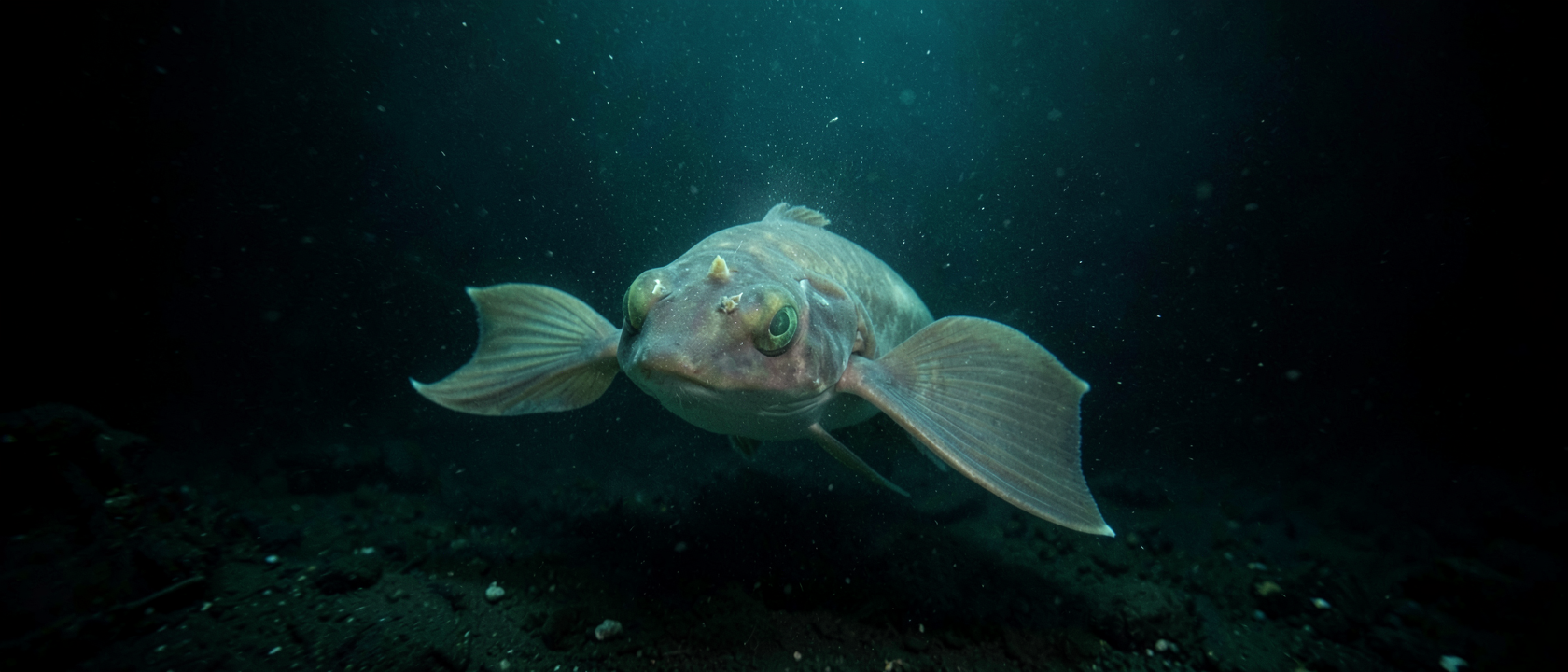
A male spotted ratfish (Hydrolagus colliei) carries two separate sets of real teeth. One set sits where you’d expect, inside his mouth. The other sits on a rod that folds flat against his forehead and swings forward only when he needs it. The spotted ratfish is one of roughly 50 living species of chimaera, fish commonly nicknamed “ghost sharks” for their shark-and-ray ancestry and their deep, dim habitat. The forehead rod is called a tenaculum, and only mature males grow one with real teeth on it. Females either lack it entirely or carry a rudimentary version that never forms teeth. The teeth on that rod aren’t for eating. They’re for gripping a mate, and they are, structurally, exactly what they look like: teeth, on a hinge, on a forehead.
How We Know They’re Teeth, Not Spikes
Karly Cohen of the University of Washington, Michael Coates of the University of Chicago, and Gareth Fraser of the University of Florida published the comparison in the Proceedings of the National Academy of Sciences on September 4, 2025, in a paper titled “Teeth Outside the Jaw: Evolution and Development of the Toothed Head Clasper in Chimaeras.” They lined up a 315-million-year-old fossil of the Carboniferous chimaera relative Helodus simplex against modern spotted ratfish collected live from Puget Sound, Washington, and checked which genes switch on while a tenaculum’s teeth form. They found the same tooth-specific genetic program that builds teeth inside the jaw running on the forehead rod, and traced the teeth back to a dental lamina, the strip of tissue that normally grows teeth only in the mouth, never before documented anywhere else on a vertebrate’s body. The 315-million-year gap between fossil and living fish matters: this isn’t a recent accident, it’s an old, stable piece of biology that evolution has kept switched on in the same spot for a very long time.
Why a Tooth-Making Kit Ends Up on a Forehead
The researchers’ reading of the data: evolution didn’t design a new gripping tool from scratch. It grabbed the tooth-building kit that already existed in the jaw and ran it somewhere else. That kit, in male spotted ratfish, got activated on the forehead instead of staying confined to the mouth, and instead of producing a jaw full of cutting teeth, it produces a short, hooked rod whose only job is holding on to a female during mating. Fraser and Cohen describe the broader pattern as the tenaculum shortening over evolutionary time while keeping its ability to grow oral-style teeth, a case of old parts repurposed for a new task rather than new parts invented for it. Exactly how the males put those teeth to work once attached, whether it’s a steady grip or something closer to scraping during courtship, is a detail the study doesn’t fully pin down. What it does establish is the tool itself: a tooth-making program borrowed from one job and reassigned to another.
The Myth This Kills
The obvious guess, before this study, was that the spiky nodules on a chimaera’s forehead were just denticles, the small tooth-like scales that give shark and ray skin its sandpaper feel. Chimaera skin itself is smooth and scaleless, but the forehead nodules still looked like a skin feature rather than a dental one. If that guess were right, the tenaculum would be unremarkable, skin doing what skin always does. Cohen, Coates, and Fraser’s genetic and histological testing says otherwise. Tenaculum teeth express the tooth-specific genes found in oral teeth, genes that dermal denticles never carry, and they grow from that same dental lamina tissue that denticles don’t have at all. As Cohen put it, the finding upends the long-held assumption that teeth only ever grow inside the mouth. This isn’t textured skin in an odd location. It’s the mouth’s own tooth recipe, running somewhere it was never supposed to run.
What Else Might Be Hiding
Fraser’s own question stays open: if a tooth-forming program can be lifted out of the jaw and set down somewhere else to grow working teeth, what’s stopping that from having happened elsewhere, in other animals, without anyone noticing yet? Nobody has an inventory of other “rogue teeth” sitting unidentified on other skeletons, places where the same ancient genetic toolkit got relocated and nobody has gone looking. It isn’t a project underway or a prediction waiting to be confirmed. It’s just a gap, stated plainly, the kind that makes you look twice at the next unfamiliar bump on an unfamiliar animal. And the next time someone calls a chimaera a shark, you’ll know the one detail that actually sets it apart: it keeps a spare set of teeth folded on its head.