
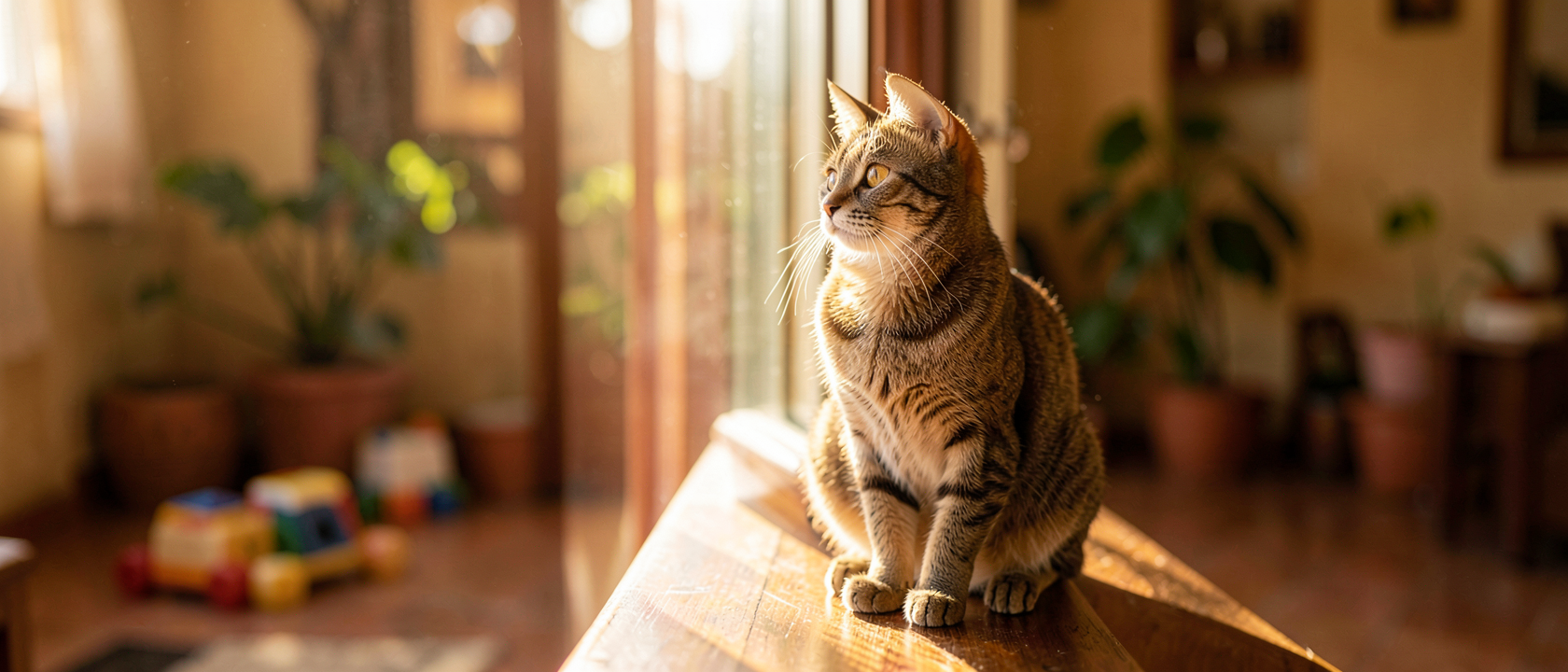
A Rabbit Looks Boring Compared to This
A rabbit or a hamster in the house at ages 4 and 5 tracked with fewer anxiety and conduct problems for a child three years later. A cat in the house at that same age tracked with more of both. That is the finding from a study of 1,893 Spanish families across the Valencia, Sabadell, Asturias and Gipuzkoa regions, run through the INMA project (Infancia y Medio Ambiente, or Environment and Childhood). Parents filled out a standardized behavior questionnaire called the Strengths and Difficulties Questionnaire when their kids were 7 and 8. Children who had owned a cat specifically at ages 4 and 5 showed a relative rate ratio of 1.37 for internalizing problems like anxiety and withdrawal (95% CI 1.05 to 1.79), and 1.26 for externalizing problems like rule-breaking and aggression (95% CI 1.02 to 1.56). The study was published in the World Journal of Pediatrics, posted online October 4, 2025.
The effect is narrow and specific, and that is the part worth sitting with. This is not pets as a category showing a risk. It is not cats at any other point in childhood either, the researchers checked, and only that one window, ages 4 to 5, carried the signal. About a quarter of the 1,893 families had owned a pet continuously, most often a dog or a cat, and roughly 52 percent of all households had owned one at some point. The cat result sits inside that larger population, attached to one slice of early childhood and nothing else.
The Hamster Comes Out Ahead
Children in the same cohort who owned what the researchers grouped as “other” small animals, rabbits, hamsters, fish, turtles, salamanders, during early childhood showed a reduced risk of both internalizing and externalizing problems at the follow-up. Dogs and birds showed no significant link to children’s mental health in either direction.
Line the results up and the ranking looks strange: a cat at ages 4 to 5, worse outcomes. A rabbit or hamster, better outcomes. A dog or a parakeet, no measurable difference at all. The animal most people assume is the reliable, kid-friendly pet does worse in this data than the one living in a glass tank in the corner of the room. If you have ever ranked pets by how much trouble they seem worth, this study just scrambled your list.
Three Guesses, All Unconfirmed
The paper does not explain why cats tracked with worse outcomes. It offers ideas, clearly labeled as unproven.
One: cats tend toward what the researchers describe as an avoidant attachment style, and a cat does not pull a child outdoors the way a dog pulls someone toward a leash and a park. Less shared movement, less of the mood regulation that tends to come with it.
Two: small pets like rabbits and hamsters often get handed to one child as theirs alone, a cage they feed and clean themselves. A cat belongs to the whole household. The direct, low-stakes caregiving bond that seems to help kids may not exist the same way with an animal nobody is solely responsible for.
Three, further out on the limb: toxoplasmosis, a parasite that infects roughly a third of the global population and has been connected in other research to effects on cognition and mood. The authors raised it as a biologically plausible angle. They did not test for it. No infection data, no exposure data, nothing in this dataset measures toxoplasmosis at all. It is a hypothesis sitting on a shelf, not a finding.
The Myth That Doesn’t Survive This Data
The usual assumption is that a pet is a flat, interchangeable good for a child’s mental health, any species, any age, roughly the same benefit. This dataset does not back that up. A cat at ages 4 to 5 tracked with more anxiety and more conduct problems three years later. A rabbit or hamster tracked with less of both. A dog or a bird tracked with no measurable shift at all. Three categories of animal, measured in the same children with the same questionnaire, produced three different outcomes. “A pet is a pet” does not survive that comparison.
What This Study Cannot Tell You
This is an observational study, so it can show a pattern, not a cause. Two explanations are equally alive. Something about living with a cat at that specific age could genuinely be nudging a child’s mood and behavior, or the arrow could point the other way entirely. Families already managing a harder-to-handle child might gravitate toward a lower-maintenance animal, a cat instead of a dog that needs walking twice a day. The study cannot tell a cat causing the problem apart from a cat being chosen because of it.
The researchers also stress-tested their own numbers, and the result got shakier under pressure. The internalizing finding slipped to borderline significance, and the externalizing finding stopped being statistically significant at all. Nobody has an explanation for why ages 4 and 5 specifically mattered, when the same pattern did not show up for cats at age 1, or for households that had always owned one. Whatever is happening in that window is happening somewhere nobody can yet explain, which is either the most interesting detail in the whole paper, or the best reason to wait for someone to run it again.