
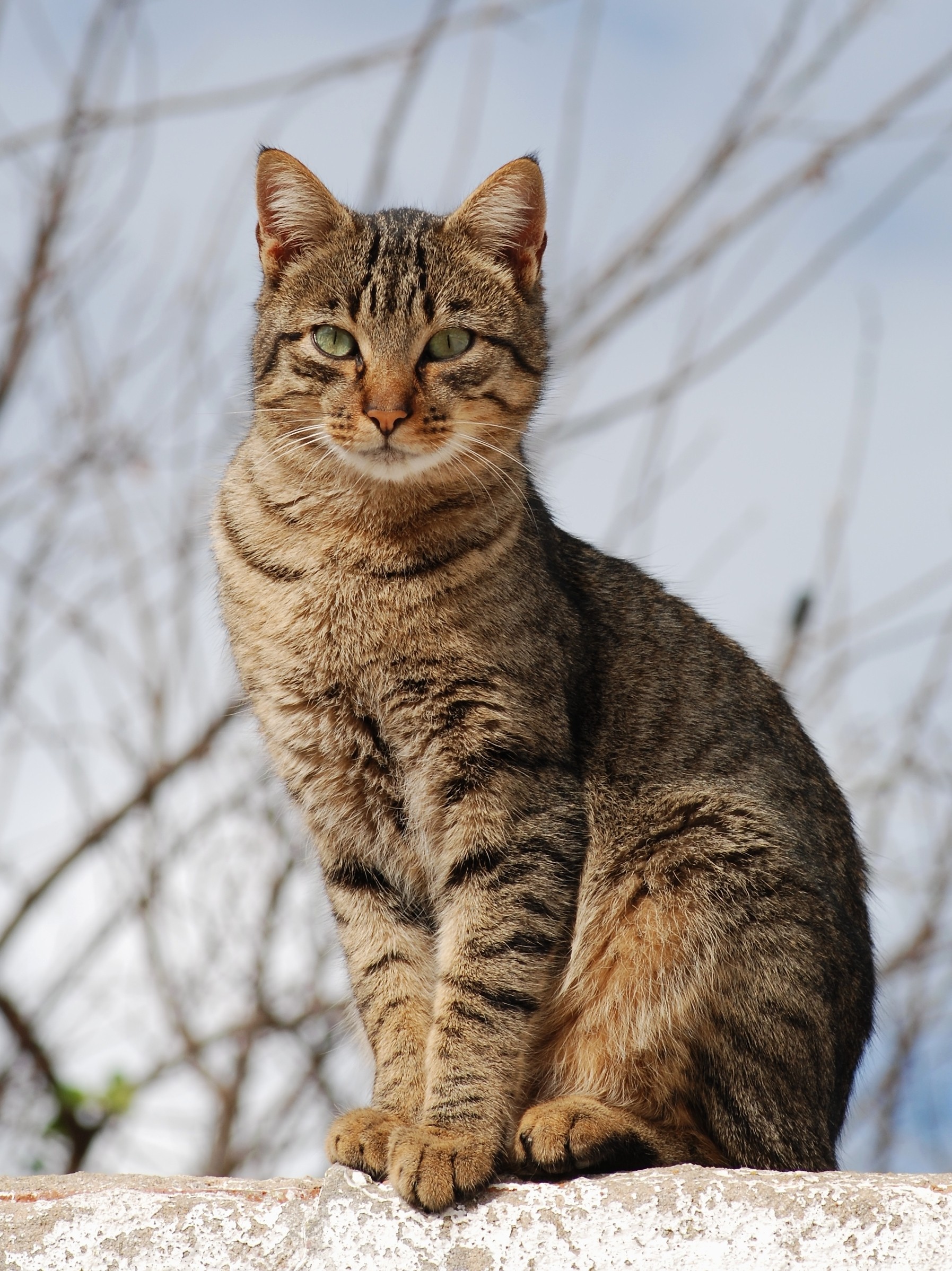
Feral cats are free-living members of the domestic cat species Felis catus, a mammal classified in the family Felidae, which Carl Linnaeus formally named in 1758. They occupy every continent except Antarctica, thriving equally in urban back-lots, grassland, forest, farmland, and upland terrain.
Key facts
- Scientific name: Felis catus
- Kingdom: Animalia
- Phylum: Chordata
- Class: Mammalia
- Order: Carnivora
- Family: Felidae
- Genus: Felis
- Taxonomic rank: species
- Life expectancy: 22 years
- Gestation period: 64 days
Physical characteristics
Feral males typically weigh 3–6 kg and females 2–4 kg. Both sexes tend to be more muscular than house cats, particularly across the head, neck, and shoulders, a difference attributed to the physical demands of entirely self-sufficient predation. The coat is almost always short and varies in colour across populations, ranging through ginger, tabby, tortoiseshell, grey, and black with no single pattern predominating.
Despite the popular idea that cats ‘go wild’ in some complete biological sense, the brain does not return to wild-type size. A 2022 study confirmed that cranial volume in Felis catus remains smaller than that of ancestral African wildcats even in free-living populations, a finding the authors attributed to the irreversible domestication syndrome.
Taxonomy and naming
The name Felis catus was proposed by Carl Linnaeus in the 10th edition of Systema Naturae, published in 1758, with Sweden recorded as the type locality. Classification places the species in the kingdom Animalia, phylum Chordata, class Mammalia, order Carnivora, family Felidae, genus Felis.
The question of whether domestic and wild populations constitute one taxon or two remained contested for decades. Following Opinion 2027 of the International Commission on Zoological Nomenclature, issued in 2003, the domestic cat is treated as a distinct species, Felis catus, separate from wild populations assigned to Felis silvestris. That ruling settled the naming debate, though the biological boundary between feral and wild populations in regions of overlap remains a subject of ongoing study.
Behaviour and social structure
Feral cats are predominantly crepuscular: peak hunting activity falls soon after sunset and just before sunrise. Despite living in groups, they hunt alone. Each cat works its own territory; no coordination occurs between individuals pursuing prey.
Colony structure is built around queens and their litters. A tom’s territory is larger, typically encompassing one or more queen colonies. The arrangement means that a colony’s visual centre of social life is female, but male presence extends across a wider geographic footprint.
Reproduction
Females become sexually mature at around 7 months of age; males reach maturity at around 12 months. The gestation period is 64 days. A feral female produces an average of 1.5 litters per year with roughly 4 kittens per litter, but more than half of kittens die before reaching maturity through exposure, disease, predation, and competition for food. The species life expectancy is recorded at 22 years, a figure rarely approached under feral conditions.
Population estimates
The feral cat population of Los Angeles County alone is believed to exceed half a million animals. Precise global numbers are unknown; the range of the species is worldwide, which means every regional estimate is a local sample from a planetary phenomenon.
Ecological impact
Feral and free-ranging domestic cats are listed among the IUCN’s 100 of the World’s Worst Invasive Alien Species. Free-ranging cats on islands have caused or contributed to 33 modern bird, mammal, and reptile extinctions recorded by the IUCN Red List, equivalent to 14 percent of such extinctions in the modern record. Those losses are not theoretical or projected; they are recorded species that no longer exist.
A detailed 60-year economic analysis identified feral cats as the single most costly invasive species in Australia, with damages and control costs totalling A$18.5 billion. The analysis also found them to be a recognised threat to more than 200 nationally listed threatened species.
A 2025 DNA study in Australia found that feral cat predation on reintroduced native species, including bettongs and bilbies, may have been grossly underestimated. The finding prompted the Invasive Species Council to call for a $60 million national feral cat plan. The gap between prior estimates and DNA-confirmed kill rates is itself an open question: if tracking and survey methods have consistently undercounted predation, the known figures are a floor, not a ceiling.
Public health
Free-roaming cats are a reservoir for several zoonotic diseases, including rabies, toxoplasmosis, cutaneous larval migrans from nematode parasites, plague, tularemia, and murine typhus. In the United States, cats account for approximately one-third of rabies post-exposure prophylaxis treatments in humans, a proportion that reflects both the size of the feral population and the frequency of contact with people who do not recognise an unowned cat as a rabies risk.
Management and research
Trap-Neuter-Return, known as TNR, is the most widely studied non-lethal management approach. A population viability analysis for that programme projects a 55 percent population reduction by 2028.
Whether TNR can reduce populations at city or landscape scale remains genuinely open. Extrapolating to larger or less structured environments requires data those environments have not yet produced.
Did you know
- A cat that goes feral does not regrow the brain it lost to domestication. A 2022 study confirmed that cranial volume in Felis catus remains measurably smaller than that of ancestral African wildcats even in populations living entirely without human support. The researchers described this as an expression of the domestication syndrome: a cluster of anatomical changes selected for during the domestication process that are not reversed by returning to free-living conditions. (ncbi.nlm.nih.gov)
Data sources
- GBIF
- Wikidata
- business.qld.gov.au
- bigcatrescue.org
- ipm.ucanr.edu
- merckvetmanual.com
- petplace.com
- scienceinsights.org
- mammaldiversity.org
- nature.com
- abcbirds.org
- dbca.wa.gov.au
- ncbi.nlm.nih.gov
- abc.net.au
- english.news.cn
Data updated: 2026-10-28