
One missing copy on chromosome 17
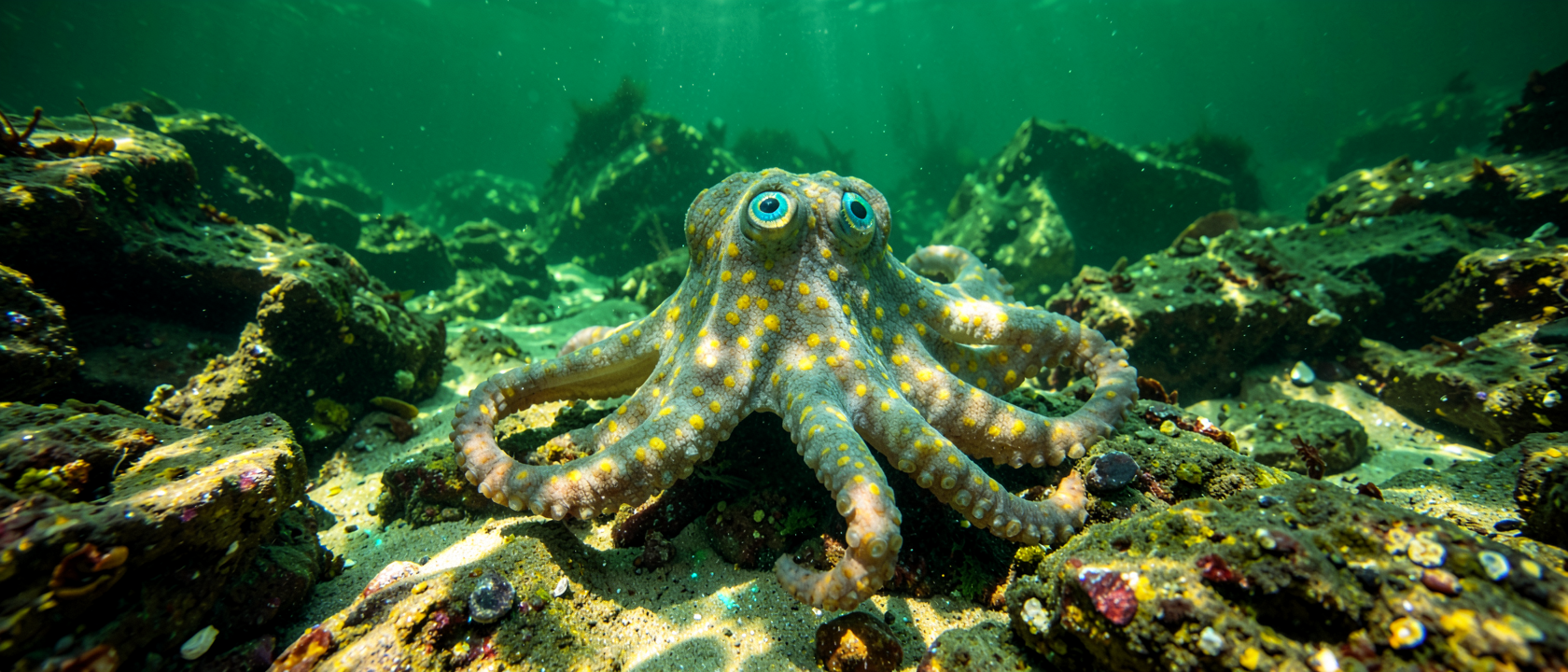
The California two-spot octopus (Octopus bimaculoides) is a modest-looking animal: gray, soft-bodied, with a yellow false eyespot under each eye, three hearts, blue blood, and a donut-shaped brain, living in tide pools and shallow coastal water from mid- and southern California down the western side of the Baja California Peninsula. What it carries inside its cells turns out to be one of the oldest pieces of genetic real estate known in any animal: a sex chromosome that has barely changed in roughly 480 million years, since before squid existed as a separate lineage and long before anything with a backbone crawled onto land.
In February 2025, Gabrielle Coffing, Andrew Kern, and their colleagues at the University of Oregon sequenced the complete genome of a female California two-spot octopus, using PacBio long-read sequencing to read long, continuous stretches of her DNA. Chromosome 17 carried only half the genetic material expected of a normal, matched pair, a pattern that usually signals a single copy instead of two. When the researchers checked genomes from male octopuses sequenced earlier, the same chromosome was missing entirely, not half there, simply absent. Published in Current Biology on February 3, 2025, the result was the first direct molecular evidence that this species determines sex through a chromosome at all. In the shorthand geneticists use, the female turned out to be ZO, carrying a single Z chromosome, while males are ZZ, carrying two. This species had already made genomic history once before, becoming the first octopus with a fully sequenced genome, back in 2015.
The same chromosome in octopus, squid, and nautilus
Beyond this single specimen, Coffing’s team searched genomic data from other cephalopods and found the same chromosome again in a second octopus species, in squid, and in the chambered nautilus (Nautilus pompilius). Squid diverged from octopuses somewhere between 248 million and 455 million years ago, depending on which fossil calibration is used, and the nautilus lineage split off even earlier, an estimated 480 million years ago. For the same chromosome to turn up in all three groups, their last common ancestor must already have carried it, before any of those splits happened. That timing puts this sex chromosome among the oldest ever identified in any animal, vertebrate or invertebrate.
A hypothesis still being tested
Researchers suspect this single chromosome is what makes an octopus female: present as one copy in females, doubled in males. How it actually does that is still being worked out. Kern and his colleagues first expected something closer to the system birds and butterflies use, where males carry two matching chromosomes and females carry one chromosome paired with a smaller, distinct partner called W. No W chromosome has shown up in any octopus genome sequenced so far, which points to another possibility: a system with no W at all, where males simply carry two copies of the Z chromosome and females carry one. Both explanations remain live, and neither is confirmed yet.
A myth about fast-evolving sex chromosomes
Whether cephalopods use chromosomes to determine sex at all had been an open question in biology for decades, since no sex chromosome had ever been confirmed in an octopus, squid, or any relative of theirs. The Current Biology paper settles that question for this lineage: cephalopods do use a sex chromosome, carried singly in females and doubly in males. A second, deeper assumption also takes a hit. Sex chromosomes are generally expected to evolve fast, reshuffling and degrading within a few million years under the pressure that reproduction puts on them. Other old sex-chromosome systems, like those found in mosses and liverworts, or the roughly 450-million-year-old systems in some insects, have shifted substantially over that time. This one broke that pattern, staying recognizable for close to half a billion years while the rest of the octopus genome kept evolving around it.
What hasn’t been found yet
No W chromosome has turned up in any octopus genome sequenced to date; if one exists, it has avoided detection so far. The researchers also searched for known sex-determination genes already identified in other mollusc species, checking whether any of them sit on the octopus Z chromosome, and found none. The chromosome’s age and its presence across octopus, squid, and nautilus genomes are established findings. Which gene, or genes, on chromosome 17 actually flips an embryo toward female development is still unidentified.