
The Family Dog vs. the Bug Eating Pennsylvania
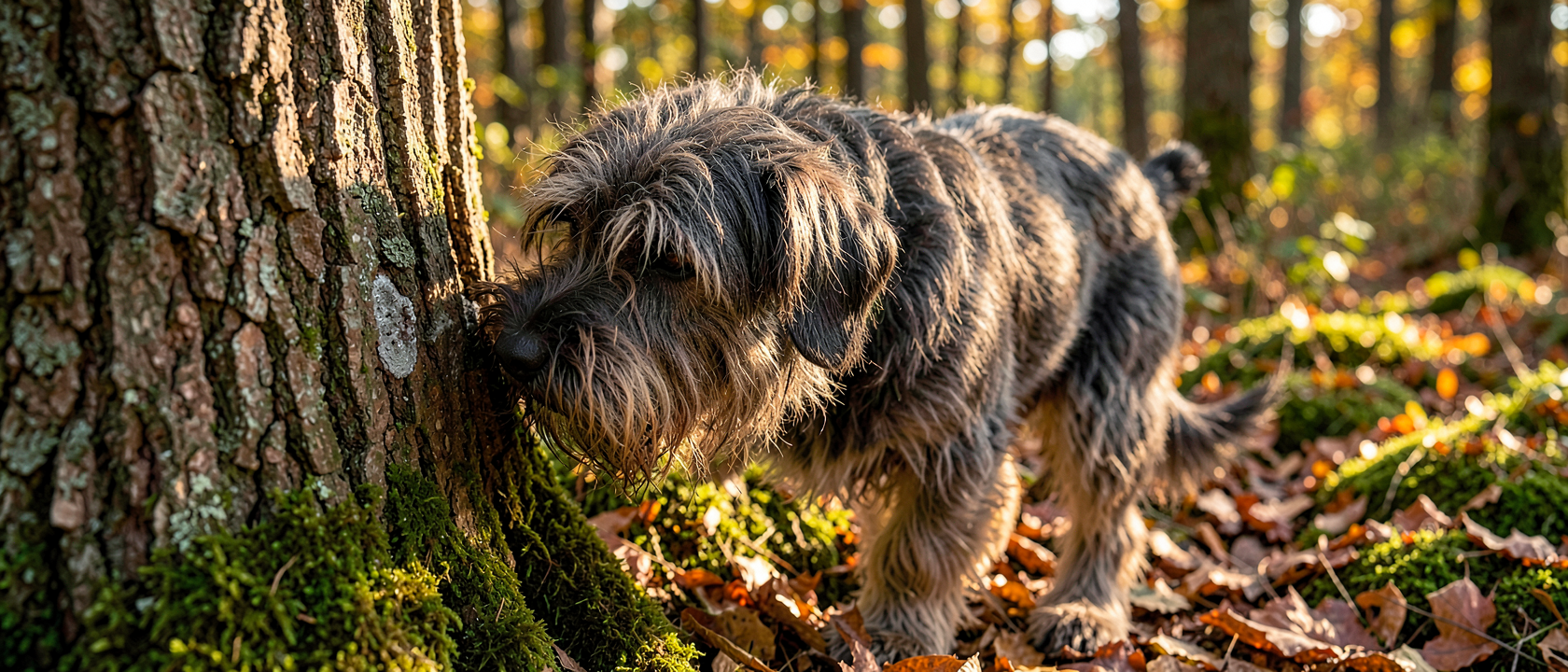
A Tibetan terrier named Pepe and a pit bull mix named Finch learned to sniff out camouflaged insect eggs with accuracy in the range reported for professional detection dogs, and neither of them has worked a day in a K-9 unit. They were two of 182 dog-handler teams in a 2025 study led by Sally Dickinson at Virginia Tech, selected from more than 1,000 applicants and trained entirely by their own owners to find the egg masses of the spotted lanternfly (Lycorma delicatula), an invasive planthopper spreading across the eastern United States. In controlled indoor tests, the dogs picked the correct target 82% of the time. Outdoors, with wind, bark, soil, and a hundred competing smells in the mix, that dropped to 61% by the press release’s count, or 58% in the peer-reviewed abstract. These were pets, not professionals, and that’s the whole point of the story.
How a Living Room Becomes a Training Lab
The method behind that number is almost aggressively unglamorous. Handlers were given devitalized spotted lanternfly egg masses, meaning treated so they can’t hatch, and told to run short sessions at home, a few hours a week, under the guidance of designated local trainers. Most teams could reliably identify the scent within 10 weeks. There was no secret ingredient: a dog’s nose is already tens of thousands of times more sensitive than a human’s, built to pull one odor out of a cluttered field the way a human eye picks a single face out of a crowd. Egg masses look like mud smears or lichen, which fools the eye easily. They don’t smell like mud or lichen, which is the part a nose was never confused about. What the owners supplied was repetition against a known target, for months. That’s the same basic architecture professional detection programs run on. The only thing missing here was the professionals.
What the Dogs Were Actually Being Built For
The indoor and outdoor tests were a gate, not the goal. Of the dogs that passed both rounds, 92% went on to find live, real spotted lanternfly egg masses with almost no extra training, meaning the skill they built on fake eggs transferred straight to the real thing. A separate 2025 study by the same research group, co-authored by Nita, Dickinson, Feuerbacher, Aviles-Rosa, and Hall, trained pet dogs to detect powdery mildew (Erysiphe necator), a fungal grapevine disease with nothing insect about it, and got accuracy over 90%. A 2026 follow-up study then compared the dogs to people directly: three human searchers found egg masses in four locations, while dog teams confirmed those same four and turned up eight more the humans missed. Put together, the researchers frame this as bigger than one bug: a scalable detection pipeline built on hobbyist scent-work dogs instead of a small, expensive pool of professional teams. That matters because the spotted lanternfly has gone from a single 2014 detection in Pennsylvania to a presence in 18 states, and the bottleneck was never knowing where to look. It’s that the eggs are camouflaged well enough to make trained human eyes walk right past them.
The Myth That a Nose Needs a Badge
The assumption this result pushes against is specific: that reliable detection work, the kind used in conservation, agriculture, and biosecurity, requires an expensive dog raised and trained inside a specialized professional program. The 182-team study is described by its authors as the first to show citizen-trained teams reaching detection accuracy in the range reported for those professional programs. The two dogs researchers keep naming have no detection-dog lineage behind them at all: a pit bull mix and a Tibetan terrier, a breed with no formal scent-work pedigree. This isn’t a claim that any dog can do anything asked of it. It’s a narrower, measured one: against this specific target, with this specific home-training protocol, ordinary pets matched a number usually reserved for professionals.
What Nobody Has Explained Yet
Two things the study doesn’t resolve. The drop from 82% indoors to around 60% outdoors is attributed only to “more competing smells”: wind, bark, stone, soil, weather, all named, none isolated to say which one actually costs the dogs their accuracy. Nobody has run the version of this test that separates wind from surface type from temperature. The gap between the press release’s 61% and the peer-reviewed abstract’s 58% is also never explained in the available material; whether it reflects a different metric or simply an updated number, nobody has said. Second, there’s no established path from “182 dogs passed a detection test” to a dog showing up at a nursery or a shipping yard as part of a real monitoring program. No certification standard, no deployment protocol, no answer for who oversees a hobbyist team working an actual infestation site. The study proves the dogs can do it. It says nothing about who decides when they’re allowed to.
Pepe and Finch Clock In
Bill Wellborn of Roanoke, Virginia, spent six months training his 7-year-old Tibetan terrier, Pepe, two or three times a week, 15 to 30 minutes a session, on a devitalized egg mass in the living room. Katie Thomas of Radford, Virginia, brought her pit bull mix, Finch, her scent-work partner of seven years, into the project because, as she put it, she wanted to put their hobby to use for the greater good. Neither household had any particular reason to think their dog was headed for entomology. Pepe is a shaggy, square-built lap dog whose face is mostly hair. Finch had spent seven years doing recreational scent work purely for fun. One dog, one owner, one smell, repeated for months, in two houses with nothing else in common. That’s the entire method, run twice. The next time a dog on your feed is just sniffing a backyard, remember: the difference between a hobby and a research-grade biosecurity tool might just be ten weeks and a jar of fake bug eggs.