
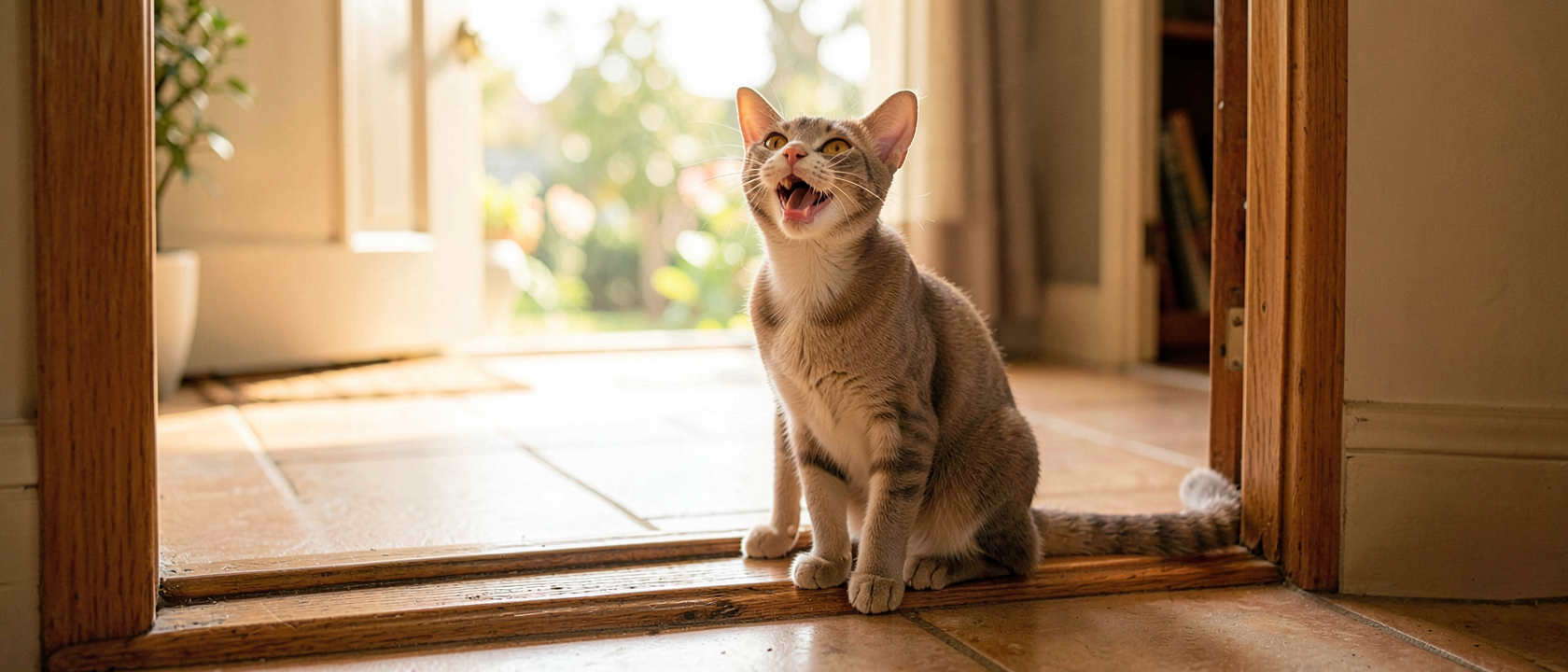
The Welcome-Home Meow Has a Favorite Target
Domestic cats (Felis catus) vocalized at male owners more than twice as often as at female owners during the first 100 seconds after the owner walked through the door: an average of 4.3 meows, purrs, and chirps aimed at men, versus 1.8 aimed at women. The finding comes from Yasemin Salgırlı Demirbaş and colleagues at Ankara University, published in a 2026 paper in the journal Ethology. The team studied 31 cat-owner pairs in their own homes in Turkey between 2022 and 2024, each cat at least 8 months old and settled in the household for six months or more. Owners wore body cameras as they came through the door, capturing exactly how their cat reacted in the moment. The 2.4-fold gap held regardless of the cat’s age, sex, breed, or household size. The only variable that moved the number was the owner’s sex.
What the Data Actually Shows
The researchers tracked 22 distinct behaviors in that footage, not just vocalizations. Some were social bids: tail held upright, approaching the owner, rubbing against their legs. Others were displacement behaviors, the small, seemingly unrelated actions animals produce when caught between conflicting impulses, like body shaking or self-scratching. The list also included yawning, a recognized stress signal in cats, and whether the cat went straight for the food bowl. When the team ran the numbers, the social behaviors clustered together and the displacement behaviors clustered together, a pattern consistent with two distinct emotional states. Vocalization landed in neither cluster, behaving statistically like its own independent signal, with no strong link to the affectionate behaviors or the stress-linked ones. Of all 22 behaviors coded, it was the only one that tracked with the owner’s sex.
A Guess, Clearly Labeled as a Guess
The paper offers one explanation for the pattern, and the authors are upfront that they did not test it directly. Drawing on prior research, they note that female caregivers tend to be more verbally interactive with their cats, better at reading feline vocal signals, and more likely to mimic a cat’s meow back at it. Male caregivers, the Ankara University team proposes, may need a louder or more repeated vocal cue before they notice what the cat wants and respond to it. If that pattern holds inside a household over months, a cat could learn, through ordinary trial and error, that the male owner requires more noise to get a reaction, and direct more of its calls toward him specifically. The idea is plausible and, by the authors’ own account, untested in this dataset. The study measured the vocalizations. It did not run the experiment that would confirm why they happened.
Working Harder for the Less Attentive Owner
Cats are widely assumed to be indifferent to who is paying attention to them, content to ignore whoever happens to be in the room. The pattern in this study argues against that assumption. By the proposed mechanism, that would mean a cat escalating its calls toward the person slower to respond, the opposite of what simple indifference would predict. It also pushes back on a separate misreading that circulated alongside this study: the paper never claims cats bond more with women or manipulate men, and draws no such comparison. What it shows is a cat tracking which person in the household needs more convincing, and adjusting its volume for them.
What the Study Still Doesn’t Tell Us
The sample is small: 31 owners, all in Turkey, recorded between 2022 and 2024. That establishes a measured pattern, but it does not show whether the effect holds across other countries or household setups. The design has one real strength: it relies on recorded footage rather than owner memory or self-report, which most pet behavior research has to depend on. Because vocalization didn’t move with either the social cluster or the displacement cluster, the researchers cannot say what the extra meowing toward men actually communicates. It could mean the cat missed its owner, wanted food, or something the 22 coded categories never captured. The paper documents the what in precise numbers. The why has not been answered.