
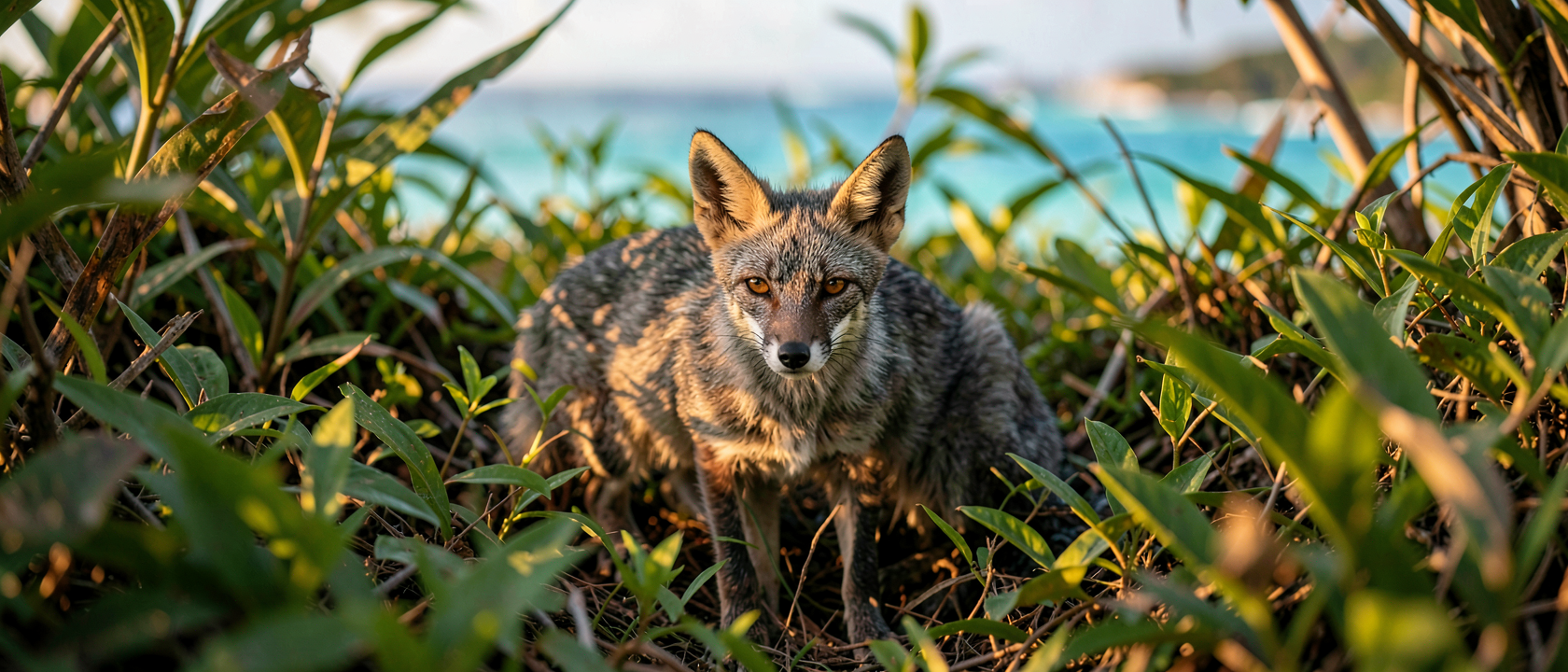
A disoriented fox near kilometer 29
On September 14, 2023, residents near kilometer 29 of Cozumel’s coastal highway reported a fox wandering close to the road, looking lost. Rafael Chacón, director of conservation and environmental education at the Parks and Museums Foundation of Cozumel, and his team went out and found an adult male. They gave him a health check and released him well clear of traffic, in the Laguna Colombia State Reserve on the island’s southeastern side.
That rescue produced the entire evidence base behind a study led by Travis Bayer of Pathos Wildlife, with co-authors Maggie McGreal and Rafael Chacón, published May 4, 2026, in Neotropical Biology and Conservation. It is the first photograph, and the first confirmed sighting of any kind, of a Cozumel fox since 2001. Bayer later called it “a very surreal moment.”
Twenty to forty percent smaller
The Cozumel fox sits in the genus Urocyon, the same genus as the mainland gray fox (Urocyon cinereoargenteus), one of the most widely distributed wild canids in the Americas. It runs roughly 20% to 40% smaller than that mainland relative: same genus, same basic build, just scaled down.
How an island shrinks a predator
The process has a name: insular dwarfism, a pattern in which a mainland species that settles on an island with less food, less space, and fewer large predators stops favoring its biggest bodies. Across generations, average size trends down, because on a limited landmass the smaller animals are the ones that keep surviving and breeding. It is not that big foxes die out in one dramatic event; it is that, generation after generation, a smaller body costs less to run on an island where prey is scarce and territory is tight, so smaller foxes raise more pups that survive to raise pups of their own. Cozumel’s pygmy raccoons and dwarf coatis show the same downward drift in size, which is why researchers treat this as a documented island-wide pattern rather than a coincidence about foxes alone.
A body sized for one island
A smaller predator needs less prey to get through a day, can hide in less cover, and can hold a smaller territory than a mainland gray fox would ever tolerate. That fit, a body scaled to a landmass of about 185 square miles (478 km²), is what the size actually buys the animal. The Cozumel fox carries its own size class for a reason: it is the mainland fox’s answer to one specific island, which is also why the genus Urocyon now counts a third lineage, alongside the gray fox and the island fox (Urocyon littoralis) of California’s Channel Islands.
Twenty-two years without a sighting
With no confirmed sighting between 2001 and September 2023, the working assumption drifted toward extinction, or toward doubt that a viable population still existed outside a handful of old bones. The 2023 capture overturns that assumption directly: the fox is alive, and a healthy adult male was examined and released back into the wild. One photographed fox confirms a sighting. A population remains unconfirmed. Bayer put the real problem plainly: “The biggest challenge facing the Cozumel dwarf fox is that we still know almost nothing about it, including its remaining population size, distribution, or ecology.” Sightings, recent and historical, suggest the range runs no farther north than the village of El Cedral in southern Cozumel, but nobody has mapped it.
The fox still has no scientific name
Whether the Cozumel fox even qualifies as its own species is unresolved. Bayer’s team says that call needs morphological study of the animal’s body and genetic sequencing, neither of which has been done yet. Until then it carries a placeholder, Urocyon sp. Archaeological remains put a dwarf fox on Cozumel for at least 5,000 years, probably longer. As Bayer put it, “species can quietly disappear without the world even realizing they are gone.”
The researchers, working with local biologists led by Chacón, say they have begun drafting an emergency conservation plan for the fox. The plan calls for thermal drone surveys and large-scale camera trap networks, aimed at generating, as fast as possible, the population and distribution data this fox has never had.