
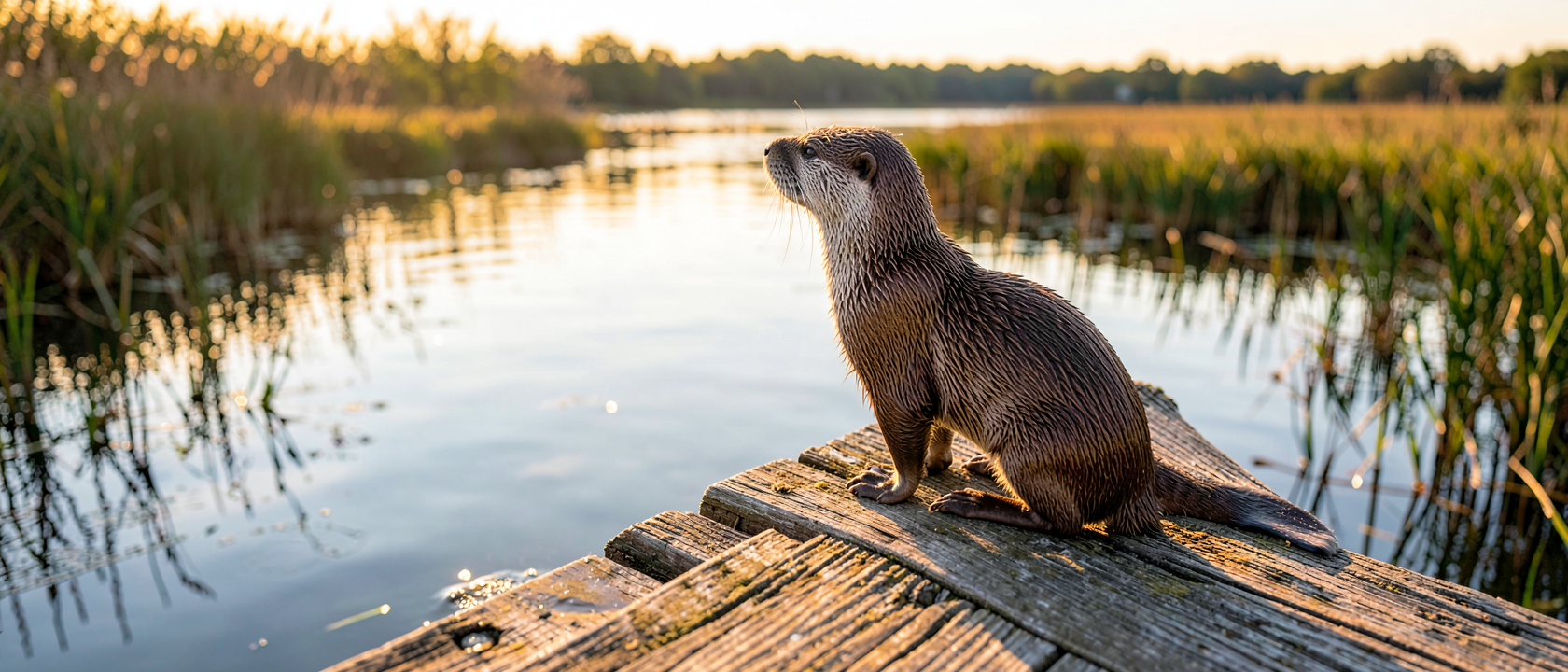
A pile of unusually watery otter droppings on a Smithsonian dock in Edgewater, Maryland, contained a bright red worm nobody could name, and chasing down that single dropping eventually convinced a team of scientists that North American river otters (Lontra canadensis) might be quietly managing the health of their prey, one scat pile at a time.
The Red Worm on the Dock
The story starts with an email. A colleague wrote to Dr. Katrina Lohan, a scientist at the Smithsonian Environmental Research Center (SERC), about a strange pile of scat sitting on the campus dock. It was runnier than normal otter droppings and packed with something nobody could identify: a worm the color of a fire engine. Nobody knew what animal had left it, or what the worm even was.
The mystery sat unsolved until a trail camera aimed at that exact spot caught the culprit on video: a river otter, squatting in broad daylight, doing precisely what otters do on docks. Lohan figured the red worm was probably a parasite. That one ordinary-looking crime scene is what sent her and her team out to start collecting otter scat on purpose.
Eighteen Toilets, Eleven Months, One Very Patient Team
What began as curiosity became a formal study. Dr. Katrina Lohan and first author Calli Wise, working with SERC and Frostburg State University, tracked 18 active river otter latrines along a subestuary (a smaller tributary branch) of the Chesapeake Bay for 11 months, collecting an average of 28 scats per site. The results were published in Frontiers in Mammal Science on August 14, 2025.
The scats, Wise reported, usually smelled strongly of fish and were full of scales and crab shell; the team wore gloves and used sterile tools to avoid contaminating samples with their own DNA. Running the scats through DNA metabarcoding, a technique that identifies species by matching short genetic sequences against reference databases, plus straightforward microscope work, the team reconstructed what Chesapeake otters are actually eating, site by site. Finfish and crabs made up 93% of everything identified, with the American blue crab the single most common crustacean. The otters also took amphibians, worms, the occasional duck, and two invasive species: common carp and southern white river crayfish.
Why the Toilet Is the Goldmine
None of this works without understanding what a latrine actually is. River otter latrines are not just toilets. They are communal hubs, reused again and again, where otters scent-mark through urine and droppings but also eat, play, socialize, and rest. Of the 18 sites studied, five sat on docks, boardwalks, and shoreline staircases; the rest were on natural shoreline among woody debris, with open water nearby and enough flattened vegetation to hide in.
Because otters tend to eat at or near the latrine itself, undigested fragments of their last meals, scales, shell, worm larvae, pile up in the same spot over time instead of scattering across open water. That is what let a stack of droppings double as both a diet record and a parasite record. Watching otters hunt underwater for 11 months would never give you this picture. A latrine does the job on its own, one deposit at a time.
The Otter as Ecosystem Bouncer
The parasite side of the data turned out to be the more interesting half. Metabarcoding found parasites from six taxonomic classes in the scat, most of them trematodes, flatworms commonly called flukes. The majority were species known to infect teleost fish, a diverse group of ray-finned fish that make up most of the otters’ diet, rather than the otters themselves. Only a handful of the parasites found were capable of infecting otters directly.
Lohan reads that pattern as a clue about who the otters are actually catching. If most of the parasites in the scat came from the prey rather than the predator, it suggests otters are disproportionately grabbing fish and crabs that were already weakened or slowed by infection. She goes further, proposing that otters, like other top predators, might struggle to catch enough food at all without parasitized prey making the hunt easier, effectively making otters something like ecosystem engineers that cull the already-compromised animals out of a population before they can reproduce. She also raises a second possibility: because otters are mammals that could share certain parasites with humans, and because they feed in waterways people use too, tracking parasites moving through otter populations could work as a kind of disease-sentinel system, flagging public health risks in a given area for free.
What Nobody Can Say Yet
Here is the honest limit of the study. Many of the parasites recovered from the scat could not be identified at all, not because the DNA was poor but because the genetic reference databases used to match it simply do not contain anything close yet. The team also could not trace any single scat, or any single parasite, back to one specific otter, since multiple animals share every latrine and none were individually tagged.
That means “ecosystem engineer” and “disease sentinel” are hypotheses the data points toward, not conclusions it has proven. Whether otters are actually reshaping the fate of Chesapeake fish and crab populations, one weakened animal at a time, is still an open question, sitting on the same dock where a red worm started the whole project.