
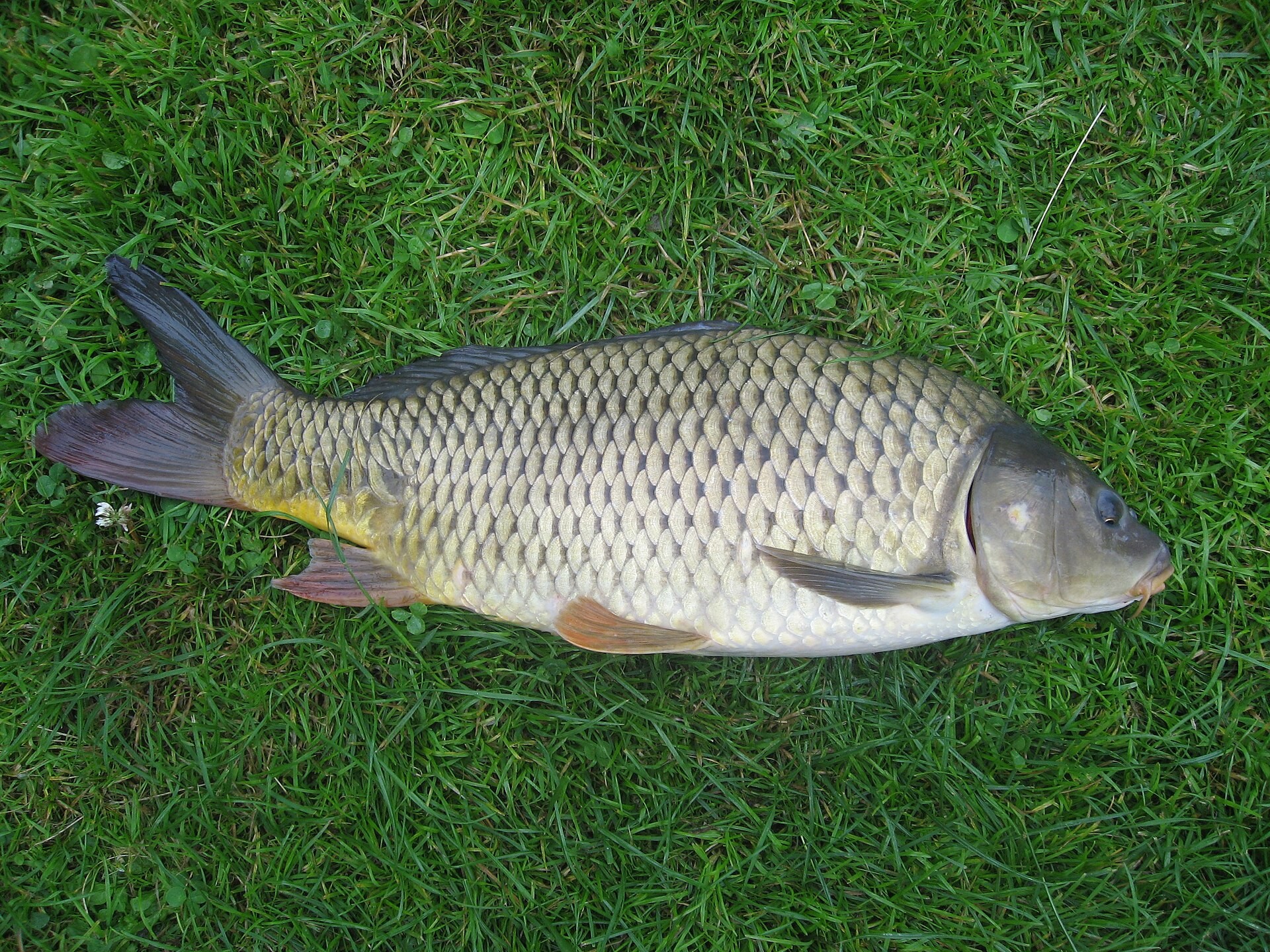
Buglemouth, known scientifically as Cyprinus carpio, is a large freshwater fish in the family Cyprinidae and the type species of the genus Cyprinus Linnaeus, 1758, meaning every other “true carp” is classified by reference to it. Carl Linnaeus formally described the species in 1758 in his Systema Naturae, page 320, noting a European freshwater fish with four barbels and a serrated dorsal spine. Few fish species occupy such contradictory positions in ecology and economy: wild native populations carry a Vulnerable listing on the IUCN Red List, while the same species appears on the List of the World’s 100 Worst Invasive Species and exceeds 4 million tonnes of annual aquaculture production globally. The maximum recorded individual reached 129 cm in length and 40.1 kg in weight, and one fish lived to at least 38 years.
Key facts
- Scientific name: Cyprinus carpio
- Kingdom: Animalia
- Phylum: Chordata
- Order: Cypriniformes
- Family: Cyprinidae
- Genus: Cyprinus
- Taxonomic rank: species
- Length: 53 cm
- Main food: insect; zooplankton; Palinuridae; Mollusca
Physical characteristics
Body coloration runs from olive-green to dusky bronze across the back, with shimmering golden flanks and a pale yellow or whitish belly. The long dorsal fin carries 17 to 22 soft rays preceded by a stout, serrated spine, and the lateral line is made up of 32 to 38 scales. According to FishBase, the maximum recorded total length is 129 cm, maximum published weight is 40.1 kg, and maximum reported age is 38 years, though the species is recorded at a typical length of 53 cm across most populations.
Wild individuals are distinguished from domesticated forms by a less stocky build, with body height measuring 1:3.2–4.8 times the standard length. The pharyngeal teeth are molar-like, with a flattened or furrowed crown suited to grinding hard food items. Two pairs of sensitive barbels on the upper jaw are used for locating food in dark benthic environments, detecting items by both touch and taste in murky substrate. A well-developed lateral line system runs along the side of the body, functioning as a sensory organ for detecting water movement and pressure changes, including vibrations transmitted through the water column.
Feeding biology
Its principal foraging strategy is bottom sifting: the fish sucks up sediment and water through the protrusible mouth and filters edible particles using specialized pharyngeal teeth in the throat. This behaviour causes significant bioturbation of lake and river sediments, destabilizing substrate and releasing nutrients into the water column, with measurable consequences for aquatic plant communities and other benthic organisms.
Reproduction
Spawning females are typically followed by several males; the species is polygamous and spawns in marginal, shallow, weed-infested areas. In temperate waters the species is a seasonal spawner, while under tropical conditions it breeds throughout the year. Male common carp reach sexual maturity at 3 to 5 years and females at 4 to 5 years, and there is no parental care after fertilization.
Eggs range from 1.2 to 1.4 millimeters in diameter, are yellowish-green in color, and typically hatch within four days. Females can produce 100,000 to 300,000 eggs per kilogram of body weight, with reports of more than one million eggs produced by a single female in one season. That reproductive output partly explains both the species’ success in aquaculture and its capacity for rapid population expansion following introduction to new water bodies.
Native range and natural history
The species is native to freshwater basins draining into the Black, Caspian, and Aral seas. Researcher Balon (1995) concluded that C. carpio evolved in the Caspian Sea and subsequently migrated naturally to the Black and Aral Seas and westward to the Danube River. Common carp generally inhabit lakes, ponds, and lower sections of rivers with moderately flowing or standing water, and are also found in brackish-water estuaries, backwaters, and bays.
Genome studies identified a Barbinae lineage as the potential diploid progenitor of C. carpio. Those same studies estimated that the two diploid progenitors diverged approximately 23 million years ago before merging approximately 12.4 million years ago, producing the polyploid genome the species carries today.
Aquaculture history
Fish bones recovered from the Early Neolithic Jiahu site in Henan Province, China, show that managed aquaculture of common carp was practiced by approximately 6000 BC. Research published in 2019 in Nature Ecology and Evolution established this as one of the earliest known examples of aquaculture, predating the previously accepted history of fish farming by thousands of years.
Domestication produced body forms and coloration far removed from wild populations. A 2025 study using a real-time biosensor found that the Qingtian paddy field carp variety of C. carpio exhibits superior adaptation to shallow water conditions compared to pond-domesticated forms, showing higher stress tolerance and faster recovery through lipid-based energy utilization. The contrast between Qingtian paddy field carp and conventional pond-reared forms illustrates how divergent selective pressures can operate across domesticated lineages of the same species.
Invasive spread and ecological impact
The introduction history of common carp outside its native range spans multiple continents. In the Murray-Darling Basin of Australia, common carp were introduced in the mid-1800s. Following extensive flooding events in the 1970s, the species spread across much of the basin and came to represent up to 90 percent of total fish biomass in some stretches, according to published records.
In the United States, the federal government’s own distribution program accelerated the spread. In 1882, the U.S. Fish Commission shipped 260,000 carp by rail to 298 out of 301 congressional districts in a single year, reaching also the Hawaiian Islands. Spencer F. Baird, director of the U.S. Fish Commission, described the species as ranking ‘with the trout’ as a food fish in that same year. By the turn of the 20th century, public opinion had reversed and the species was widely regarded as a nuisance.
Conservation status
Wild native populations of Cyprinus carpio are listed as Vulnerable on the IUCN Red List. At the same time, the species appears on the List of the World’s 100 Worst Invasive Species for its destructive ecological impacts outside its native range, placing it in the rare category of organisms simultaneously threatened in one region and threatening in another.
Global aquaculture production of common carp surpasses 4 million tonnes per year, making it one of the most farmed freshwater fish on Earth. The divergence between wild population vulnerability and cultivated abundance is not merely statistical.
Genomics
The common carp genome carries the record for the most recent whole-genome duplication documented among all vertebrates studied. The carp-specific fourth duplication is dated to approximately 8 million years ago. Genome studies have also traced the two diploid progenitor lineages to a divergence point around 23 million years ago and a merger approximately 12.4 million years ago, establishing a detailed evolutionary timeline for the species’ polyploid origin.
Did you know
- The major U.S. introduction of common carp in 1882 was so extensive that the U.S. Fish Commission shipped 260,000 carp by rail to 298 out of 301 congressional districts in a single year, as well as to the Hawaiian Islands. (invasions.si.edu)
- A common carp caught by angler Michel Schoenmakers at Euro-Aqua Lake in Hungary in 2018 holds the rod-and-reel weight world record at 51.20 kg (112 lb 14 oz), while the length record of 129 cm was set on the Sava River in Serbia in 2001. (fishing-worldrecords.com)
- In 1882 the species originally welcomed as a prized food fish by U.S. officials was described as ranking “with the trout” by Spencer F. Baird, director of the U.S. Fish Commission, yet by the turn of the 20th century it was widely regarded as a nuisance fish. (invasions.si.edu)
- The common carp’s genome underwent not three but four rounds of whole-genome duplication, and the fourth (carp-specific) duplication, dated to approximately 8 million years ago, is considered the most recent genome duplication among all vertebrates studied. (ncbi.nlm.nih.gov)
- Research published in 2019 in Nature Ecology and Evolution showed that managed aquaculture of common carp at the Early Neolithic Jiahu site in China, around 6000 BC, predates the previously accepted history of fish farming by thousands of years. (nature.com)
- Despite being classified as Vulnerable in its native range on the IUCN Red List, the common carp is simultaneously one of the most farmed freshwater fish on Earth, with global aquaculture production surpassing 4 million tonnes per year, illustrating a paradox between wild population decline and cultivated abundance. (ncbi.nlm.nih.gov)
Data sources
- GBIF
- Wikidata
- zenodo.org
- marinespecies.org
- ecoregistros.org
- fishi-pedia.com
- fishbase.se
- nas.er.usgs.gov
- uh.app
- iucngisd.org
- animaldiversity.org
- ncbi.nlm.nih.gov
- nature.com
Data updated: 2026-10-28