
The Fight Nobody Expected
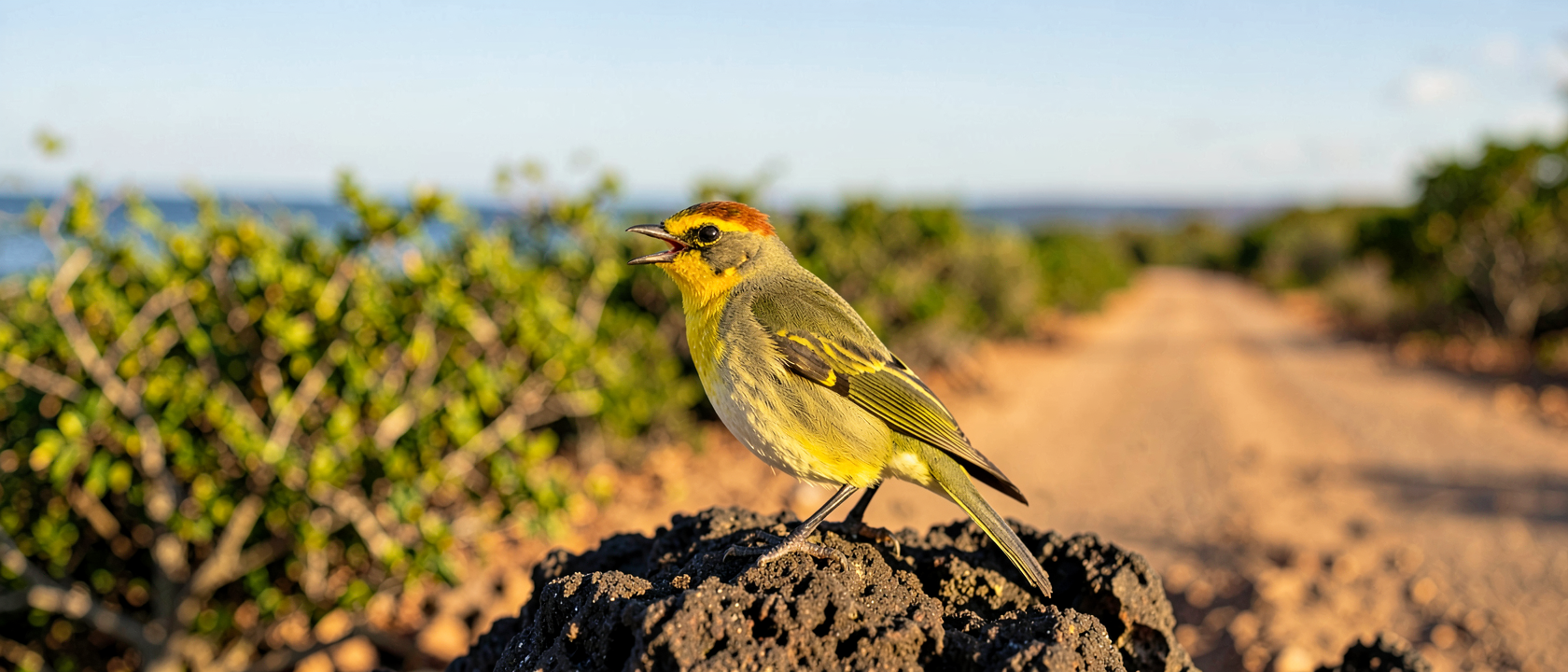
A male Galápagos yellow warbler (Setophaga petechia aureola) that holds a territory beside a paved road does not back off when a truck goes by. It gets meaner. A 2025 study of 38 warbler territories on Santa Cruz and Floreana islands, published in the journal Animal Behaviour and led by researchers from Anglia Ruskin University and the Konrad Lorenz Research Centre at the University of Vienna, found that roadside males escalated their aggression toward a simulated rival exactly when recorded traffic noise started playing alongside the rival’s song. They puffed into a combat stance, closed the distance to the speaker, and in some trials struck the speaker outright. This is not a finding about “birds near roads” in general. It is this subspecies, on these two islands, reacting to this specific noise.
Isolating the Noise, Not the Road
The obvious objection is that roadside birds might just be different birds to begin with, bolder individuals that happened to settle near traffic. The researchers built that objection out of the design. They classed territories as near a road or at least 299 feet (91 m) from one, then ran two playback versions at each site: a rival male’s call alone, and the same call with a layer of recorded car noise mixed in. The aggression spike tracked the noise, not the location. Birds already living beside the road got more aggressive when the noise played; birds living farther away actually calmed down under the same noise, as if a rival’s song in traffic simply did not register as urgent. During the noisy trials, warblers also lengthened their songs and raised the pitch of the lowest notes, nudging their calls out of the frequency range that traffic occupies. The effect held even on Floreana, a road with roughly 10 vehicles on it, which says the threshold for triggering this response is low.
Why Noise Would Make a Bird Fight Harder
The study authors treat song and physical aggression as two tools for the same job: settling a territorial dispute without bloodshed. A rival’s song usually carries enough information to assess the threat from a distance. When traffic noise buries part of that signal, the bird cannot read the situation as clearly, so escalating to a close, physical confrontation becomes a safer bet than waiting and possibly misjudging it. The authors also raise a learning explanation: birds that hold territories near the road hear this exact pairing of song and traffic constantly, and may have picked up that traffic noise signals a fight is coming. The stakes here are not abstract. An earlier study by Garcia-Carrasco et al. (2020) found that this subspecies made up 70% of the roadkill recorded on Santa Cruz’s main road. The Galápagos’ resident human population is growing by about 6% a year, and the study authors point to that growth as the reason the islands now function as a live, unplanned laboratory for watching bird temperament under new pressure. The same shift toward urban confrontation has turned up in great tits, European robins, song sparrows, and dark-eyed juncos living near built-up areas, so this warbler is not pulling off a one-off trick. Cornell Lab of Ornithology’s Mike Webster, who was not involved in the study, called it a clear demonstration of how a single environmental change can shift behavior.
The Myth: Aggressive Doesn’t Mean Neglectful
It is tempting to assume a scrappier bird must be a worse parent, as if combativeness and care were drawn from the same limited tank. A separate study of song sparrows in southwestern Virginia, led by Sarah Foltz of Radford University, tested exactly that assumption in a different species entirely, and it did not hold. More aggressive females spent equal or more time tending the nest than their calmer, rural counterparts. Fighting harder for a territory and attending to the nest inside it turned out not to be competing expenses.
Learned or Born That Way?
What nobody has settled is where this boldness comes from. Jeremy Hyman of Western Carolina University calls the question of whether urban birds learn their aggression during life, or are simply born more combative, a “big unanswered question,” with evidence pointing in both directions. Hyman also raises a harsher possibility for urban and roadside birds generally: a noisy, disturbed edge habitat may simply weed out anything but the boldest individuals, since only a genuinely combative bird can hold a territory under constant disturbance in the first place. That idea is his broader read on urban bird aggression, not a conclusion the warbler study itself tested. Sarah Foltz notes that aggression clearly has a genetic component, yet the same birds visibly shift their behavior when their surroundings change, which argues for some real-time flexibility layered on top of whatever they were born with. Foltz adds that whether more aggression actually helps a bird survive depends on the environment, and nobody has mapped that out across species yet. The honest answer, for now, is probably both nature and learning, in proportions nobody has measured.