
The Gene Everyone Was Looking in the Wrong Place For
An orange cat’s coat does not come from a mutated pigment gene. It comes from a 5-kilobase deletion sitting inside an intron of a gene called ARHGAP36, a gene nobody had ever connected to fur color, and that deletion drives the gene’s activity in skin cells up 13-fold. That is the answer geneticists spent roughly 60 years hunting for.
A Sixty-Year Puzzle, Solved Twice
Orange cats have been bred, shown, and painted for centuries, and the trait is famously tangled with sex: tomcats go solid orange or solid black, queens go calico or tortoiseshell. Geneticists could map the gene to the X chromosome decades ago but never found the culprit itself. Two teams finally did, independently, and published within the same issue of Current Biology on May 15, 2025, after their findings had already circulated as preprints in 2024. One team was led by Stanford University geneticist Christopher Kaelin and Greg Barsh; the other by Kyushu University’s Hiroyuki Sasaki, with Hidehiro Toh as first author. Barsh had called it, bluntly, “a genetic mystery, a conundrum.” Both labs expected to find the mutation inside the protein-coding part of some known pigment gene, the kind that sets coat color in mice or horses. Neither did. Two separate groups landing on the exact same, unexpected gene is a strong form of replication, the kind biology rarely gets handed twice in the same year.
Not a Broken Gene. A Volume Knob.
The mutation Barsh’s team found was not a change to a protein. It was a 5-kilobase deletion inside an intron, a stretch of DNA within the gene that doesn’t code for protein, sitting next to the gene’s coding region. That deletion doesn’t disable the gene: it removes something that was holding its expression down. In orange-furred skin cells, ARHGAP36 produced 13 times more RNA than skin cells from cats with no orange hair. The Kaelin team traced the downstream effect: the overactive gene interferes with a signaling step, activation of protein kinase A, that sits downstream of a receptor called Mc1r, the same receptor long known to control red-versus-black pigment switching in many mammals. Toh’s team showed the practical result of that interference: the surge in ARHGAP36 suppresses dark eumelanin pigment and lets reddish-yellow pheomelanin take over instead. The deletion turned up in every single orange and calico or tortoiseshell cat in a 188-cat database, 145 orange cats and 6 calico or tortoiseshell cats, with none of the 37 nonorange cats carrying it. Sasaki’s team found the same deletion separately, in 10 orange cats out of an 18-cat sample, and later confirmed it across a global database of 258 cats, again absent from every non-orange animal.
Why Your Orange Cat Is Almost Certainly Male
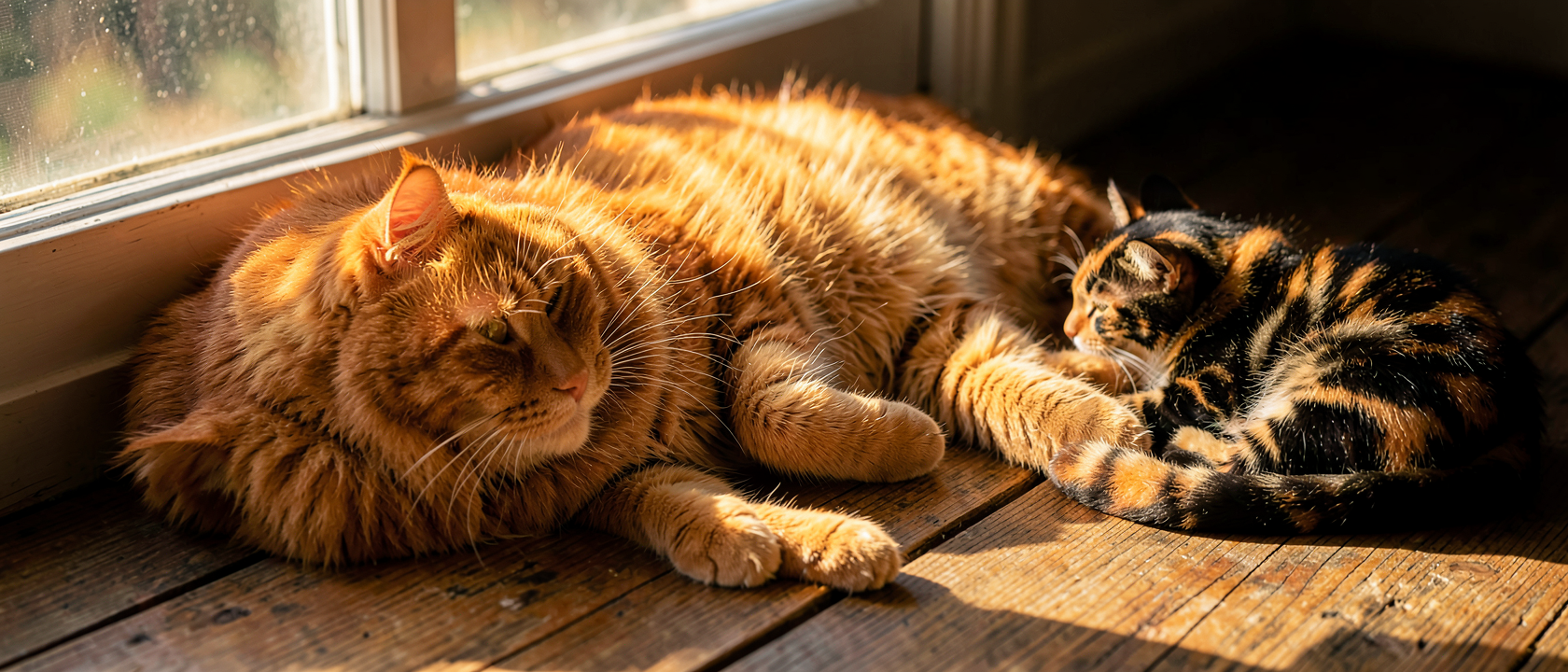
ARHGAP36 sits on the X chromosome, right where decades of breeding records had already placed this trait. Male cats carry one X, so they get one verdict: the deletion present means fully orange, absent means no orange at all. Female cats carry two X chromosomes, and every cell in a female mammal’s body randomly shuts off one of its two X’s during early development. A female cat with the deletion on one X and not the other ends up as a patchwork, some skin cells running the active copy, some not. That patchwork is a calico or tortoiseshell cat. A female cat with the deletion on both X’s skips the patchwork entirely and comes out solid orange, just like a male. Barsh’s team also identified a separate white-spotting mutation that explains why calicoes get large, clean-edged blocks of color while tortoiseshells get a fine, mottled mix: the white-spotting mutation changes how far surviving melanocyte clones, the pigment-producing cells that migrate out across the developing skin, manage to spread before settling.
The Myth: Orange Cats Aren’t Wired Any Differently
The internet has decided orange cats run a little dumber, a little goofier, a little more accident-prone than other cats. There is nothing in either paper to back that up. The elevated ARHGAP36 activity these teams measured was specific to skin cells, and neither study found any link between the deletion and cognition, behavior, or health outcomes; the claim is, in the researchers’ own framing, scientifically unsupported. It is fine to keep the joke. It is just not biology.
What Nobody Has Nailed Down Yet
ARHGAP36 is active elsewhere in the body too, including regions of the brain and in hormone-producing glands like the pituitary, which raises a real possibility researchers have flagged but not confirmed: that this deletion might do something beyond coat color somewhere else in a cat’s biology. Nobody has tested that yet. Nor has anyone pinned down when or why this particular deletion first appeared. Based on how calico cats show up in historical paintings, Kaelin and Barsh’s team has floated the idea that the ancestral mutation may trace back to a single cat more than 900 years ago, but that is a proposal built on art history, not a dated finding. The deepest version of the second why, what advantage, if any, let this deletion spread through domestic cat populations, is still unanswered. Sasaki put it simply after finishing the search: “Identifying the gene has been a longtime dream, so it’s a joy to have finally cracked it.” The joy covers the gene. The origin story is still open.