
The Bachelors of Flying Foam Passage
The Headgear
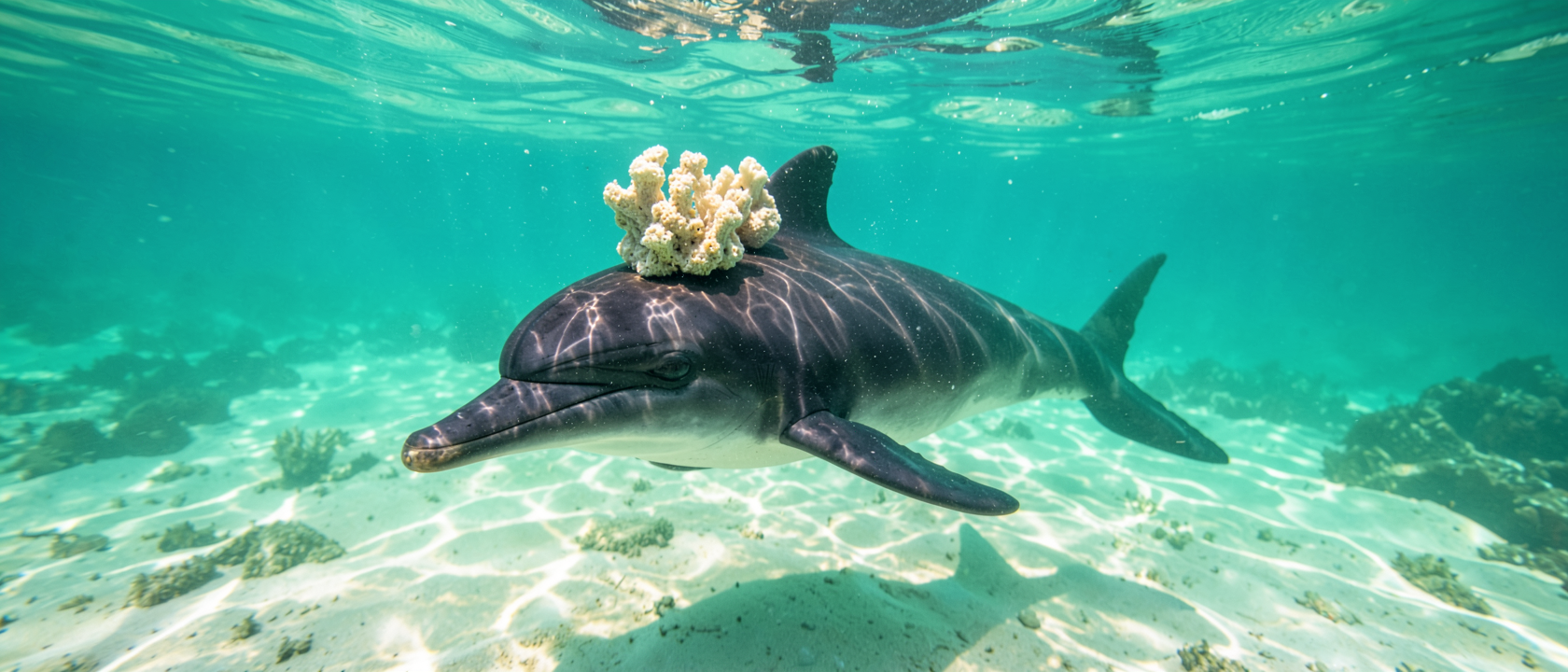
Off the Burrup Peninsula in Western Australia, male Australian humpback dolphins (Sousa sahulensis) have been photographed cruising through the water with a sea sponge balanced on top of their heads. Scientists from the Department of Biodiversity, Conservation and Attractions (DBCA) captured the images while surveying Flying Foam Passage, a channel running through the Dampier Archipelago. The sponges are not identical props: some are squat and round, others ragged and elongated, in colors from pale cream to deep rust. Enough males have turned up wearing one that DBCA researchers no longer treat it as a one-off curiosity. It is a pattern with a name now: sponge fashion.
The Bouquet Theory
DBCA marine biologist Holly Raudino has an explanation, offered through the department’s own channels: the sponge works as a courtship offering, something a male presents to a female the way a person might hand over flowers. That reading is not plucked from nowhere. Back in 2017, researcher Dr. Allen and colleagues described a related display across northern Australia, the so-called “banana pose,” in which a male humpback dolphin lifts his head and tail out of the water, often with a sponge perched on his forehead, as one piece of what Allen called a multimodal socio-sexual courtship display. The sponge, in that framework, is a prop in a bigger performance, not the whole show.
Why a sponge would work as a love token is still an open question, but Allen offered a proposed mechanism worth sitting with: sea sponges are wedged into the ocean floor and are genuinely hard to rip free. Tearing one loose takes real effort, which means a male showing up with one in his mouth is, in effect, flexing. It is a demonstration of strength dressed up as a gift. Nobody has confirmed that females respond to the sponge itself rather than the pose, the swimming, or something else entirely in the display, so call this an educated guess from the researcher who first described the behavior, not a settled fact.
Not the Sponge You Know
If this sounds familiar, resist the shortcut. The dolphin world’s well-known sponge users are Indo-Pacific bottlenose dolphins (Tursiops aduncus), especially the population at Shark Bay, who carry a sponge over the rostrum, the long bony snout, while digging through the seabed for fish hiding in the coral. There, the sponge is a tool: it protects the dolphin’s face from sharp rock and coral, a behavior passed down matrilineally, from mother to calf. It has nothing to do with romance. The Pilbara dolphins are a different species, wear the sponge on the head rather than the snout, and use it, as far as DBCA can tell, to court rather than to eat. No other dolphin population anywhere has been reported doing this particular headwear display.
Nobody Knows How Far This Goes
The behavior has only turned up at a handful of sites along the Western Australia coast: the Dampier Archipelago, Exmouth Gulf to the south, and the Kimberley coast further north. Whether that is the real range of sponge-wearing, or simply the range of places where someone has been close enough with a camera, is unresolved. Australian humpback dolphins live across a long stretch of coastline running from northern Australia into Southeast Asian waters, and most of that water gets far less observation than the Pilbara coast does. The honest answer, for now, is that nobody knows whether this is a local habit or a widespread one that has simply never been photographed.
The Orcas Wore Salmon First
Dolphins are not the only cetaceans to go through a head-fashion phase. Orcas off the Pacific Northwest have been filmed and photographed wearing dead salmon on their heads, a spectacle that went viral. Unlike the Pilbara sponge display, nobody has proposed a courtship link for the salmon hats; it stands as a single documented case, a story about specific orcas on specific days, not a described behavior with a theory attached. Line the two up and the real pattern is not that cetaceans decorate themselves for love. It is that two unrelated whale species, oceans apart, have each been caught mid-trend for reasons nobody has nailed down.
A Species Nobody Named Until 2014
Australian humpback dolphins were not recognized as their own species until 2014, when they were split off from other humpback dolphin populations and formally described as Sousa sahulensis. They are currently classed as vulnerable, with fewer than 10,000 adults estimated to survive. Their Pilbara habitat, including the waters around the Burrup Peninsula, sits beside an expanding footprint of petroleum and mineral export infrastructure, which a 2023 study led by Raudino names as a likely major threat through habitat loss and degradation. A species given a name this recently, swimming past that kind of construction, still has a courtship ritual nobody has confirmed. That gap, between what has been photographed and what has been proven, is most of what anyone actually knows about these dolphins.