
A Three-Year Clock That Slipped to Four
Southern right whales (Eubalaena australis) that come to calve in the Great Australian Bight used to have a calf roughly every three years. Since around 2015, that gap has stretched toward four, according to more than three decades of shore-based monitoring, run from 1991 to 2024 at a calving ground inside the Yalata Indigenous Protected Area in South Australia. The study, led by Flinders University associate researcher Claire Charlton with Curtin University colleagues and published in Scientific Reports, tracked 1,144 calving events across 696 individually identified whales. The number behind the headline: the average interval between births climbed from 3.4 years to 4.1 years, a shift measured over a single decade, not one rough season skewing an average. It cuts against the tidy comeback story most people assumed was already finished.
How You Track the Same Whale for 33 Years
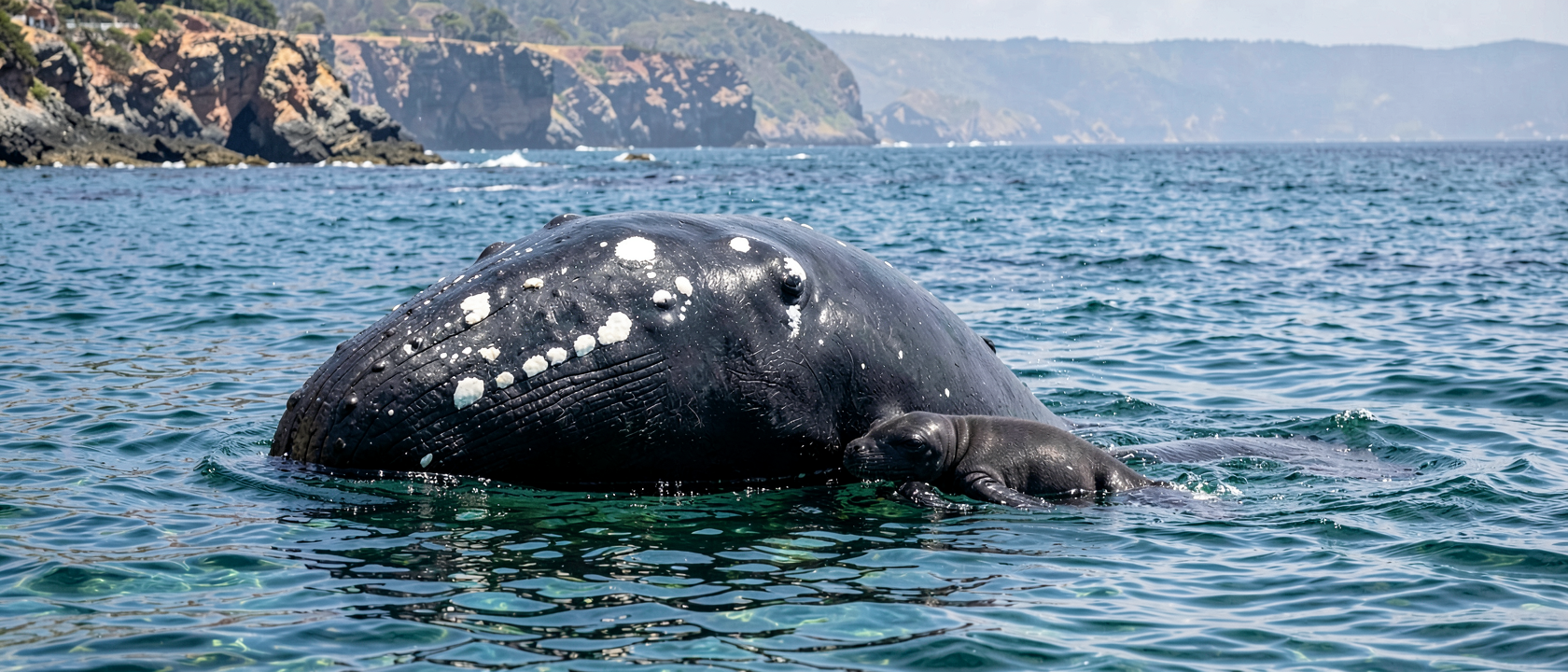
Southern right whales have no dorsal fin, a stocky black body, and a head crowded with callosities: raised patches of thickened skin colonized by whale lice, which turn them pale gray or orange. The pattern is set while a whale is young and then stays fixed for life, as individual as a fingerprint. Researchers photograph the same patches on the same animals, season after season, and build a calving record female by female: this whale had a calf in 1998, then nothing again until 2019. That photo-identification method, used on right whale populations worldwide, is what turns “3.4 years to 4.1 years” into a measured interval rather than a guess built from counting shapes in the water each winter.
The Nursery Bill Gets Paid an Ocean Away
Southern right whales don’t feed anywhere near where they give birth. The Bight is a nursery, not a cafeteria. Mothers nurse their calves there through the Australian winter, then migrate south into the Southern Ocean, close to the edge of the Antarctic sea ice, to spend the rest of the year feeding on krill. A pregnancy followed by roughly a year of lactation is an enormous energy cost, and a female has to bank most of that fat thousands of miles from the water where her calf is actually born. Charlton’s team links the longer calving interval to a decade of warming in the Southern Ocean, shrinking Antarctic sea ice, and a persistently positive phase of the Antarctic Oscillation, a shift in regional wind and current patterns that points toward less krill reaching the whales’ feeding grounds. If a female can’t rebuild her reserves fast enough, she skips a breeding year, then sometimes another. That makes the species a kind of sentinel: a slow-breeding animal whose own reproductive timing works like a running ledger of conditions in an ocean most people never connect to a nursery bay on the South Australian coast. The researchers present this as the explanation that fits the pattern, not yet as a proven mechanical chain.
The Comeback Story Needs an Update
Southern right whales are routinely held up as proof that conservation works: hunted down to as few as 300 animals worldwide by commercial whaling, then protected into a slow recovery toward roughly 15,000. That rebound is real, and it happened over the 20th century. What the 1991 to 2024 Bight dataset shows is that the trend has reversed over the past decade: calving has slowed, not accelerated, since around 2015. A follow-up census covering 50 years of records, reported September 6, 2026, found the pattern continuing, with the typical cycle between calves now running closer to five years, according to Dr. Smith, a researcher involved in that follow-up analysis. None of this looks like an Australian quirk. The Conversation article behind this research notes that reduced calving has also turned up in southern right whale populations off South America and off South Africa, though whether those slowdowns share the same Southern Ocean mechanism as the Bight whales is still unresolved.
What Nobody Has Measured Yet
What the Flinders and Curtin team has not shown is a direct causal chain running from melting sea ice to an empty calving bay. The link between warming Southern Ocean conditions and longer calving intervals is a correlation in timing, not a demonstrated mechanism. There is no published figure for how much krill biomass has actually dropped, and no measurements of individual whale body condition, such as blubber thickness, to confirm that mothers are arriving at the Bight thinner than they used to. The dataset also can’t say whether the total number of southern right whales is falling, or simply spreading the same number of calves across longer gaps while the population itself holds steady. Whether the interval keeps stretching toward five years and beyond depends on two things the whale data alone cannot settle: how Southern Ocean krill fisheries are managed, and how the broader climate trend unfolds.