
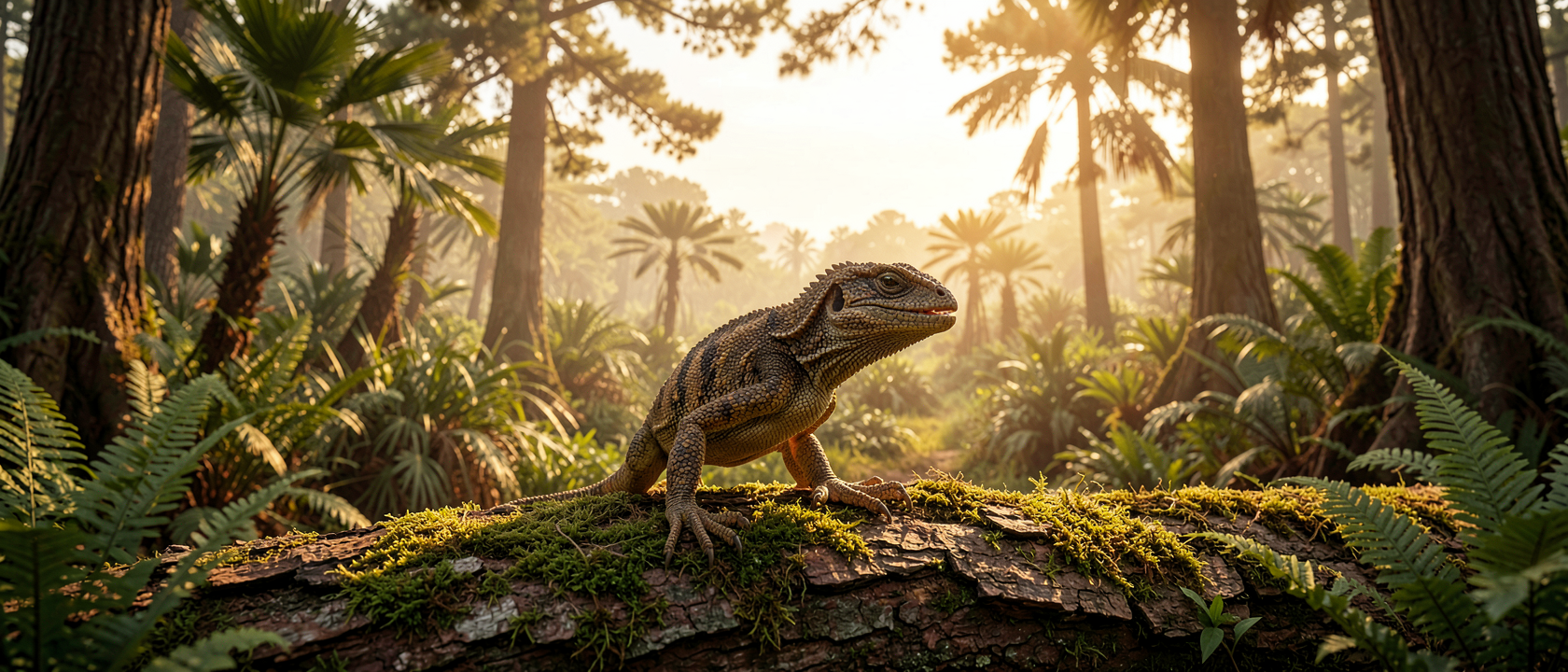
The tiny Jurassic lodger nobody expected
A reptile about 6 inches (16 centimeters) long, small enough to curl up in an adult human’s palm, lived its entire life a few hundred feet from an Allosaurus nest in what is now northern Wyoming, 150 million years ago. Paleontologists at the Smithsonian’s National Museum of Natural History, including curator of Dinosauria Matthew Carrano and research associate David DeMar Jr. working with University College London scientific associate Marc Jones, described the animal as a new species, Opisthiamimus gregori, in a paper published September 15, 2022, in the Journal of Systematic Palaeontology. The fossil came out of the Morrison Formation, the same rock layer that has given up Stegosaurus and Allosaurus skeletons for well over a century. While those two dominate every mental picture of the Jurassic, something this small was living underfoot the whole time, close enough to the Allosaurus nest site to have practically been a neighbor.
Getting a flattened fossil to talk
The skeleton arrived crushed flat, pressed into the stone like a leaf in a book. To read it, the team scanned the fossil with high-resolution CT at three separate facilities, then digitally reassembled the bones into a 3D model accurate to a fraction of a millimeter. The reconstructed skull came out to just 0.81 inches (2.05 centimeters) long. That rebuild is what let the researchers see something a flattened fossil would never have shown on its own: teeth fused directly onto the jawbone, rather than sitting in individual sockets the way most reptile teeth do, and a jaw built to saw back and forth rather than simply clamp shut.
Why the chewing motion is the whole story
That sawing bite is not a quirk. Paired with the tooth shape and a notably rigid skull, it points to a specific diet, something the UCL-led team concluded Opisthiamimus was built for: insects, and probably harder-shelled prey like beetles or water bugs. That exact combination, jaw mechanics and tooth setup for cracking small, hard-bodied prey, survives today in exactly one living animal: the tuatara of New Zealand, still doing the same job, the same way, 150 million years later. The resemblance runs further than diet. Opisthiamimus looks like a miniature version of the tuatara, which grows to roughly five times its length.
The “lizard” that technically never has been one
The tuatara gets called a lizard constantly, and it is easy to see why: it basks on rocks, it has four legs and a tail, and it looks the part. It is not one. Opisthiamimus and the tuatara both belong to Rhynchocephalia, an order that split off from true lizards more than 200 million years ago. The tuatara’s resemblance to a lizard is a case of two separate branches of reptile ending up looking similar, not evidence that one is a member of the other’s family. Calling a tuatara a lizard is a bit like calling a bat a bird because both have wings.
An entire order, down to one address
Rhynchocephalians were not always this rare. Other species in the order are known from scattered fossils, teeth and jaw fragments turning up in different places, while Opisthiamimus stands out precisely because its skeleton is one of the first nearly complete rhynchocephalian fossils found in North America. For most of the Mesozoic, this was a reptile group common enough to matter, before lizards and snakes gradually took over as the planet’s default reptile. Why that happened is genuinely unresolved. Matthew Carrano has floated competition from expanding lizard populations, shifts in global climate, and changing habitats as plausible pressures, but no single explanation has been confirmed. The ending is known: one species left, confined to islands off New Zealand. The cause of the ending is not.
Two bone flecks and a volunteer’s patience
None of the above exists without a very small, very unglamorous moment in 2010, when museum fossil preparator Pete Kroehler noticed two tiny specks of bone poking out of a block of Morrison Formation rock, with no idea yet whether they belonged to anything worth the trouble. They did. Freeing the skeleton from that stone fell to museum volunteer Joseph Gregor, who spent hundreds of hours scraping and chiseling it loose, grain by grain, work that made the later CT scans, and the whole reconstruction, possible in the first place. The species name honors him directly: gregori. The dramatic science came after. The tedious part came first, and it took hundreds of hours longer than any of it.