The Vacancy Sign Off Gansbaai
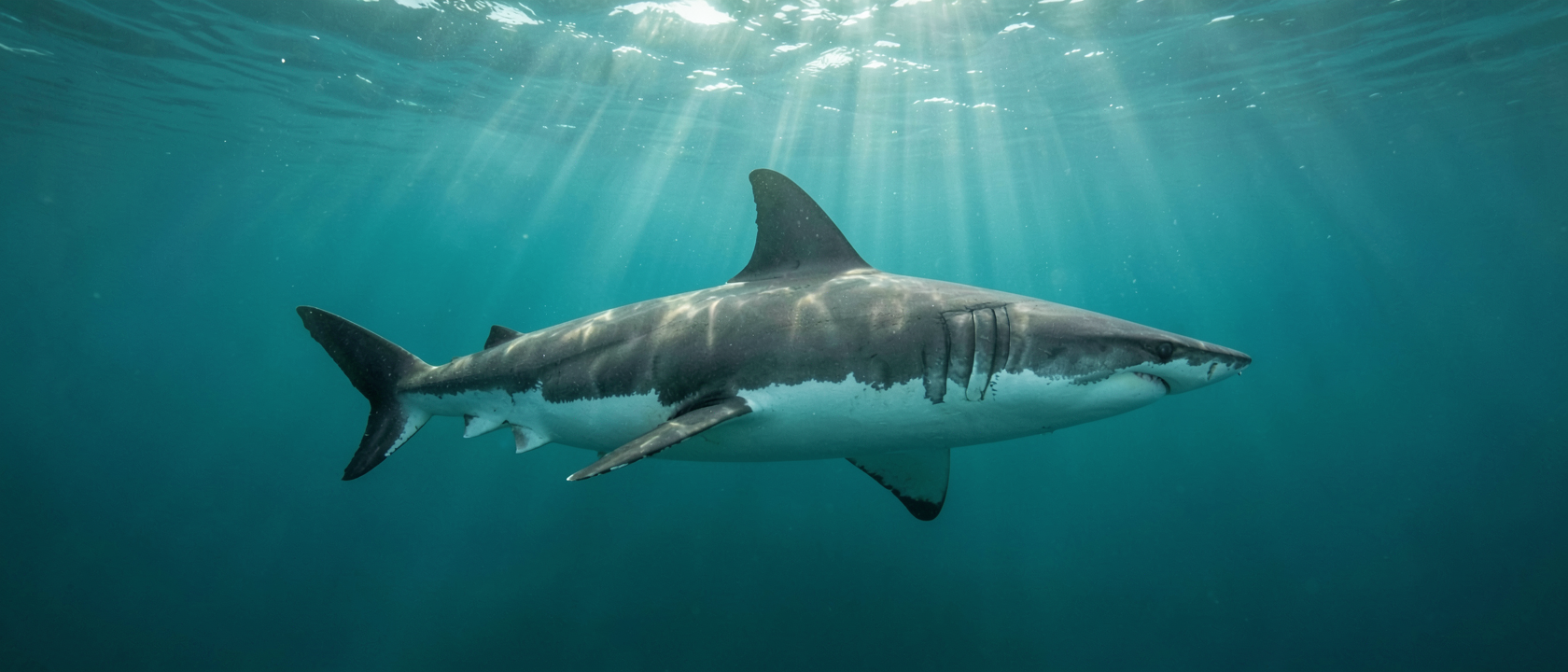
Every one of the 14 GPS-tagged great white sharks (Carcharodon carcharias) being tracked off Gansbaai, South Africa, fled the area whenever two specific orcas (Orcinus orca) arrived. Not most of them. Not the juveniles. Every tracked individual, every single time. A 2022 study led by marine biologist Alison Towner of the Dyer Island Conservation Trust, published in the African Journal of Marine Science, combined those GPS records with years of shore-based sighting data to pin down the cause of a collapse in great white sightings that had begun in 2017. The culprits were two animals, not a fleet, not a shifting food web. Two orcas, named Port and Starboard, had effectively turned off the lights at a stretch of coastline marketed, with some justification, as the great white shark capital of the world.
What They’re Actually After (It’s Not the Whole Shark)
Port and Starboard are not hunting great whites the way great whites hunt seals. The documented technique: grip the shark by a pectoral fin, flip it upside down, hold it until it enters tonic immobility, a paralysis-like state sharks involuntarily drop into when inverted, then open the body cavity and extract the liver. The rest of the carcass is largely abandoned. Since 2017, eight great white carcasses have washed ashore near Gansbaai; seven had their livers removed, and several were also missing their hearts. The shark’s liver is a large, lipid-rich structure the animal uses to fuel long oceanic migrations. Port and Starboard prize it above everything else.
Their appetite for shark liver extends well beyond great whites. In February 2023, field documentation circulated via social media by marine biologist Dr. Alison Kock, supported by photographic evidence, recorded at least 17 broadnose sevengill sharks (Notorynchus cepedianus) killed by Port and Starboard off South Africa in a single day. This was not a peer-reviewed study, it was field-level reporting, but the physical evidence was consistent: seventeen largely intact carcasses washed ashore, livers gone.
The Landscape They Don’t Want to Be In Anymore
Towner’s 2022 data reveal something beyond the bare fact of departure: the duration of the absence is where the story turns. The data show a clear dose-response relationship, the more frequently Port and Starboard visited a given site, the longer the great whites avoided returning. Towner’s team compared this to wild dogs on the Serengeti maintaining wide berth from lion territories: a landscape-level fear response where the animal recalculates which patch of ocean it wants to inhabit at all.
The same pattern holds in a different ocean. A 2019 study led by Dr. Salvador Jorgensen of Monterey Bay Aquarium, published in Scientific Reports, analyzed data from 165 white sharks tagged between 2006 and 2013, combined with 27 years of shark, seal, and orca survey records at the Farallon Islands off San Francisco. In every one of the four documented encounters between orcas and great whites at that site, the sharks immediately abandoned their preferred hunting ground and did not return until the following season, even when the orca was present for less than an hour.
Back in Gansbaai, copper sharks (Carcharhinus brachyurus) have moved into the vacant niche. Port and Starboard have begun targeting those too. Towner has raised the hypothesis, and she labels it a hypothesis, not a finding, that without great whites suppressing Cape fur seal behavior, seal predation on critically endangered African penguins may increase. Whether that cascade is real and how far it reaches is, as of the 2022 paper, an open question.
About That “No Natural Enemies” Thing
Before Port and Starboard began working the Gansbaai coast, great white sharks had been recorded absent from the area for a week or longer exactly twice in documented history: once for one week in 2007, and once for approximately three weeks in 2016. What Towner et al. (2022) describe as unprecedented in both duration and scale has been happening repeatedly since 2017. The displacement is not caused by collapsing prey populations, industrial fishing pressure, or a years-long environmental shift. Towner’s data point to two individual orcas with bent fins, clearing an apex predator from its own most famous stronghold on a repeating schedule.
The Questions the Carcasses Can’t Answer
Four genuine unknowns sit in this record. First, eight confirmed carcasses is a floor, not a ceiling; researchers consider it likely that additional great whites were killed but never reached shore. Second, how Port and Starboard identified shark livers as a high-value target is unknown; cultural transmission to other orcas has been proposed but not confirmed. Third, the trophic cascade Towner describes remains her team’s stated hypothesis, not an established finding. Those distinctions matter: they are precise scientific positions, not hedged language. Fourth, the long-term population consequence for a species already listed as Vulnerable on the IUCN Red List, with slow growth, late sexual maturity, and an estimated lifespan of 70 years or more, has not been determined.
Why One Fin Points Left and One Points Right
Port and Starboard are individually identifiable because each has a permanently collapsed dorsal fin: Port’s leans to the left, Starboard’s to the right. Dorsal fin shape is a standard tool in orca identification; collapsed fins of this kind are not rare in wild populations. Possible causes include prior entanglement injury, dietary factors, or natural variation; researchers at Sea Search have noted these specific cases but no single cause has been confirmed. These are the two animals that have accomplished what the historical sighting record had never recorded: clearing Carcharodon carcharias from its own best-known hunting ground, on repeat, with a liver-extraction technique precise enough that seven out of eight carcasses washed ashore essentially intact from the neck down.