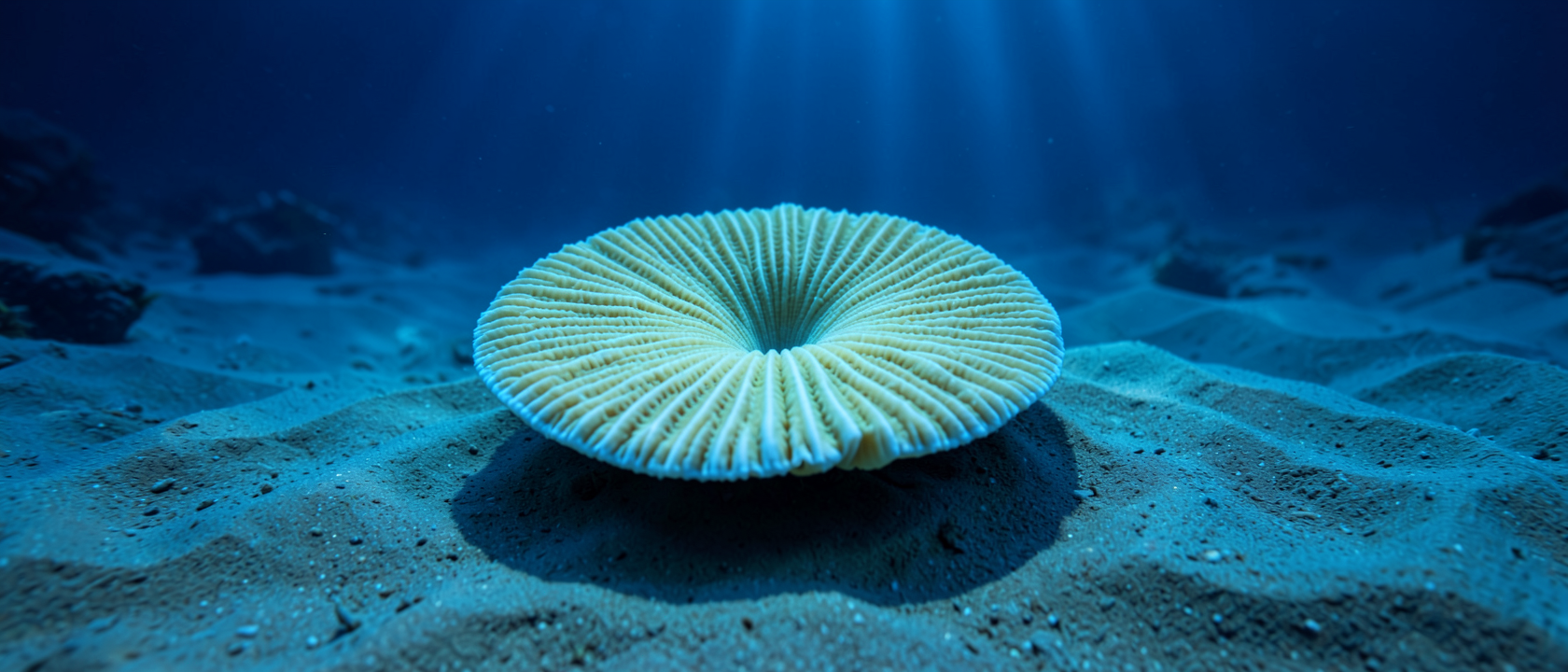
A Coral That Walks Itself to the Light
Cycloseris cyclolites, a solitary, disc-shaped mushroom coral roughly 1.6 to 2 inches (4 to 5 centimeters) across, crosses the seafloor under its own power. Not drifting, not rolling in a current: walking. A study led by Brett Lewis at Queensland University of Technology, published in PLOS One on January 22, 2025, captured this on time-lapse video and measured it precisely. The smallest displacement recorded was 1.72 inches (43.73 mm) in a single 24-hour period, the floor of the range, not the ceiling; others covered up to 8.66 inches (220 mm) in the same span. None moved randomly: every coral oriented itself toward blue light.
How It Actually Does It: Inflate, Plant, Pull
The movement works in a repeating cycle with three components, all documented from the time-lapse footage in Lewis et al. 2025.
The coral’s outermost tissue, the fleshy skirt ringing its body, inflates over roughly one to two hours. This lifts the coral’s center off the substrate. As the inflated tissue then contracts and twists, a structure on the coral’s underside, described in the paper as a foot, presses against the floor and the coral inches forward. The contraction is coordinated asymmetrically, producing a net directional vector. Applied in pulses, that adds up to directed travel.
Lewis and colleagues explicitly compare this sequence to jellyfish swimming, not as metaphor but as a mechanistic parallel: the pulsed inflation-and-contraction cycle belongs to the same class of locomotion. Pulsed inflation in free-living corals had been observed before in two narrower contexts: self-righting when inverted, and sediment rejection after burial. Lewis et al. add a third documented function, directed navigation toward a preferred light environment.
Why Blue, Specifically, and Why It Matters
Like most corals, C. cyclolites harbors dinoflagellates, photosynthetic, single-celled organisms, inside its tissue. These partners supply energy derived from sunlight, making appropriate light a biological requirement. Water absorbs wavelengths selectively: red, orange, and yellow are gone within the first few meters. Blue, in the range of roughly 420 to 510 nanometers, penetrates to depth, the only sunlight that reaches the sandy seafloors where adult C. cyclolites lives, sometimes at depths reaching 279 feet (85 meters).
The Lewis et al. experiments made the coral’s preference quantifiable. In blue-light trials with 15 individual corals, 86.7% showed positive phototaxis. In white-light trials with a separate group of 15, only 20% responded that way. In a direct-choice experiment placing blue and white sources at opposite ends of the tank, all three corals tested chose blue without exception.
The researchers’ interpretation goes further than spectral preference. White light, characteristic of shallower zones, comes with higher temperatures, and higher temperatures drive coral bleaching, the process by which dinoflagellates are expelled and the coral loses its energy supply. Lewis and colleagues propose that avoidance of white-spectrum light may reflect an evolved response to bleaching risk, though the study does not establish that causal link directly. What it does establish is that C. cyclolites distinguishes between light environments and acts on the distinction: the coral navigates toward the precise spectral signature of a depth at which its internal biology functions.
Sessile: The Word That No Longer Fits
The standard assumption about corals is that they are sessile, permanently fixed after the larval stage. Cycloseris cyclolites does begin that way, anchored as a stalked juvenile; as it matures, the stalk dissolves and the animal becomes fully free-living. From that point it is self-propelled and, as the 2025 paper demonstrates, capable of navigating toward a specific wavelength of light.
Distinguishing blue at approximately 420 to 510 nanometers from broad-spectrum white, then translating that distinction into coordinated, directional tissue contraction across the whole body, requires sensory processing and distributed response. Cycloseris cyclolites has no centralized nervous system in the vertebrate sense, but Lewis and colleagues conclude that its neural organization is more sophisticated than previously assumed.
What the Study Leaves Open
Three questions remain unresolved. First, the mechanism of light detection: no photoreceptor has been identified in C. cyclolites, no signal pathway mapped from light detection to directional contraction. Second, scope: whether other free-living coral species use the same pulsed-inflation locomotion for phototaxis is not addressed. The mechanism appears in other Fungiidae behaviors, but whether directed phototactic walking extends beyond Cycloseris is unknown. Third, environmental responsiveness: how movement rate changes with water temperature, current, substrate type, or light intensity remains uncharacterized.
He Was Afraid It Would Pop
During observation sessions, Brett Lewis watched a single C. cyclolites inflate its outer tissue so fully that he told the New York Times he had spent a very long time watching it, convinced the animal was going to “pop.” The coral did not pop. It contracted, shifted, and moved forward.