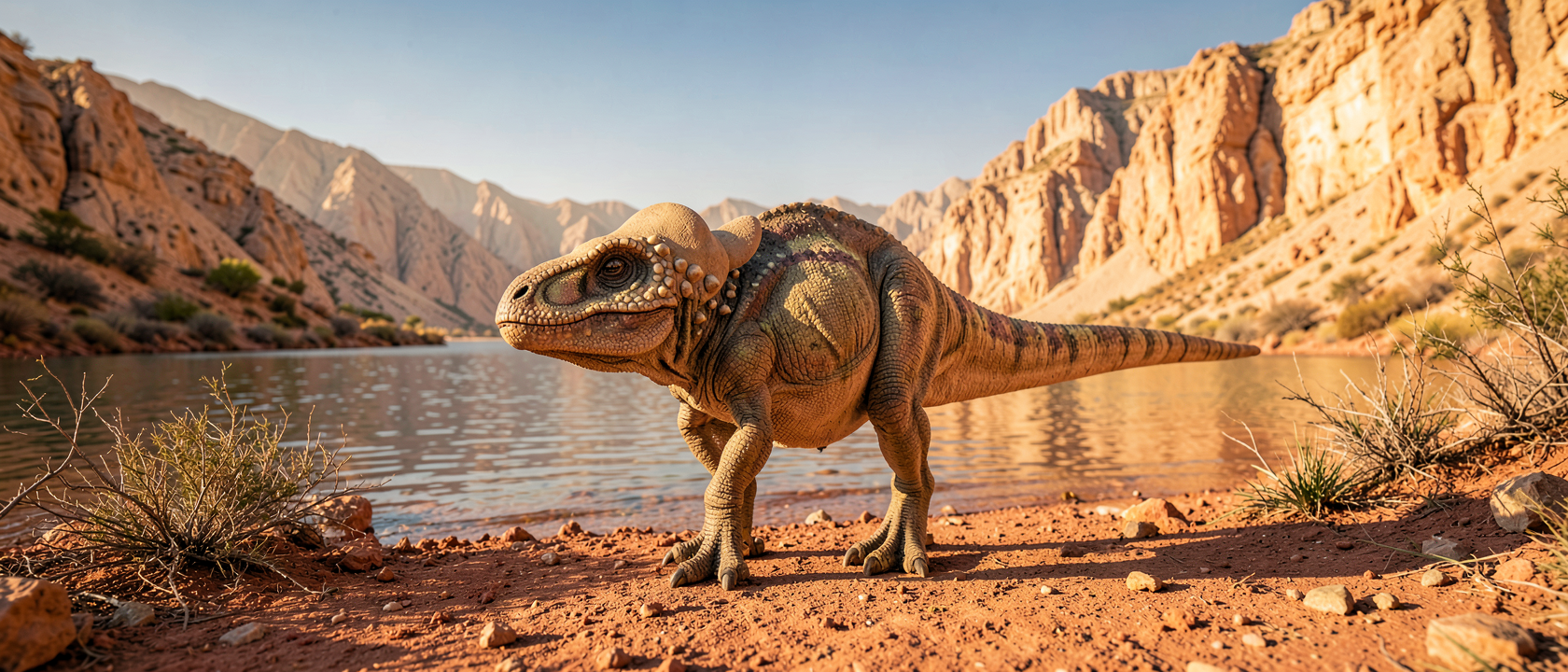
The Teenager Who Already Had the Skull for a Fight
A Zavacephale rinpoche individual that had not finished growing was already carrying a complete cranial dome, the dense, mineralized skull cap that defines the pachycephalosaur group. Unfused sutures in the scapula and coracoid confirmed the animal was still growing; two growth rings in a cross-section of the tibia placed it firmly in sub-adulthood. Sitting on top of all that developmental incompleteness was a dome as fully formed as any adult’s.
The specimen was recovered from the Eastern Gobi Basin in southeastern Mongolia and described by Tsogtbaatar Chinzorig, Lindsay Zanno, and colleagues in a September 2025 paper in Nature. At death, the animal measured less than 3.3 feet (approximately 1 meter) in body length and weighed an estimated 12.9 pounds (5.85 kilograms). Zavacephale rinpoche belongs to the Early Cretaceous, roughly 108 to 115 million years ago, and is the oldest confirmed pachycephalosaur ever found. It died before reaching full size.
The implication the 2025 paper draws is direct: the dome reached full development before the skeleton around it caught up. Whatever the dome was for, and that question is genuinely unresolved, natural selection was prioritizing it early enough that these animals may have been using or displaying their headgear before they were fully grown.
Why We Know Almost Nothing About Pachycephalosaurs (and Why This Fossil Changed That)
Pachycephalosaurs are almost entirely known from one part of their anatomy. Thick, heavily mineralized cranial domes preserve well; the rest of the skeleton scatters, erodes, or does not survive long enough to become a fossil. Paleontologists spent more than a century reconstructing the biology of an entire dinosaur group from a single structure.
Zavacephale rinpoche was different. Burial conditions in the Khuren Dukh Formation preserved more than half the skeleton of a single individual, including elements the field had never seen from any pachycephalosaur. The specimen yielded the first documented hand bones for the group, confirming greatly reduced forelimbs and tiny hands. It preserved a complete articulated tail sheathed in ossified tendons, bony rods holding the tail rigid, never previously described in any pachycephalosaur. In the region corresponding to the digestive tract, there was a mass of gastroliths: swallowed stones used to grind food internally, the first ever found associated with a pachycephalosaur.
The Dome That Predates the Dinosaurs Named After It
Phylogenetic analysis placed Zavacephale rinpoche among the earliest-diverging members of the pachycephalosaur family tree, approximately 15 million years earlier than any other confirmed member of the group, sitting close to the common ancestor of all subsequent lineages.
That position creates a genuine puzzle. If one of the earliest known members of the group already carries a fully developed dome, the feature cannot be a late innovation. Either it appeared very rapidly at the group’s origin, or, as the 2025 Nature paper raises, it was inherited from a pre-pachycephalosaur ancestor and is therefore older than the clade built around it. No fossil evidence yet confirms the frontoparietal dome existed before Zavacephale rinpoche, but the logic holds: the dome may have a prehistory the field cannot see yet.
What the Dome Was Actually For, Nobody Has Won This Argument
The popular image of pachycephalosaurs charging each other head-on, like scaled-up bighorn sheep, is the dominant hypothesis but not the settled one. A 2013 study by Peterson, Dischler, and Longrich, published in PLOS ONE, examined more than 100 pachycephalosaurid domes from over 14 species and found approximately 22% showed lesions clustered near the dome’s apex, consistent with repeated impact stress from intraspecific contact. The same study’s authors acknowledged the findings do not rule out alternative interpretations.
Flank-ramming, shoving contests, and purely visual signalling all remain live hypotheses. Zanno, co-author of the 2025 description, framed the question in exactly those terms: head-to-head combat, display, or some combination. Zavacephale rinpoche sharpens the problem without resolving it: if the dome was complete before the animal reached adult size, whatever selective pressure maintained it was operating early in life, and that demands an explanation regardless of which functional hypothesis eventually wins out.
Built to Disappear Without a Trace
Three explanations exist for why pachycephalosaurs are rare in the fossil record, and they are not mutually exclusive: genuine ecological scarcity, a habitat bias toward inland upland environments where sediment accumulation was low, and a straightforward taphonomic disadvantage in which relatively small-bodied animals lose most skeletal elements before burial can occur, leaving only the densest bone behind. Paul Barrett, a dinosaur specialist at the Natural History Museum, has noted the rarity question remains unresolved. What Zavacephale rinpoche illustrates is the scale of what disappears when those conditions don’t align: a group that may have been ecologically diverse across tens of millions of years, represented in almost every locality by a single bone too dense to dissolve.