
One Amino Acid, Two Different Squeaks
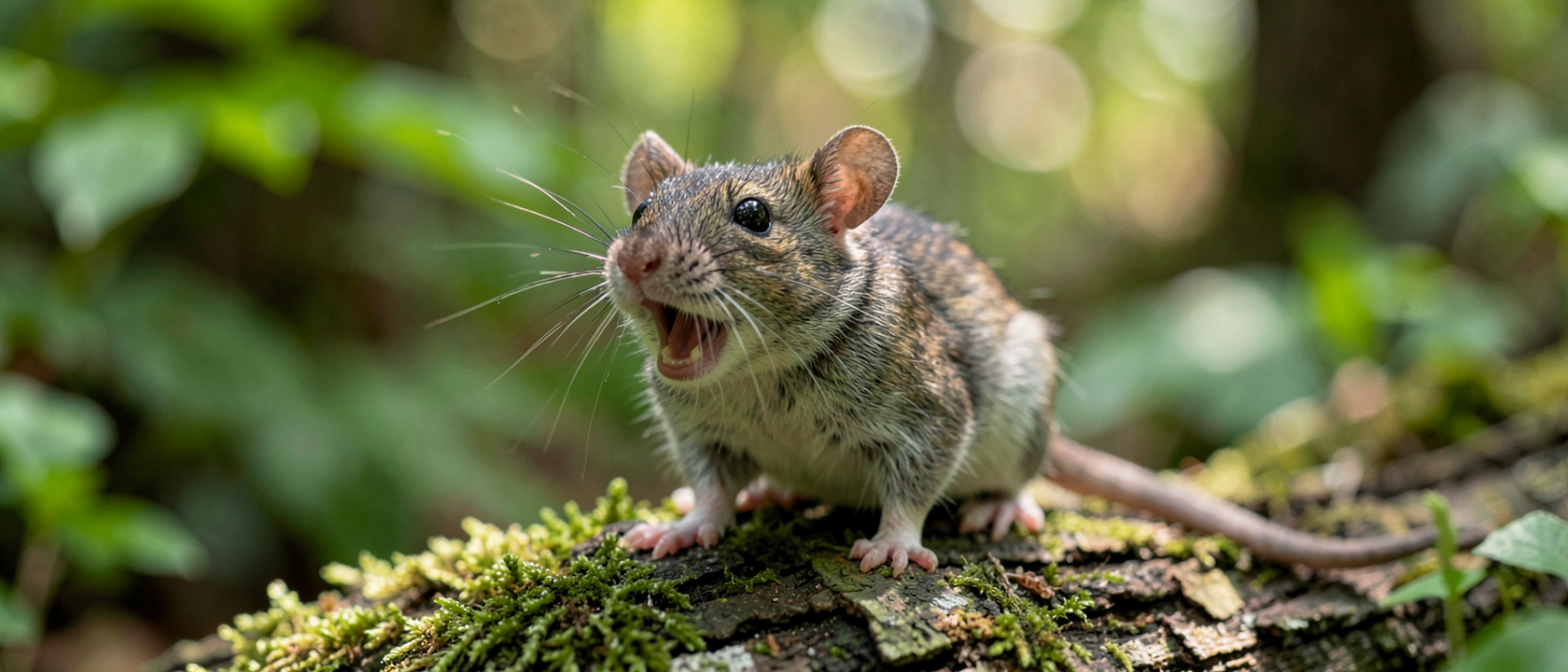
Lab mice carrying a single human-specific change in one gene started vocalizing differently at two separate points in their lives. Researchers at Rockefeller University and Cold Spring Harbor Laboratory, led by neuro-oncologist Robert Darnell, used CRISPR gene editing to swap the standard mouse version of a gene called NOVA1 for the human variant, creating a line the paper calls Nova1(hu/hu) mice. The study, published in Nature Communications on February 18, 2025, found that pups carrying the human variant shifted toward higher-frequency ultrasonic calls in certain call types, while adult males produced subtly different vocalizations when courting females in estrus, the total number of calls stayed about the same, but the pitch and the “shape” of the sounds changed. These are house mice, Mus musculus, typically about 3 to 4 inches (7.5 to 10 cm) long with a tail of similar length and weighing under an ounce (20 to 30 g), not rodents in general. Nobody trained these mice to do anything. The change traces back to one swapped amino acid: isoleucine to valine, at position 197 of the NOVA1 protein, written as I197V.
How a Single Gene Edits Thousands of Others
NOVA1 does not build a vocal cord or wire a brain region by itself. It works as what Darnell’s team calls a master regulator: its protein travels through neurons and edits messenger RNA, the working copy of a gene’s instructions that a cell reads to build a protein, deciding which segments get kept and which get cut out, a process called splicing. Using a technique called cross-linking immunoprecipitation, the team mapped where NOVA1 protein attaches to RNA inside the mouse midbrain and found multiple binding sites on transcripts tied to vocalization. The I197V swap barely changed how tightly NOVA1 grips RNA. What it changed was the splicing outcome itself, in brain regions involved in making sound. Language researchers already break down pup squeaks into four basic “letters”, S, D, U, and M, and when the team transliterated the calls of the edited mice, some of those letters had simply changed. “We did not expect that,” Darnell said of the result. One amino acid did not reshape a single protein’s job; it reshaped how thousands of other proteins get assembled in the neurons that produce a squeak.
A Change Neanderthals Never Had
NOVA1 was first identified by Darnell in 1993, and the ordinary version is nearly identical across mammals and birds. The human I197V variant is different: it shows up in modern human genomes but not in Neanderthal or Denisovan DNA, the archaic relatives our ancestors interbred with and whose genetic traces still turn up in many people today. That absence places the mutation’s origin after our lineage split from theirs, sometime in the last few hundred thousand years, and before modern humans left Africa. Darnell’s proposed explanation is that the variant arose in an ancestral African population and spread because it offered some edge in vocal communication, carried along as modern humans moved across and eventually out of the continent. That is his interpretation of the timing, not a settled fact about why it spread. But if it holds up, a mouse singing a slightly different courtship song in a New York lab is a working model of a change that may have helped shape how our own species talks.
The Language Gene Myth FOXP2 Couldn’t Carry
For two decades, FOXP2 has carried the label “the language gene,” after it was linked to a British family with inherited speech and language disorders. Mice carrying a humanized version of FOXP2 do show altered pup ultrasonic calls, shifts in frequency and modulation, and geneticist Svante Pääbo has pointed out that its effects on mouse vocalization look similar to NOVA1’s, suggesting the two act on overlapping neural circuits. But FOXP2 is also present in Neanderthal DNA. Whatever advantage it gives, it cannot explain something unique to modern human speech, because Neanderthals had the same gene. NOVA1’s human variant is the opposite case: present in us, absent in them. That does not retire FOXP2. It retires the idea that any single gene gets to hold the title.
What Nobody Has Mapped Yet
Even Darnell is careful not to oversell this. Asked whether NOVA1 deserves to be called a language gene, he called it potentially one, but “certainly only one of many,” since language almost certainly came from a pile of genetic changes working together. Nobody yet knows the exact molecular chain between an altered splicing pattern and an actual shift in pitch or syllable complexity. The CLIP mapping turned up NOVA1 binding sites in midbrain neurons tied to vocalization, which Darnell said surprised the team, but it is still unresolved whether older midbrain and brainstem circuits that control basic vocal output are doing the work, or whether newer cortical circuits involved in more flexible, learned sound patterns are also involved. Neuroscientist Erich Jarvis, who was not part of the molecular work, has floated the idea that the variant might be an extra ingredient that makes mice, and by extension humans, more flexible vocal learners, and has suggested testing the same human variant in songbirds. That is a hypothesis on the table, not a finding on the books.
Six People Still Carry the Old Version
Somewhere in a scan of more than 650,000 human genome sequences, researchers found six anonymous people who do not carry the modern human NOVA1 variant at all. They carry the ancestral version instead, the one every other mammal has, the one Neanderthals and Denisovans had. Nothing else is known. No names, no interviews, no record of how they talk or whether it matters at all. They turned up as a line in a database search, not as subjects of a study. Six people, quietly walking around with a piece of the genome the rest of our species left behind hundreds of thousands of years ago, and no one has ever asked them a thing about it.