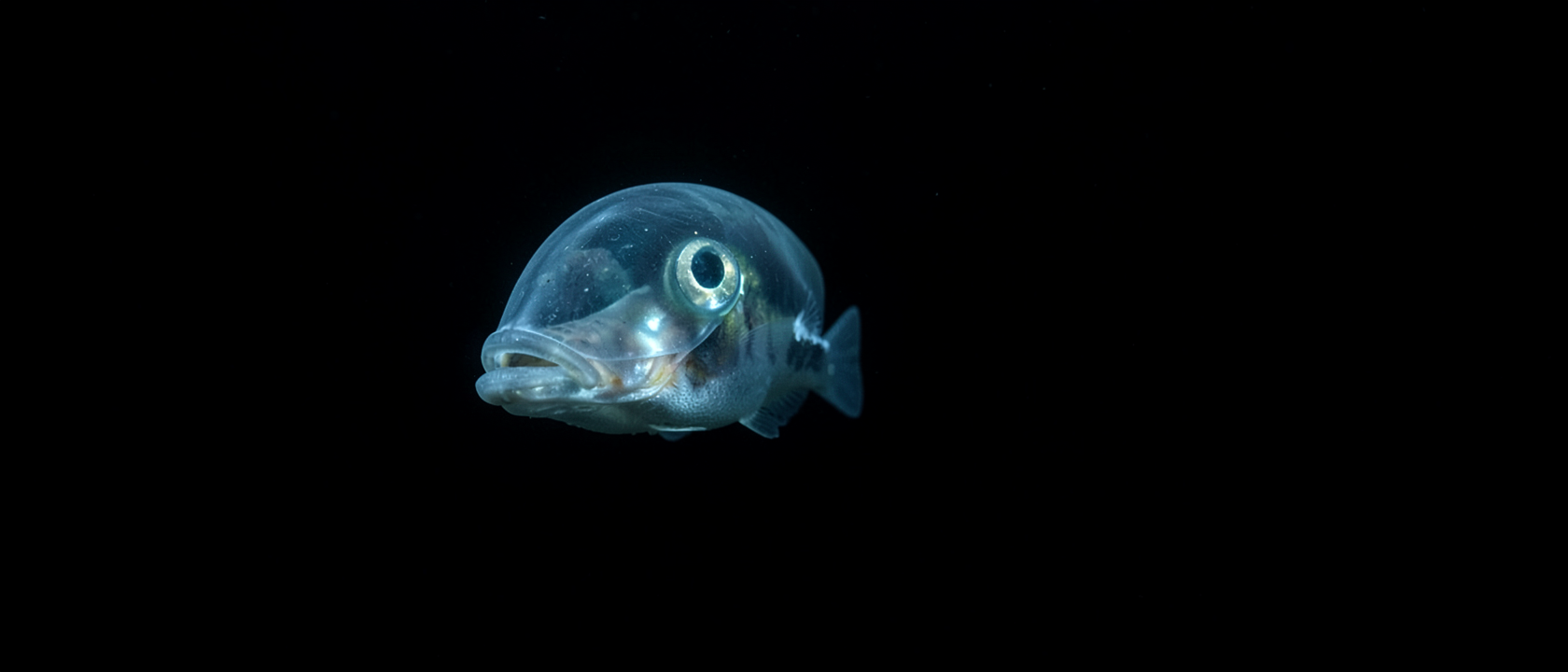
Every barreleye fish ever examined in a laboratory was already missing its most important feature
Winteria telescopa was formally described in 1901. Scientists have been collecting, preserving, and dissecting specimens ever since. The anatomical drawings that resulted were accurate, accurate to what arrived in the net. What arrived in the net was missing the most distinctive structure on the animal’s head.
On June 29, 2026, ROV SuBastian filmed a W. telescopa alive at 2,329 feet (710 m) depth in the Doldrums Megatransform and Fracture Zone, roughly 808 miles (1,300 km) off the northeast coast of Brazil. The footage was captured during a 35-day expedition aboard the research vessel Falkor (too), led by Dr. Aaron Micallef, a senior scientist at the Monterey Bay Aquarium Research Institute. What the camera showed was a transparent, fluid-filled dome sitting over the entire top of the skull, with the fish’s two tubular eyes enclosed inside it. The Schmidt Ocean Institute described the sighting as the first footage of this species alive in its natural habitat.
The dome was not disputed or rumored. It was simply absent from the data, because collecting the fish destroyed it before anyone looked.
Why the dome vanishes: pressure, physics, and a structure built for exactly one environment
The dome is calibrated to conditions approximately 2,300 feet down: hydrostatic pressure far exceeding anything at the surface, temperatures just above freezing, and near-total darkness. When a trawl net hauls a W. telescopa toward the surface, pressure drops sharply. The dome, a fluid-filled gelatinous structure with no rigidity suited to surface conditions, collapses and disintegrates before the fish clears the water.
This is not decomposition in the ordinary sense. The structure physically cannot persist outside the pressure and temperature regime it was built for. Every researcher who opened a jar containing a preserved W. telescopa was examining an animal already altered, in the single most visible way possible, before measurement began. The tools of collection were also, without anyone knowing it, tools of erasure.
What the dome is actually for, and why that question is still genuinely open
The function of the transparent dome in W. telescopa is not established. As of the expedition announcement on July 7, 2026, peer-reviewed analysis of the footage had not been published.
Two candidate hypotheses exist, both drawn from related research on a different barreleye species, Macropinna microstoma. In 2008, MBARI researchers Bruce Robison and Kim Reisenbichler, working from ROV video off Central California at depths between roughly 1,970 and 2,625 feet (600 to 800 m), proposed that the dome in M. microstoma may protect the fish’s unusually sensitive tubular eyes from the stinging cells of siphonophores, colonial, tentacled deep-sea animals, since individuals were observed hovering beneath siphonophore tentacle curtains, apparently pilfering ensnared prey. A second possibility is that the dome acts as a biological lens or light-filter in the twilight zone, where the only illumination is dim, downwelling bioluminescence. Whether either explanation applies to W. telescopa is unknown; the 2026 footage is the first observational basis from which to ask the question for this species at all.
The quiet assumption that just collapsed: bringing an animal to the lab gives you the animal
Every published anatomical description of W. telescopa that reported no transparent dome was accurate about what existed in the jar. The problem was the assumption underneath: that the animal in the jar is the animal.
The dome was absent not because scientists missed it in dissection or because it is too small to see, but because collection destroyed it before anyone looked. This is not a folk belief outrunning the literature. It is a methodological assumption embedded in 125 years of professional scientific description, that a surface-collected specimen represents intact deep-sea anatomy. In this case, it did not, and there was no way to tell from inside the laboratory.
The same 2008 paper in Copeia sharpens the point. Robison and Reisenbichler also overturned the long-standing claim that barreleye eyes are fixed pointing upward, a conclusion drawn from surface-collected specimens. Their ROV footage of living Macropinna microstoma showed the eyes rotating up to roughly 90 degrees within the dome, allowing the fish to track prey forward when feeding. That correction, too, was only possible by watching the animal alive at depth. The instrument of study and the thing it destroys can be the same instrument.
The species is identified, the ecology is unknown, and the analysis has not yet begun
The individual filmed on June 29, 2026 has been identified as Winteria telescopa, a species with a recorded maximum length of 6 inches (15 cm), distributed across the mesopelagic and bathypelagic zones, roughly 1,300 to 8,200 feet (400 to 2,500 m), in the Atlantic, Pacific, and Indian Oceans. What it was doing in the Doldrums Megatransform and Fracture Zone, what it feeds on, what preys on it, and where it sits in the food web of a seafloor system spanning approximately 23,166 square miles (60,000 km²) are all open questions.
AUV The Childlike Empress, on its first science mission, mapped the Doldrums zone at one-meter resolution during the same expedition and measured water chemistry throughout the water column. ROV SuBastian also found two previously unknown hydrothermal vent fields at depths of approximately 12,762 feet (3,890 m), both associated with serpentinization, a process in which seawater reacts with the mantle rock peridotite to produce hydrogen and reduced chemicals capable of sustaining life without sunlight. Peer-reviewed papers on all of these findings had not been published as of July 7, 2026.
The dome has been seen. What it does, what the fish does around it, and what the intact structure’s full anatomy looks like under analysis remain open questions.